IMO Meaning in Text | What Does IMO Mean?
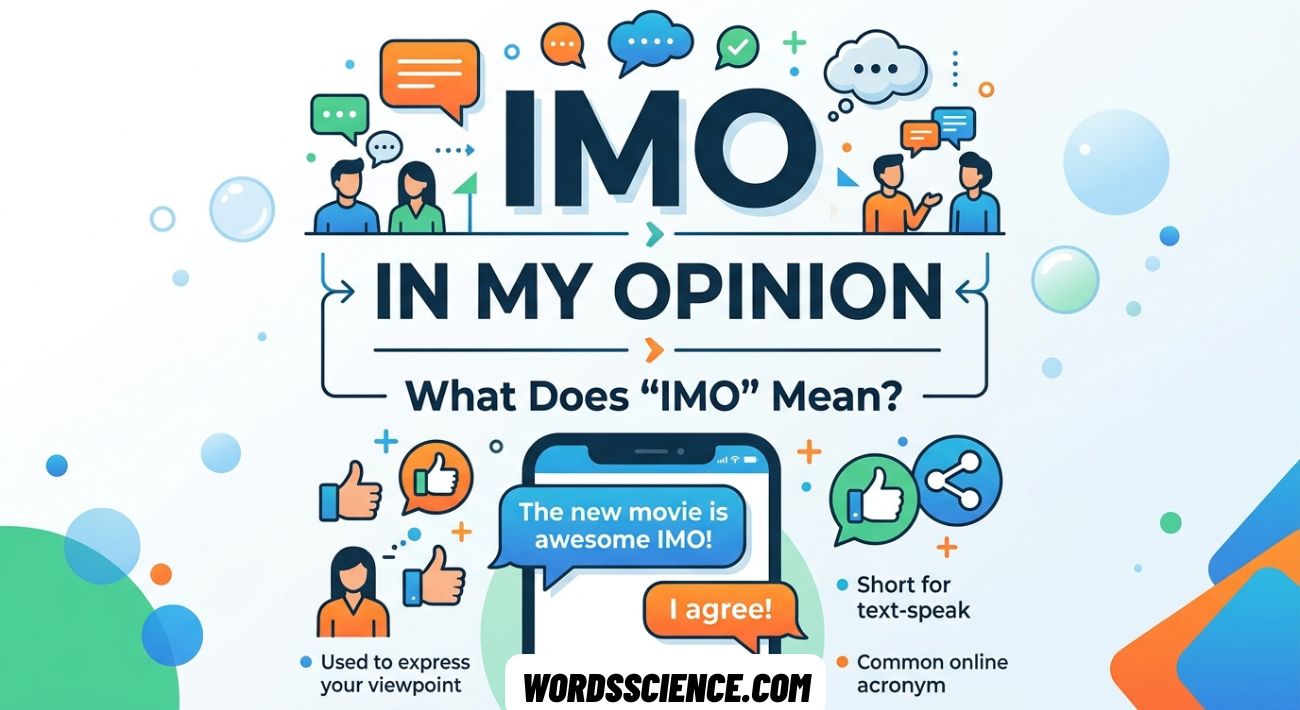
The IMO Meaning in Text is “in my opinion.” This informal abbreviation shows that someone is sharing a personal viewpoint, preference, or judgment. You will often see IMO in casual messages, chats, and online conversations.
IMO helps separate a personal opinion from an objective fact or statement. Its tone is usually neutral and conversational, although the words around it can make the message sound stronger or softer. The same meaning commonly appears across social media, group chats, and everyday texting.
This article explains What Does IMO Mean and how people use it in different situations. You will also find clear IMO examples, common replies, tone details, and guidance on when to use IMO. These examples make the meaning easier to understand in real conversations.
What Does IMO Mean in Text?
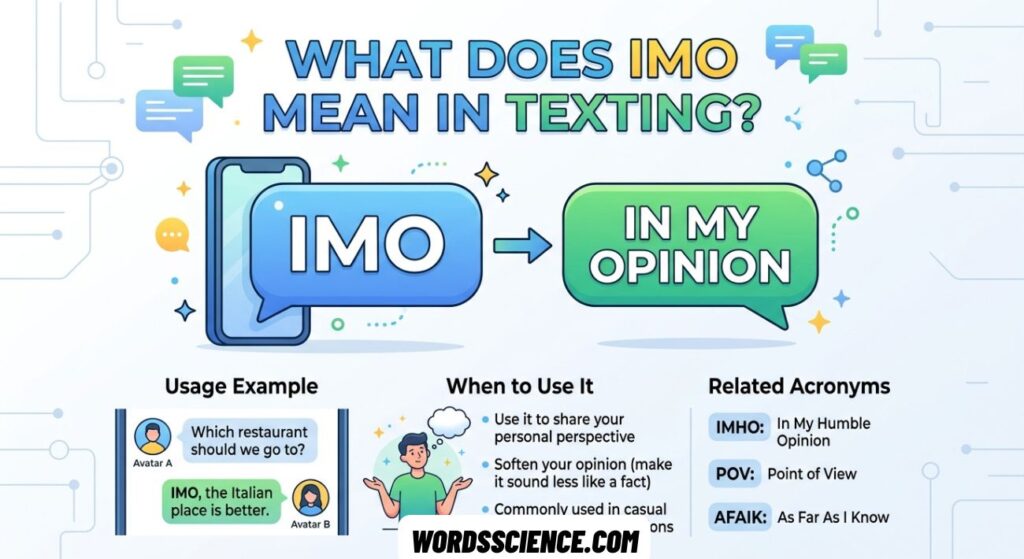
IMO means “in my opinion.” It is a common internet abbreviation used in texting, online conversations, group chats, forums, and social media.
When someone writes IMO, they are usually signaling that what follows is their own view. It can make a statement sound less absolute because the speaker is presenting a personal viewpoint rather than claiming that everyone should agree.
Example:
Person A: “Which phone should I get?”
Person B: “IMO, the smaller one is easier to use.”
Here, IMO shows that the recommendation is based on Person B’s personal preference.
What Is the IMO Slang Meaning?
The IMO slang meaning is simply “in my opinion.” Although people often call it texting slang or internet slang, IMO is more accurately described as an informal abbreviation or initialism.
It is common in casual communication because it quickly tells the reader that the following statement represents a personal belief or judgment.
For example:
“IMO, this is the easiest way to learn it.”
The writer is not presenting the statement as a proven fact. They are sharing their own view.
IMO can also appear before a strong opinion, a friendly preference, or a casual recommendation. The surrounding context helps show how strongly the person feels.
How Context Changes the Meaning of IMO
The basic meaning of IMO does not usually change, but the tone and purpose can change with the surrounding context.
In a friendly conversation, “IMO, you should try the blue one” may simply express a personal recommendation. In a disagreement, “IMO, that argument misses the main point” can introduce a stronger personal judgment while still making clear that it is the speaker’s viewpoint.
The wording after IMO matters too. “IMO, pizza is better than burgers” expresses a preference, while “IMO, this report needs more detail” gives an opinion about someone’s work.
Context can also help distinguish an objective fact from a subjective opinion. For example, “The meeting starts at 9” is presented as a factual statement. “IMO, the meeting should start at 10” expresses a personal opinion.
IMO Meaning on Texts and Social Media
IMO is widely understood in casual online communication, including texting and social media. People use it when sharing a viewpoint without writing the full phrase “in my opinion.”
Text Messages and Group Chats
In text messages and group chats, IMO can make an opinion sound casual and conversational.
Example:
“IMO, we should order pizza tonight.”
This does not necessarily mean the sender strongly disagrees with everyone else. It simply introduces their preferred choice.
TikTok and Instagram
On TikTok and Instagram, IMO may appear in comments, captions, replies, or discussions about videos and posts.
Someone might write:
“IMO, the original version was better.”
Here, the person is clearly sharing a personal viewpoint rather than stating a universal fact.
Snapchat and WhatsApp
People can use IMO on Snapchat and WhatsApp in much the same way they use it in ordinary texting.
Example:
“IMO, you should wait before buying it.”
The phrase keeps the message informal while showing that the recommendation is based on the sender’s personal judgment.
Online Forums and Gaming Chats
IMO is also useful in online forums and gaming chats, especially when people discuss strategies, characters, games, equipment, or other preferences.
For example:
“IMO, that character works better for beginners.”
The writer is sharing an opinion rather than claiming that the strategy is objectively correct.
IMO Examples in Real Conversations
1: Friends
Friend A: “Should we watch the comedy or the thriller?”
Friend B: “IMO, the comedy looks more fun.”
Meaning: Friend B is sharing a personal preference.
2: Classmates
Classmate A: “Which topic should we choose for the presentation?”
Classmate B: “IMO, climate change will be easier to explain.”
Meaning: The student is giving a personal recommendation based on their judgment.
3: Social Media
Commenter A: “Which design do you like better?”
Commenter B: “IMO, the first one looks cleaner.”
Meaning: The commenter is expressing a personal viewpoint.
See Also : Zionist Meaning | What Does Zionist Mean?
What Tone Does IMO Have?
IMO usually has a casual, neutral, and conversational tone. It is not automatically rude, sarcastic, or offensive.
The abbreviation can actually make a statement feel less absolute because the speaker identifies it as their own opinion. However, the rest of the sentence determines the overall tone.
For example, “IMO, you could try this instead” sounds fairly gentle, while “IMO, that’s a terrible idea” expresses a much stronger opinion.
Is IMO Rude?
IMO is not inherently rude. It simply means “in my opinion.”
The sentence that follows it can sound polite, neutral, or harsh depending on the wording. Compare “IMO, you could choose another option” with “IMO, your idea makes no sense.” Both use IMO, but the second statement is more direct.
If you want to disagree politely, combine IMO with respectful language rather than assuming the abbreviation itself makes a message polite.
How to Reply to IMO
There is no single required response to IMO. Your reply can acknowledge the opinion, agree with it, disagree politely, or ask for more explanation.
Friendly Replies
If you agree, you can respond naturally:
“I agree. I was thinking the same thing.”
Or:
“Yeah, IMO, that makes sense too.”
When You Disagree
You can disagree without making the conversation hostile.
“I see your point, but I think the second option works better.”
Or:
“That makes sense, but I have a different view.”
These responses recognize the other person’s personal opinion while expressing your own.
When You Want More Explanation
If you want to understand why someone has that opinion, ask a simple follow-up question:
“What makes you think that?”
Or:
“Why do you prefer that one?”
This keeps the conversation open instead of turning a difference of opinion into an argument.
When to Use IMO
Use IMO when you want to clearly mark something as your personal opinion in casual communication. It works well in texts, group chats, comments, online forums, gaming conversations, and other informal settings.
It is especially useful when you are giving a recommendation, sharing a preference, or politely introducing a personal judgment.
For example:
“IMO, the earlier train is more convenient.”
The abbreviation tells the reader that this is your viewpoint rather than a universal rule.
When to Avoid IMO
IMO is mainly an informal abbreviation, so it may not fit formal writing. In a professional report, academic paper, official letter, or formal business document, writing “in my opinion” or using more precise wording may be more appropriate.
You should also avoid using IMO when you are presenting a verified fact and the opinion marker could make the statement unclear.
For example, instead of writing “IMO, water freezes at 0°C,” a factual statement should simply be presented as a fact when the relevant conditions are understood.
Common Mistakes About IMO
One common mistake is thinking that IMO means someone is stating a fact. It does the opposite: it signals that the statement represents the speaker’s opinion.
Another mistake is assuming that IMO is automatically rude or dismissive. The abbreviation itself is neutral. The wording, relationship between the speakers, and context determine the tone.
Some people also confuse IMO with similar abbreviations such as IMHO or IME. These expressions have related uses, but they do not mean exactly the same thing.
Finally, IMO can have meanings outside texting. In a shipping or international-policy context, IMO can refer to the International Maritime Organization. The context tells you which meaning applies.
IMO vs. Similar Slang Terms
| Term | Meaning | Typical use |
|---|---|---|
| IMO | In my opinion | Sharing a personal opinion |
| IMHO | In my humble opinion | Sharing an opinion with a modest or softened tone |
| IME | In my experience | Sharing something based on personal experience |
| IIRC | If I recall correctly | Showing that you may not remember something perfectly |
| TBH | To be honest | Introducing a candid or direct statement |
The difference between IMO vs. IMHO is mainly tone. Both introduce an opinion, but IMHO traditionally adds “humble,” although people may use it simply as another way to introduce a personal view.
IMO vs. IME is more distinct. IMO means the person is giving an opinion, while IME means the statement comes from the person’s own experience.
For example, “IMO, this app is easy to use” gives an opinion. “IME, this app uses less battery” refers to the speaker’s personal experience.
IMO Full Form and Other Possible Meanings
The IMO full form most commonly used in texting and online communication is “in my opinion.” It is an initialism because each letter represents the first letter of a word.
In other contexts, IMO can have a completely different meaning. A well-known example is the International Maritime Organization, a United Nations agency concerned with international shipping.
This is why context matters. In a message such as “IMO, the blue one looks better,” the meaning is clearly “in my opinion.” In a discussion about maritime shipping, IMO may refer to the International Maritime Organization instead.
Can IMO Be Used in Formal Writing?
IMO is mainly used in casual texting, online conversations, and social media. In formal writing, it is usually better to write “in my opinion” because it sounds clearer and more professional.
For school assignments, business emails, reports, or official documents, avoid IMO unless the style specifically allows informal abbreviations. The full phrase helps readers understand your meaning without relying on texting language.
Is IMO a Slang Word or an Abbreviation?
IMO is commonly called texting slang or internet slang, but it is more accurately an informal abbreviation or initialism. It became popular as a quick way to express an opinion in digital communication.
You may see IMO in text messages, group chats, comments, forums, and social media posts. Its meaning stays the same in most of these casual settings: “in my opinion.”
Can IMO Sound Sarcastic?
IMO does not automatically sound sarcastic. The tone depends on the words around it, the conversation, and the relationship between the people communicating.
For example, “IMO, that was a great idea” can sound sincere, while “IMO, that was genius” could be sarcastic in a certain context. Punctuation, emojis, and previous messages can also help explain the intended tone.
Why Do People Use IMO in Texts?
People use IMO because it quickly shows that they are sharing a personal viewpoint rather than stating an objective fact. It can make opinions, preferences, and recommendations easier to identify in a conversation.
The abbreviation also keeps messages short and natural. Instead of typing “in my opinion,” someone can simply write “IMO,” which works well in casual texting and online communication.
Quick Recap
IMO meaning in text is “in my opinion.” It is an informal abbreviation used to introduce a personal viewpoint, preference, recommendation, or judgment.
You will commonly see IMO in text messages, group chats, social media, forums, gaming chats, and other casual online conversations. It normally has a neutral or conversational tone and is not rude by itself.
FAQs
What Does “IMO Girl” Mean?
“IMO girl” usually refers to a girl using IMO, which means “in my opinion.”
The exact meaning can depend on the context of the conversation.
What Does IMO Mean in Gen Z?
In Gen Z texting and online chats, IMO means “in my opinion.”
People use it to share a personal viewpoint, preference, or judgment.
What Does IMV Mean in Text?
IMV usually means “in my view” in text messages and online conversations.
It is similar to IMO because both introduce someone’s personal opinion.
What Is IMO as a Slang?
IMO is an informal internet abbreviation for “in my opinion.”
It is commonly used in texting, social media, group chats, and casual online conversations.
Final Thoughts
The IMO Meaning in Text is “in my opinion,” a common abbreviation used to share a personal viewpoint. You may see it in text messages, group chats, social media, and online conversations. It shows that the statement reflects the writer’s preference or judgment, rather than an objective fact. The meaning stays the same across casual settings, while the tone depends on context.
When you see IMO, consider the surrounding context before judging the speaker’s tone. IMO is usually neutral and conversational, so it is not rude by itself. You can reply by agreeing, sharing a different view politely, or asking for more explanation. Using IMO fits casual communication, while formal writing often works better with the full phrase “in my opinion.”