Fascist Meaning | Definition, Context, and Examples
The Fascist Meaning refers to a person, movement, or system connected with fascism, an authoritarian political ideology. It is linked with extreme nationalism, strong state power, obedience, and limited political freedom. The term has a specific political and historical meaning beyond simply describing someone as strict or controlling.
In everyday conversation, texting, or social media, “fascist” can also be used loosely for someone seen as very controlling. This casual use may be exaggerated and does not always describe actual fascist beliefs. In serious political discussions, the word carries a much stronger meaning and should be understood through context.
This article explains What Does Fascist Mean, including its political definition, historical use, and common misunderstandings. You will also see examples, tone, everyday usage, and the difference between fascist vs authoritarian.
What Does Fascist Mean?
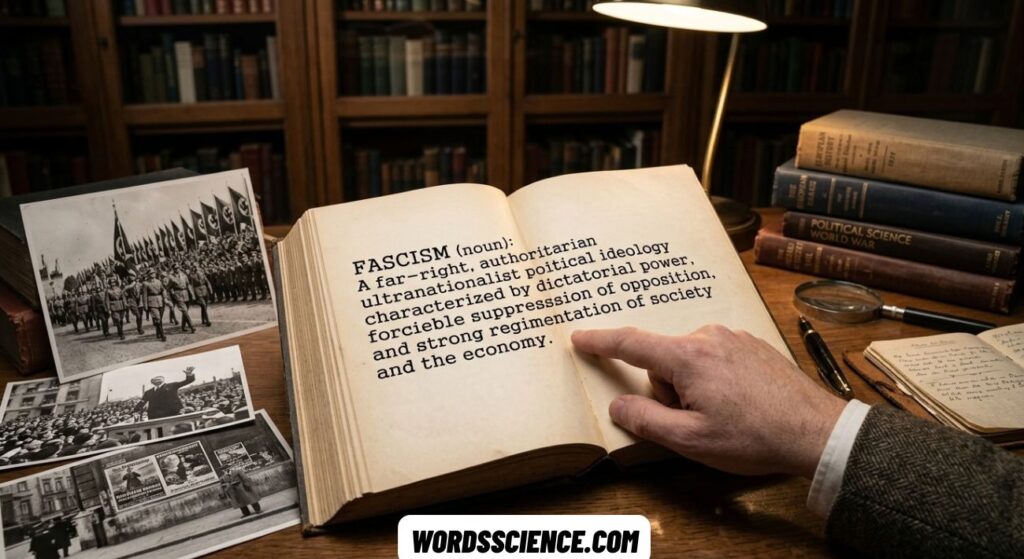
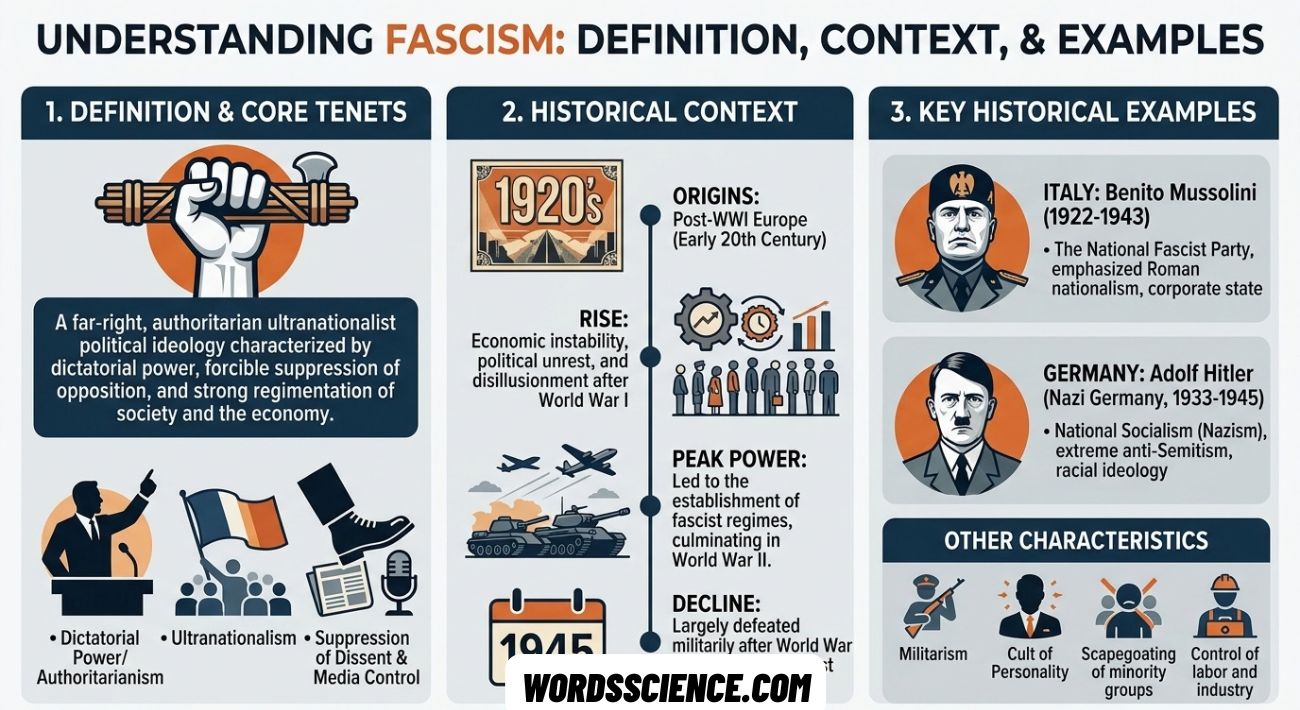
A fascist is generally a person who supports or is associated with fascism. Fascism is a political ideology associated with extreme nationalism, authoritarian leadership, political repression, hostility toward political opposition, and the weakening or rejection of democratic pluralism and individual freedoms.
In simple terms, the word can describe someone who supports a political system in which national unity and obedience to a powerful state or leader take priority over individual rights and political disagreement.
The word can also describe something associated with fascist movements or fascist politics, such as a fascist regime, historical organization, or political doctrine. It should not automatically be used for every strict, controlling, or authoritarian person because those concepts are related but not identical.
What Is the Fascist Meaning in Politics?
In politics, fascist meaning has a much more specific sense than simply “strict” or “controlling.” Fascism developed as a political movement in the early 20th century and became especially associated with Benito Mussolini and Fascist Italy. The United States Holocaust Memorial Museum describes fascism as an ultranationalist, authoritarian political philosophy that rejects democratic government, political pluralism, and individual rights.
Fascist movements generally emphasize the power and unity of the nation, strong leadership, mass political mobilization, and suppression of people or groups considered threats to national unity. Historical fascist governments also used political repression and violence to eliminate opposition.
The historical example most closely connected to the origin of the term is Italian Fascism under Mussolini. Mussolini founded the Italian Fascist movement in 1919 and later established a dictatorship in Italy.
Because of this history, calling a person or government “fascist” is a serious political accusation rather than a neutral synonym for “strict.”
Is Fascist the Same as Authoritarian?
No. Fascist and authoritarian overlap, but they are not interchangeable.
Authoritarianism generally refers to a political system or style of leadership in which power is concentrated and political freedoms are restricted. Fascism is a particular political ideology with additional characteristics, including extreme nationalism, mass political mobilization, and a strong emphasis on national unity and obedience.
A government can therefore be authoritarian without being fascist. Using the word “fascist” simply because a leader is strict or limits certain freedoms can make the political characterization less precise.
The distinction matters because fascist ideology has a specific historical and political background. Fascist governments in 20th-century Europe sought to reshape society around an authoritarian conception of the nation and used organized political movements to pursue that goal.
How Context Changes the Meaning
The meaning of “fascist” can change considerably depending on why, where, and how someone uses it.
1. Historical context
In a history discussion, “fascist” usually has its formal political meaning. For example, a textbook might describe Mussolini’s government as fascist because it was part of the historical development of Italian Fascism.
Here, the term is being used as a historical description, not as a casual insult. Mussolini’s Fascist movement came to power in Italy in 1922, and his government developed into a one-party dictatorship during the following years.
2. Political debate
During a political debate, someone may call another person or group “fascist” to characterize its political beliefs or actions.
This use can be more complicated because people sometimes use the term rhetorically. A serious political discussion should explain what specific beliefs, policies, or actions are being described rather than relying only on the label.
For example, saying “I disagree with this policy” communicates a position. Saying “That policy is fascist” makes a much stronger political characterization and requires context to understand what the speaker means.
3. Casual exaggeration
People sometimes use “fascist” casually to describe someone who seems unusually strict or controlling.
For example:
Person A: “My coach won’t let anyone choose their own practice schedule.”
Person B: “He’s such a fascist.”
In this situation, the speaker may simply mean “very controlling.” That does not necessarily mean the coach supports fascism as a political ideology.
4. Online argument
On social media, “fascist” can appear during heated political arguments. People may use it as a political accusation, an ideological label, or rhetorical language intended to criticize someone strongly.
Because short posts often lack context, it can be difficult to tell whether the person is making a historically grounded political claim or using the word as an exaggerated insult.
Fascist Meaning in Text and Online Chat
The fascist meaning in text usually depends on the conversation.
In a history or politics discussion, “fascist” is likely being used in its literal political sense. In a casual group chat, someone might use it jokingly to describe a person who is extremely strict.
For example:
Person A: “My roommate says I can’t touch the thermostat.”
Person B: “Wow, thermostat fascist.”
Here, the word is probably humorous exaggeration rather than a serious claim about political beliefs.
In a political conversation, however, the same word can carry a much more serious meaning:
Person A: “The government should silence every political opponent.”
Person B: “That sounds fascist.”
The second example uses “fascist” as a political characterization connected to political repression and opposition to political freedom.
So, what does fascist mean in text? It can mean a person associated with fascism, or it can be an exaggerated way to describe someone as extremely controlling. The surrounding conversation determines the intended meaning.
Fascist Meaning on Social Media
The fascist meaning on social media can range from historical discussion to political criticism and casual exaggeration.
A post about Mussolini, Fascist Italy, or political history may use the term in its traditional historical sense. A political post may use “fascist” to criticize a person’s political beliefs or actions. In an online argument, the word may also be used loosely as an insult.
This makes context especially important. Look at what the person is discussing, what behavior or belief they are referring to, and whether they provide a reason for using the label.
For example, “He supports a one-party state and wants to eliminate political opposition” is a specific political claim. “He’s a fascist because I don’t like him” is much less precise.
Real Conversation Examples
1: History class
Student A: “Why is Mussolini called a fascist?”
Student B: “He led the Italian Fascist movement and established a dictatorship in Italy.”
Meaning: The term is being used historically and politically. Mussolini founded the Italian Fascist movement in 1919 and later consolidated dictatorial power.
2: Friends joking
Friend A: “You made a rule that nobody can eat snacks before dinner?”
Friend B: “Yep. I’m a total fascist about dinner.”
Meaning: The speaker is joking about being strict. This does not necessarily express a real fascist political belief.
3: Political discussion
Person A: “The government should ban opposition parties.”
Person B: “That is an authoritarian position, and some people might describe it as fascist depending on the wider political program.”
Meaning: The speakers are discussing political systems and the suppression of opposition rather than simply calling someone strict.
What Tone Does “Fascist” Have?
“Fascist” usually has a strong and negative tone, especially when it is directed at a person.
Its tone can be neutral in historical or academic writing. It can also be humorous when friends exaggerate about someone’s strict behavior. In political arguments, however, it often functions as a serious accusation or highly charged political label.
Is Fascist Rude?
Calling someone “fascist” can be rude, especially when the word is used as a personal attack rather than a carefully explained political characterization.
The word does not always function as an insult. In a historical sentence such as “Mussolini led Fascist Italy,” it is a descriptive political term. In a casual statement such as “You’re a fascist because you won’t let me pick the movie,” it is probably exaggeration or an insult.
The relationship between the speakers and the surrounding conversation also matters.
Is Fascist an Insult?
Fascist can be used as an insult, but it is not always an insult.
When someone uses the word to attack another person’s character, it can function as a harsh political insult. When historians use it to identify a historical movement or political system, it is a descriptive term.
Because fascism is associated with dictatorship, repression, anti-democratic politics, and historical violence, calling someone a fascist can carry a much heavier meaning than calling them “strict” or “bossy.”
How to Reply When Someone Calls You a Fascist
Your response can depend on whether the person is joking, criticizing your politics, or making an unclear accusation.
If You Want Clarification
You can ask:
“What do you mean by fascist?”
Or:
“Which part of what I said are you calling fascist?”
These replies encourage the other person to explain the political characterization instead of turning the conversation into another insult.
They Are Joking
If a friend is clearly joking, you can respond casually:
“Okay, that’s dramatic.”
Or:
“I’m strict about snacks, not politics.”
The goal is to recognize the joke without treating a casual exaggeration as a serious political claim.
If It Is a Serious Political Argument
If the discussion is serious, ask for specifics:
“What political belief or policy are you referring to?”
You can then discuss the actual issue instead of arguing only about the label. This is especially useful because “fascist” has a specific historical meaning and should not simply be treated as another word for “authoritarian.”
When to Use the Term
Use “fascist” when the historical or political context supports the term and you can explain what you mean.
It is appropriate in discussions of fascism, Fascist Italy, historical fascist movements, political ideology, or political systems that are being analyzed through the relevant characteristics of fascism.
In serious political writing, it is usually clearer to identify the specific feature you are discussing, such as suppression of opposition, extreme nationalism, rejection of democratic pluralism, or authoritarian rule. That gives the reader more information than the label alone.
When to Avoid the Term
Avoid using “fascist” simply as a synonym for “mean,” “strict,” “controlling,” or “someone I strongly disagree with.”
It can also be unhelpful when you use the word without explaining the behavior or political belief behind the accusation. A disagreement about taxes, school rules, workplace policies, or personal preferences does not automatically involve fascism.
Careful language is especially useful in political discussions because a powerful label can distract from the actual issue being debated.
Common Mistakes
One common mistake is treating fascist and authoritarian as exact synonyms. Authoritarianism is a broader concept, while fascism refers to a particular political ideology and historical tradition.
Another mistake is assuming that every dictator is automatically fascist. A dictatorship can take different ideological forms, so the political system needs to be considered in context.
People also sometimes use “fascist” for anyone who supports strict rules. That casual use can turn a specific political term into an exaggerated insult.
Finally, using the word without explaining the reason can make a political argument less clear. If the concern is censorship, suppression of opposition, extreme nationalism, or concentration of state power, naming the specific concern can communicate the point more accurately.
Similar Political Terms
| Term | Basic meaning |
|---|---|
| Fascist | A person, movement, or system associated with fascism, an authoritarian and ultranationalist political ideology. |
| Authoritarian | Describes concentrated political power and limited political freedom or participation. |
| Dictator | A ruler who holds extensive political power, typically without meaningful democratic checks. |
| Totalitarianism | A system that seeks extensive control over political and social life. |
| Extremist | A broad term for someone whose political or social views are considered far outside a particular mainstream; its meaning depends on context. |
| Ultranationalism | An intense form of nationalism that places exceptional importance on the nation or national identity. |
| Political repression | The use of state power to restrict, punish, or silence political opposition or dissent. |
These terms can overlap, but they should not automatically be substituted for one another. Fascist ideology has its own historical and political characteristics, particularly its combination of authoritarianism, extreme nationalism, anti-democratic politics, and the idea of subordinating individual interests to the nation.
Origin and Historical Use
The word fascist comes from fascismo, the Italian term associated with Mussolini’s movement. The deeper origin traces to the Latin fasces, a bundle of rods associated with authority in ancient Rome. The symbol was used before the 20th-century fascist movement and later became associated with Italian Fascism.
Modern fascism developed as a political movement in the early 20th century, particularly during the political instability surrounding and following World War I. Mussolini founded the Italian Fascist movement in 1919. His supporters later helped him take political power, and his government developed into a dictatorship.
The term is also strongly associated with Nazi Germany. The Nazi Party was a far-right, racist, antisemitic, and anti-democratic movement led by Adolf Hitler, and Nazi Germany became a one-party totalitarian dictatorship from 1933 to 1945.
Because of this history, the word carries significant weight in modern political terminology. Its historical use should be distinguished from casual use in online arguments or everyday conversation.
Fascist vs. Dictatorship
A fascist political system can involve dictatorship, but the two terms do not mean exactly the same thing. Fascism refers to a specific political ideology, while a dictatorship describes a system in which political power is concentrated under one ruler or a small group.
A dictatorship can follow different political beliefs, so not every dictator or authoritarian government is fascist. The fascist political meaning depends on additional features such as extreme nationalism, political repression, mass political mobilization, and rejection of democratic pluralism.
Fascist Ideology and Individual Freedom
Fascist ideology generally places the interests of the nation and state above individual freedoms. It emphasizes unity, obedience, strong leadership, and loyalty to the national community rather than broad political disagreement.
This approach can limit political freedom and suppress political opposition. Understanding this difference helps explain why the word “fascist” has a much stronger meaning than simply describing someone as strict, controlling, or demanding.
Why Is “Fascist” a Strong Political Word?
The word “fascist” carries strong historical weight because of its connection to fascist regimes and political movements of the 20th century. It is therefore more serious than ordinary words such as “bossy” or “strict.”
In a political debate, calling someone fascist can become a serious accusation. For that reason, it is useful to explain the specific political belief or action being criticized instead of relying on the label alone.
How Is Fascist Used Today?
Today, fascist is used in historical discussions, political writing, news coverage, and online conversations. Its traditional meaning still refers to fascism, but people sometimes use it rhetorically for someone they believe is extremely controlling or hostile to political freedom.
The intended meaning depends on the context. In a serious political discussion, the term should be connected to specific political ideas or actions, while casual online use may simply be an exaggerated insult.
Quick Recap
The fascist meaning refers primarily to a person, movement, or system associated with fascism, an authoritarian and ultranationalist political ideology that rejects liberal democracy and places strong emphasis on the nation, state power, and political unity. The term has deep roots in the political history of 20th-century Europe, especially Mussolini’s Italy.
In text messages, conversations, and social media, “fascist” can also be used casually to describe someone as extremely strict or controlling. That rhetorical use is different from the historical and political meaning. When the word appears in a serious political discussion, looking at the specific beliefs, actions, and context behind the label gives a much clearer understanding.
FAQs
What is fascist in simple terms?
A fascist is someone associated with fascism, a political ideology that supports strong national power, strict control, and limited political freedom.
What does “fascist” mean in slang?
In casual slang, “fascist” can be an exaggerated insult for someone who seems extremely strict, controlling, or demanding.
What is a good example of fascism?
Mussolini’s Fascist Italy is a historical example of fascism, with authoritarian rule, extreme nationalism, and suppression of political opposition.
How to explain fascism to a kid?
You can explain fascism as a system where one powerful leader and the state demand strong obedience and leave people less freedom to disagree.
Final Thoughts
The Fascist Meaning refers to a person, movement, or system linked to fascism, an authoritarian political ideology built around extreme nationalism, strong state power, obedience, and limited political freedom. The term has a specific historical meaning, especially in discussions of Mussolini and Fascist Italy. However, people also use “fascist” loosely for someone they see as very strict or highly controlling.
When you see the word, consider the setting and reason behind its use. In serious political discussion, the label should connect to specific beliefs, actions, or systems rather than simply mean “strict.” In casual conversation, it may be joking or exaggerated. Understanding fascist vs authoritarian also prevents confusion. Clear context makes the term easier to understand and use responsibly.