Fascist Meaning | Definition, Context, and Examples
The Fascist Meaning refers to a person, belief, or movement connected with fascism, an authoritarian political ideology. Fascism emphasizes strong national power, strict control, and limited individual freedom. The Fascist Definition can change slightly when the word is used politically or casually.
In everyday conversation, “fascist” may describe someone who seems extremely strict or controlling. Fascist Meaning in Text or on social media can also be exaggerated and used as a strong insult during an argument. The context helps show whether the word has a serious political meaning or a casual meaning.
This article explains What Does Fascist Mean through clear definitions, examples, and everyday uses. You will learn about its political meaning, tone, history, and how the term can appear in conversation or online. It also explains the difference between Fascist vs Authoritarian and when each term is more accurate.
What Does Fascist Mean?
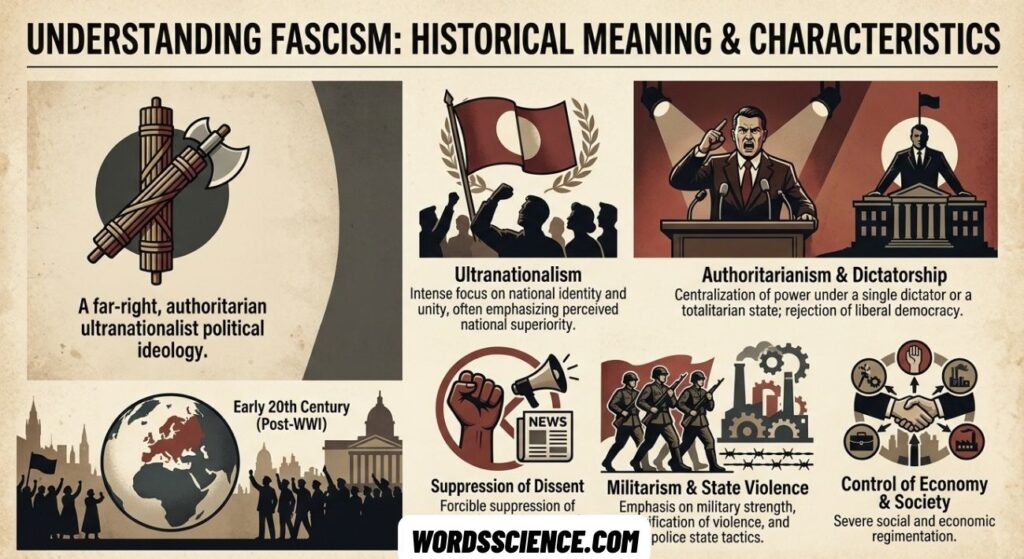
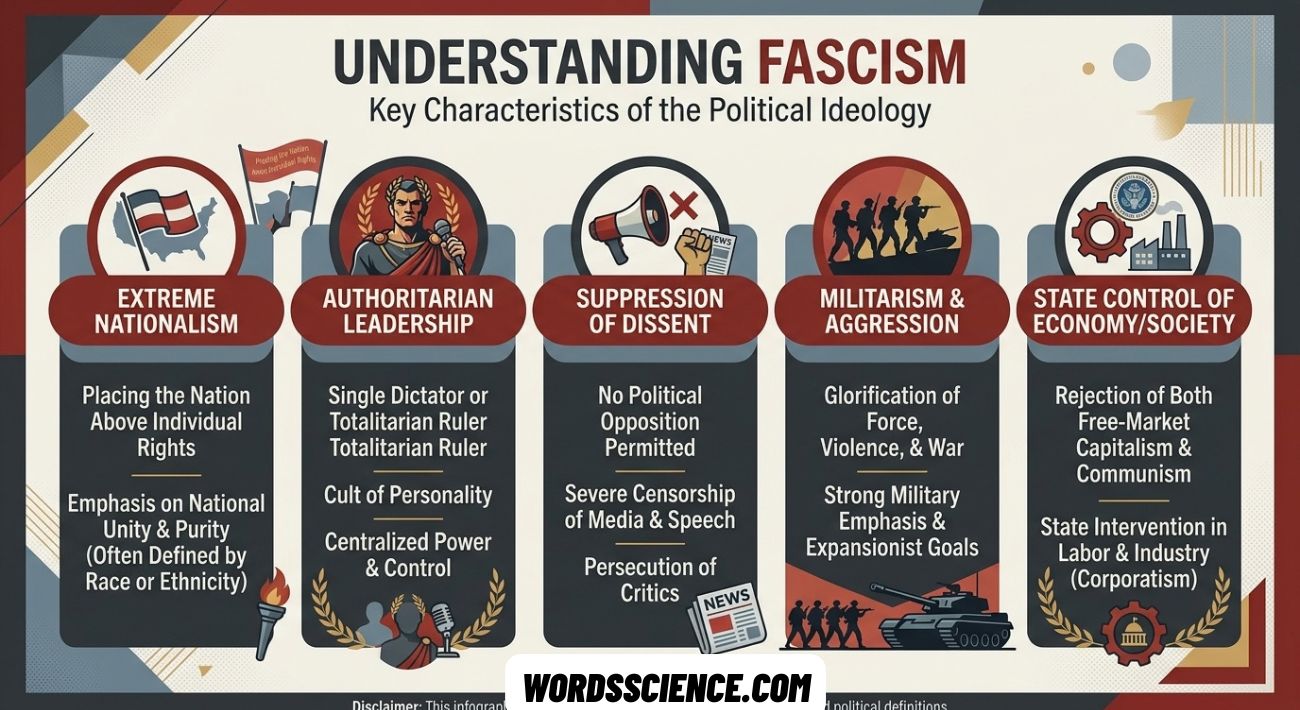
Fascist usually describes a person, movement, government, or political belief associated with fascism, an authoritarian political ideology that places the nation or collective above individual rights and strongly rejects liberal democratic pluralism. Fascist movements have historically emphasized extreme nationalism, centralized political power, political repression, and obedience to a strong leader.
The Fascist definition has a specific historical and political meaning, so it should not simply be treated as another word for “strict” or “controlling.” The term is closely connected with Mussolini, Fascist Italy, and the fascist political movement that emerged in Italy after World War I.
In everyday conversation, however, people sometimes use “fascist” more loosely to describe someone they think is extremely controlling or intolerant. That casual use can be exaggerated and may not match the historical meaning of the political term.
What Is the Fascist Meaning in Politics?
In politics, fascist meaning refers to ideas or movements associated with fascism. Fascism is generally described as an ultranationalist and authoritarian political philosophy that places the interests of the nation above individual rights and opposes democratic pluralism. Historical fascist movements also used political violence, repression, and one-party rule to eliminate opposition.
A fascist government therefore involves more than simply having strict laws or a powerful leader. Historical fascist systems sought extensive control over political life and suppressed people and organizations that challenged the ruling movement. Mussolini’s government in Italy gradually ended parliamentary democracy and established a dictatorship during the 1920s.
The term can also refer to a fascist movement, political organization, or set of beliefs rather than an established government. Because of this, calling a person or political group fascist is a serious accusation that should be supported by specific political beliefs or behavior rather than used simply as a synonym for disagreement.
Is Fascist the Same as Authoritarian?
No. Fascist vs authoritarian is an important distinction. Authoritarianism is a broader political concept involving concentrated power and limited political freedom, while fascism refers to a particular political ideology with additional features such as extreme nationalism, rejection of liberal democracy, mass political mobilization, and the subordination of individual interests to the nation.
This means a government or leader can be authoritarian without being fascist. Likewise, calling someone a dictator describes a form of political rule, while “fascist” identifies an ideological tradition. The terms can overlap in historical cases, but they are not interchangeable.
How Context Changes the Meaning
The word fascist can carry different implications depending on why, where, and how someone uses it. The historical meaning remains specific, while informal use can be much broader.
1. Historical context
In a history discussion, “fascist” normally refers to fascism as a political movement or ideology. For example, a textbook might discuss Mussolini’s Fascist Italy or the development of fascist movements in Europe after World War I. Mussolini founded the Italian Fascist movement in 1919, and the Fascists later established a one-party dictatorship in Italy.
Here, the word has a precise historical meaning rather than an everyday insult.
2. Political debate
During a political debate, someone may call a policy, movement, or politician “fascist.” In this setting, the speaker may be making a claim about authoritarianism, nationalism, repression, or hostility toward democratic institutions.
However, the label alone does not establish that the subject is actually fascist. A more useful discussion identifies the specific political behavior or belief being criticized.
3. Casual exaggeration
In casual speech, someone might say, “My boss is a fascist,” simply because the boss is extremely strict about workplace rules.
This is an informal and exaggerated use. It does not necessarily mean that the speaker believes the boss supports fascism as a political ideology.
4. Online argument
Online arguments often use political terms more loosely than academic or historical writing. Someone may use “fascist” as a strong insult toward a person they believe is overly controlling.
Because short comments can lack context, readers should look at the surrounding discussion before deciding whether “fascist” is being used historically, politically, or simply as an insult.
Fascist Meaning in Text and Online Chat
The Fascist Meaning in Text is usually determined by the surrounding conversation. In a history-related message, it may refer directly to fascism or a historical fascist government. In a personal argument, it may mean “extremely controlling” or “oppressive” in the speaker’s opinion.
For example, someone might text, “That rule is fascist.” They may not be making a technical statement about fascism. They could simply be expressing strong disagreement with a rule they consider excessive.
So, what does fascist mean in text? It can describe an actual political concept, a historical reference, or an exaggerated criticism. The sentence and conversation around it are essential for understanding the intended meaning.
Fascist Meaning on Social Media
On social media, fascist can appear in political debate, historical discussions, memes, arguments, or casual comments. Its meaning can range from a literal reference to fascist politics to a broad accusation that someone is highly controlling.
The phrase fascist online meaning should therefore be interpreted carefully. A post about Mussolini, Italian Fascism, or a fascist regime is likely using the term historically. A comment such as “My teacher is a fascist” may be using it figuratively.
The same applies to Fascist Meaning on TikTok. A short video or comment may use the word as political criticism, historical terminology, or exaggeration. The platform itself does not give the word a separate dictionary meaning.
Real Conversation Examples
1: History class
Student A: “Why was Mussolini called a fascist?”
Student B: “He led the Italian Fascist movement and established a dictatorship in Italy.”
Meaning: Here, “fascist” is being used in its historical and political sense.
2: Friends joking
Friend A: “You won’t let me choose the movie? You’re such a fascist.”
Friend B: “Fine, you pick the movie.”
Meaning: In this example, “fascist” is an exaggerated joke about being controlling. It is not a literal claim about fascist political beliefs.
3: Political discussion
Person A: “I think that movement is fascist.”
Person B: “What makes you describe it that way?”
Meaning: The second speaker asks for specific evidence instead of treating the label as self-explanatory. In serious political discussion, explaining the relevant beliefs or behavior makes the conversation clearer.
What Tone Does “Fascist” Have?
“Fascist” can sound very strong, especially when it is directed at a person. Its tone depends on whether it is being used historically, politically, jokingly, or as an accusation.
In a history textbook, it is a neutral descriptive term. In an argument, calling someone a fascist can be highly confrontational.
Is Fascist Rude?
Fascist can be rude or offensive when it is directed at someone as an accusation or insult. The word itself is not automatically rude because it has a legitimate historical and political meaning.
For example, “Mussolini led a fascist movement” is a historical statement. “You’re a fascist!” is much more confrontational because it directly labels another person.
Is Fascist an Insult?
Yes, fascist can be used as an insult, especially in casual arguments and online discussions. But its insult-like use should be separated from its genuine political meaning.
Using the word simply because someone is strict can make the conversation less precise. If the concern is excessive control, it may be clearer to describe the specific behavior instead.
How to Reply When Someone Calls You a Fascist
The best response depends on what the other person appears to mean. You can ask what behavior or belief led them to use the term instead of immediately arguing about the label.
If You Want Clarification
You could say:
“What specifically did I say or do that you mean by fascist?”
This invites the other person to explain their claim and can turn a vague accusation into a specific discussion.
They Are Joking
If a friend clearly uses the word jokingly, you can respond casually:
“Okay, okay. I promise I’ll let you choose the restaurant.”
The response can match the light tone if both people understand that the term is being used as exaggeration.
If It Is a Serious Political Argument
A more direct response is:
“If you’re using fascist in the political sense, which specific beliefs or actions are you referring to?”
This keeps the discussion focused on concrete political behavior instead of trading labels.
When to Use the Term
Use fascist when the historical or political meaning is actually relevant. It is appropriate in discussions of fascism, Fascist Italy, Mussolini, fascist movements, fascist governments, and related political history.
In political discussion, it is also more useful when the term is accompanied by an explanation of the specific features being discussed, such as extreme nationalism, suppression of political opposition, rejection of democratic pluralism, or concentration of political power.
When to Avoid the Term
Avoid using “fascist” as a casual replacement for every word meaning strict, controlling, unfair, or authoritarian. Those concepts are related but do not always describe fascism.
For example, a strict teacher is not automatically fascist, and a difficult workplace rule is not automatically evidence of a fascist political system. More precise language usually makes the conversation easier to understand.
Common Mistakes
One common mistake is treating fascist vs dictator as though the terms mean exactly the same thing. A dictator is a ruler who holds concentrated political power, while fascism refers to a particular political ideology and movement.
Another mistake is assuming that every authoritarian government is fascist. Authoritarianism is broader, and not every authoritarian system has the distinctive nationalist and ideological features associated with fascism.
A third mistake is using “fascist” whenever someone strongly disagrees with you. Political disagreement alone does not establish that a person or movement belongs to a fascist tradition.
A final mistake is assuming that every use online has a technical political meaning. In social media posts and casual conversations, the word may be used as an exaggerated insult.
Similar Political Terms
| Term | General meaning |
|---|---|
| Fascist | Related to fascism, an ultranationalist and authoritarian political ideology and movement. |
| Authoritarian | Describes political systems or behavior involving concentrated authority and limited political freedom. |
| Dictator | A ruler who exercises highly concentrated political power, often without meaningful democratic checks. |
| Totalitarian | Describes a system seeking extensive control over political and social life. |
| Nationalist | A person or movement that strongly emphasizes the interests or identity of a nation. |
| Democratic | Related to government based on popular participation and political institutions that allow meaningful competition and representation. |
These terms can overlap in particular historical cases, but they should not be treated as exact synonyms.
Origin and Historical Use
The word fascism is connected to the Italian fascismo and ultimately to the Latin fasces, a bundle of rods associated with authority in ancient Rome. The fasces became a symbol used by the Italian Fascist movement.
Modern fascism developed in Europe during the early twentieth century. Benito Mussolini founded the Italian Fascist movement in 1919. After the March on Rome in 1922, he became prime minister, and the Fascists subsequently consolidated a one-party dictatorship.
The historical meaning of fascist is therefore strongly connected to Italian Fascism and later fascist movements, including Nazi Germany. The term later became part of broader political language, where it is sometimes applied to people or movements outside those original historical settings.
How Is “Fascist” Used in Everyday Language?
The word fascist is sometimes used in everyday conversation to describe someone who seems extremely strict, controlling, or unwilling to accept disagreement. In this casual use, the speaker may not be referring to the actual political ideology of fascism.
Because the word has a serious historical meaning, using it casually can make a statement sound much stronger than intended. The exact meaning depends on the situation, the speaker’s tone, and the behavior being discussed.
What Is the Difference Between Fascist and Dictator?
A fascist refers to a person, movement, or system connected with fascism, while a dictator is a ruler who holds concentrated political power. A dictator does not necessarily follow fascist beliefs or belong to a fascist movement.
The terms can overlap in some historical examples, but they are not synonyms. Fascist vs dictator is therefore an important distinction when discussing political history or government.
Can “Fascist” Be Used as a Joke?
Yes, people sometimes use fascist jokingly to describe someone who is being unusually strict or controlling. For example, a friend might jokingly call another friend a “fascist” for always deciding where everyone should eat.
This is an exaggerated use rather than the historical fascist definition. Since the word has a strong political meaning, a joke may still sound offensive or overly serious if the other person does not understand the intended tone.
Why Is Context Important When Using “Fascist”?
Context helps show whether fascist is being used as a historical term, a political description, or a casual insult. A discussion about Mussolini and Fascist Italy has a very different meaning from a social media comment calling someone fascist for enforcing a rule.
Looking at the surrounding words, topic, and relationship between the speakers can help clarify the intended meaning. When discussing politics seriously, explaining the specific behavior or belief is usually clearer than using the label alone.
Quick Recap
Fascist meaning depends on context, but its core political meaning relates to fascism: an authoritarian, ultranationalist political ideology that places the nation above individual interests and rejects liberal democratic pluralism.
In text, conversation, and social media, “fascist” can also be used more loosely to describe someone seen as extremely controlling. Because it is a strong political term, using it accurately and explaining the specific behavior or belief behind the label can prevent unnecessary confusion.
FAQs
What Is Fascist in Simple Terms?
A fascist is someone associated with fascism, a political system that emphasizes strong national power, strict control, and limited individual freedom.
What Does “Fascist” Mean in Slang?
In slang, “fascist” can describe someone who seems extremely strict or controlling, but this is usually an exaggerated use of the word.
What Is a Good Example of Fascism?
Mussolini’s Fascist Italy is a historical example of fascism, where the government became a dictatorship and suppressed political opposition.
How to Explain Fascism to a Kid?
You can explain fascism as a system where one powerful leader or group wants strong control over the country and does not allow much disagreement.
Final Thoughts
The Fascist Meaning refers to a person, movement, or system connected with fascism, an authoritarian political ideology linked with extreme nationalism, strong state power, and limits on individual freedom. The term has a specific historical meaning tied to movements such as Mussolini’s Fascist Italy. In everyday speech, people may also use “fascist” more loosely for someone they see as controlling.
When you see fascist in text, conversation, or social media, context matters. It can describe a political belief, a historical subject, or an exaggerated insult. The word can sound rude or serious when aimed at a person, so use it carefully. A clear explanation of the behavior or belief behind the label is often more useful than the label alone.