Idioms for Soccer: 10 Football Idioms and What They Mean
One of the most useful idioms for soccer is move the goalposts. An idiom is a common expression whose meaning differs from the meaning of its single words. When a boss “moves the goalposts” just before a deadline, nobody touches a real goal — she has changed the rules in the middle of the job to make it harder.
English has many idioms for soccer like this. Some use goals, nets, and kick-offs; others talk about buses, parrots, and a game split in two. Each one pictures fair play, teamwork, a sudden change, or a painful mistake.
This guide collects 10 real idioms for soccer. You will learn what each one means, see an example sentence, and learn which ones are safe in school essays. One quick naming note: in the United States the sport is called soccer, while in Britain and most of the world it is called football — the idioms in this guide are the same in both.
Why Idioms for Soccer Matter
Students and teachers meet soccer idioms in sports reports, stories, and daily talk. Football is the world’s most watched sport, so its language travels everywhere: a newspaper can call a politician’s mistake an “own goal,” and a business page can ask for a “level playing field.” Knowing this figurative language helps students understand real English fast.
Writers and ESL learners use these idioms to sound natural and clear. Plain words can say “the rules changed unfairly,” but an idiom adds a picture: goalposts that move, a bus parked in front of a goal, and a match that turns around completely after half-time.
What Is an Idiom?
An idiom is a fixed group of words with a special meaning you cannot guess from the words alone — “move the goalposts” means changing the rules, not carrying a wooden frame across a field.
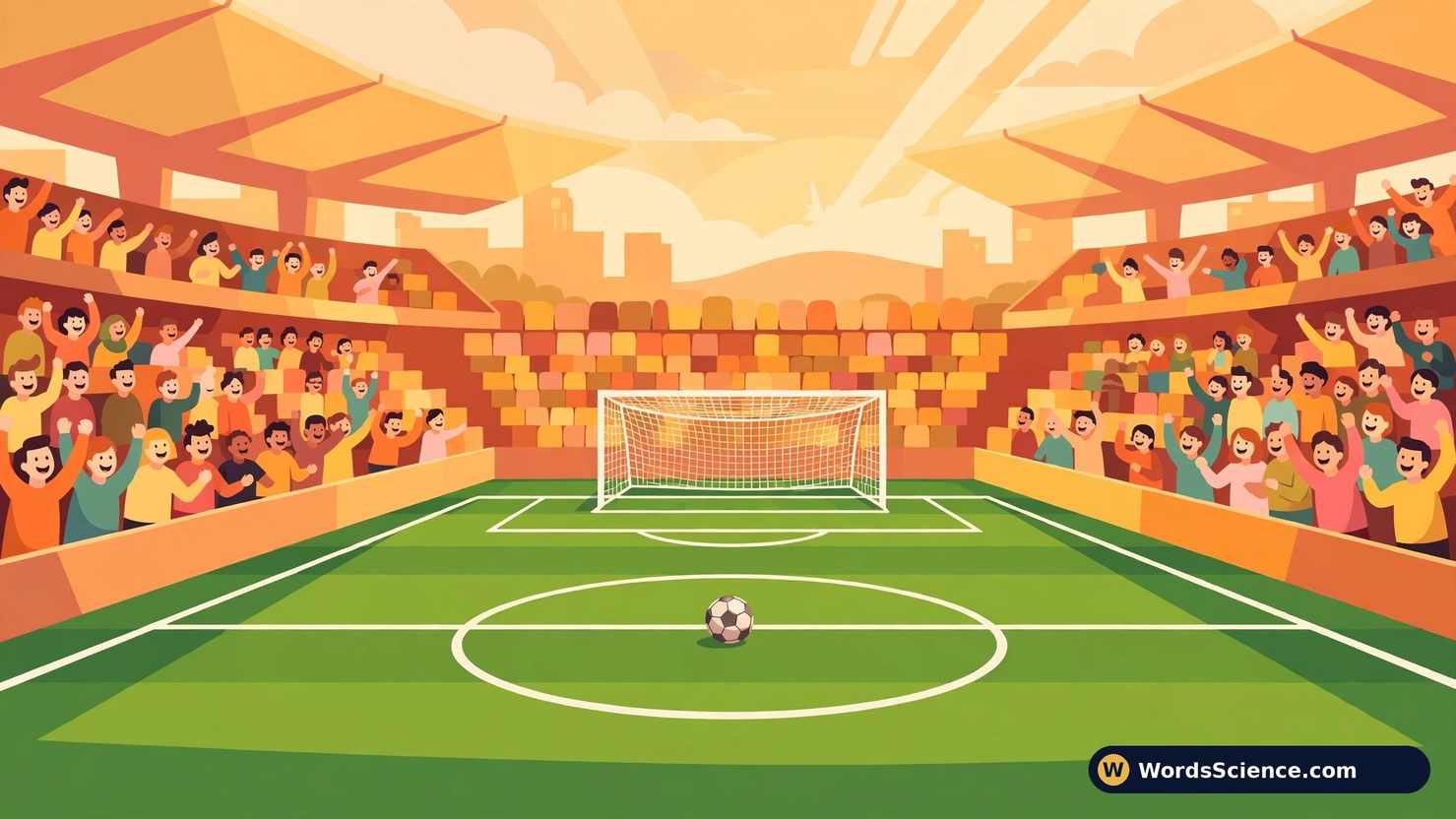
Many soccer idioms come from the match itself — the kick-off, the goal, the net, and the two halves — and they picture scoring, defending, fairness, and sudden changes.
Idioms from the Goal Mouth
These idioms use the goal and the net — the places where matches are won and lost.
Move the Goalposts
To move the goalposts means to change the rules or conditions of something while it is already happening, in a way that makes success harder for someone. Cambridge Dictionary lists it as an informal idiom, and it comes from British football: imagine trying to score when the goal itself keeps moving. Example: We had finished the report when the manager moved the goalposts and asked for two extra chapters.
An Own Goal
An own goal is, first, a goal scored when a player accidentally puts the ball into their own team’s net, so the point goes to the other side. In its idiom sense, an own goal is something you do that harms yourself or your own side — the opposite of what you intended. Cambridge Dictionary’s writers list it among the classic football idioms. Example: The shop’s rude reply to a customer was an own goal — the story spread online and sales fell.
An Open Goal
An open goal is a situation that gives someone a chance to succeed very easily, with nobody standing in the way. On the field, the goalkeeper is missing and the net is empty; in daily life, the chance is so simple that missing it is embarrassing. Example: With the other teams out of the race, the contract was an open goal for our company — and we still missed it.
Back of the Net
Back of the net describes the happy moment when the ball hits the back of the goal net — a goal has been scored. Fans and commentators shout it as a cry of success, and people also use it for wins in daily life, like passing an exam or getting a job. Honest label: inside football it is a set commentary phrase rather than a deep idiom, but its success sense is real English. Example: She sent off her job application on Monday, and by Friday it was back of the net — she got the job!
Idioms About How the Game Is Played

These idioms come from the pitch, the tactics, and the shape of the match itself.
A Level Playing Field
A level playing field is a situation in which everyone has the same fair chances and nobody has a special advantage. The picture is a field with no slope: if one team attacked uphill all game, the match would not be fair. Honest label: this idiom comes from field sports in general — football, hockey, rugby — and not from soccer alone, and people use it most in business and politics. Example: Small farms cannot compete with big companies unless the government creates a level playing field.
Park the Bus
To park the bus means to play in a very defensive way, keeping almost the whole team close to your own goal and hardly trying to attack. The Oxford English Dictionary records the phrase with exactly this meaning. It is a young expression: the manager José Mourinho brought it into English football in 2004, complaining that Tottenham had “brought the bus and left the bus in front of the goal.” People now use it for any very cautious, defensive behaviour. Example: Winning 1–0 with ten minutes left, the team parked the bus and defended until the final whistle.
A Game of Two Halves
A game of two halves is a situation whose second part is completely different from its first part. A soccer match has two halves of 45 minutes, and a team losing badly in the first half can return and win — so the phrase warns us never to judge too early. Honest label: phrase experts call it a football commentator’s cliché — a set phrase everyone in British football knows — rather than a hidden-meaning idiom, but its “things can change completely” lesson is real. Example: The school play was a game of two halves: a slow, quiet start, then a second half full of songs and laughter.
Hat-Trick
A hat-trick is three goals scored by one player in a single match. People also use it for any three successes of the same kind, one after another. Honest label: hat-trick is a sports term, not an idiom born in soccer — it began in cricket in 1858, when the bowler H. H. Stephenson took three wickets with three balls in a row and was given a new hat as a prize. Soccer borrowed the word later. Example: With three goals against the champions, the young striker completed a famous hat-trick.
Idioms About Starting and Feeling
These two idioms cover the first kick of the match and the worst feeling after it.
Kick Off
To kick off means to start. In soccer, the kick-off is the first kick of the match, from the centre spot; in daily English, meetings, parties, courses, and discussions all “kick off.” Cambridge Dictionary lists it as a phrasal verb meaning “to begin.” Honest label: like “brush up on” in our art idioms guide, it is a phrasal verb rather than a classic idiom — but no list of soccer expressions is complete without it. Example: The workshop kicks off at nine o’clock with a short welcome talk.
Sick as a Parrot
To be sick as a parrot means to be extremely disappointed or sad about something — not ill. Collins dictionaries list it as British and informal, and it became famous in the 1970s, when British footballers and managers used it in interviews after losing matches. Honest label: it is a simile — an “as … as” comparison — and nobody knows exactly why a parrot was chosen; the phrase’s roots are uncertain. Example: He missed the last train home and felt as sick as a parrot.
A Famous Nickname, Not an Idiom
One famous football expression is not an idiom at all — it is a nickname for the sport itself. It belongs here, in its own section, not counted above.
The Beautiful Game
The beautiful game is the best-known nickname for soccer in the world. It praises the sport’s skill, speed, and grace — football played as art. The Brazilian star Pelé made the phrase world-famous, naming his 1977 autobiography My Life and the Beautiful Game; in Brazil the game is called o jogo bonito. Honest label: writers used “beautiful game” about football before Pelé — as early as 1913 — and Pelé himself may have borrowed it from his team-mate Didi, so no single person truly invented it. Example: Millions of fans call football the beautiful game, and a great match shows why.
Idioms for Soccer at a Glance
| Idiom | Simple Meaning | Best For |
|---|---|---|
| Move the goalposts | Change the rules unfairly during a task | Unfair changes |
| An own goal | A mistake that harms your own side | Blunders |
| An open goal | A very easy chance to succeed | Easy opportunities |
| Back of the net | A goal; a joyful success | Winning moments |
| A level playing field | Fair conditions for everyone | Fairness, business |
| Park the bus | Defend with almost the whole team | Defensive tactics |
| A game of two halves | A situation that changes completely in part two | Sudden changes |
| Hat-trick | Three goals by one player; three successes | Triple success |
| Kick off | To start something | Beginnings |
| Sick as a parrot | Extremely disappointed (British) | Losing, disappointment |
How to Use Soccer Idioms in Writing and Speaking
- Match the idiom to the moment. Unfair rule change: “move the goalposts.” A mistake that hurts your own side: “an own goal.” A very easy chance: “an open goal.”
- Use fairness idioms in serious writing. “A level playing field” and “kick off” are safe in essays, news, and work reports.
- Keep the British informal ones for friendly talk. “Sick as a parrot” and “back of the net” sound natural in conversation and sports writing, but too playful for a formal essay.
- Learn each idiom as a whole phrase. Never translate an idiom word for word — the translation usually makes no sense.
- Use one idiom at a time. One clear idiom is stronger than three in a single sentence.
Expressions That Are Not Really Soccer Idioms
Some famous expressions sit near soccer but do not belong in the list above. “Take one for the team” is a real idiom — Oxford lists it: to accept something unpleasant to help your friends or group. But it comes from baseball, where a batter lets the ball hit his body so his team gains a base; word histories trace it in baseball from around 1969. Soccer players sacrifice themselves too, of course, but borrowing a baseball idiom does not make it a soccer idiom. “Keep your eye on the ball” and “on the ball” are also real English — they mean to stay alert and ready, a picture from ball games in general. In soccer, “on the ball” mostly keeps its plain meaning: the player who has the ball at their feet. The alertness idiom’s exact home sport is disputed — several word experts point to baseball — so honest lists do not claim it for soccer.
Other near-misses are famous but softer. “At the end of the day” — meaning “when everything is considered” — is heard in almost every football interview, and British fans joke about it as the footballer’s favourite sentence. But it is a general English phrase, found in writing from the 1800s, long before television interviews; football did not invent it, it only overuses it. Even the word soccer itself surprises people: it is not an American invention. It began in England in the 1880s, when Oxford students shortened “association football” — the game’s full official name — to “soccer,” the way they shortened rugby football to “rugger.”
Idioms are only one part of lively English. Keep your hands busy with the tools that start with G word list, then spend time with good company in the idioms for friendship collection.
Frequently Asked Questions
What does “move the goalposts” mean?
It means to change the rules or conditions of something while it is happening, making it harder for someone to succeed. It comes from British football, where a moving goal would make scoring almost impossible.
Why is the sport called “soccer” in America and “football” in Britain?
Both names are English. The game’s full name is “association football.” In the 1880s, Oxford students shortened “association” and added “-er,” making “soccer” — a British invention that travelled to America, Canada, and Australia, while Britain kept “football.”
What does “park the bus” mean?
It means to play very defensively, with almost the whole team in front of your own goal. The manager José Mourinho brought the phrase into English football in 2004 to criticise Tottenham’s defensive play.
Is “hat-trick” a soccer word?
No — it began in cricket. In 1858 the bowler H. H. Stephenson took three wickets with three balls in a row in England and received a new hat as a prize. Soccer borrowed the term for three goals by one player.
Can I use soccer idioms in a school essay?
Yes — “a level playing field,” “kick off,” and “move the goalposts” are safe and common in essays and news. Save “sick as a parrot” and “back of the net” for friendly writing and speaking.
Conclusion
You now have 10 soccer idioms, from the first kick-off to the bus parked in front of the goal. Each one turns a match picture — goalposts, nets, halves, and hat-tricks — into a clear meaning about fairness, mistakes, and sudden changes.
Practise with one idiom at a time: learn it as a whole phrase and use it in a sentence about your own team, school, or work. To explore the sport itself — its laws, its history, and its world competitions — read the encyclopedia article on association football and how it became the world’s most popular game.