Elegy Meaning | Definition, Examples, Types & Uses
The elegy meaning refers to a poem or literary work that expresses grief, remembrance, or reflection after a death or major loss. An elegy may honor someone who has died while expressing sadness and thoughtful reflection. It can also describe writing about the loss of a place, relationship, tradition, or period of life.
In everyday English, elegy usually has a serious, mournful, and respectful tone. The word often appears when people discuss poetry, literature, memorial writing, or meaningful loss. Its meaning can also be figurative when a work mourns something that has disappeared or changed.
This article explains What Does Elegy Mean with clear definitions and original examples. You will also learn about its literary meaning, tone, types, and the difference between an elegy and a eulogy.
What Does Elegy Mean?
Elegy means a poem or piece of writing that mourns a death, loss, or something deeply valued that has disappeared. It commonly combines grief, remembrance, reflection, and sometimes praise.
An elegy poem does not have to focus only on sadness. Many elegies move from sorrow toward understanding, acceptance, or appreciation. The writer may remember the past while thinking about death, change, love, or human life.
For example:
“She wrote an elegy for her grandfather, remembering his kindness and the lessons he taught her.”
Here, the word describes a memorial poem or literary work created to express grief and remembrance.
The Main Elegy Meaning in Literature
In literature, an elegy is a literary form associated with mourning and serious reflection. Traditional elegies often respond to the death of a person, but writers have also used the form to explore broader ideas about loss and mortality.
An elegy can praise the person who has died, describe the speaker’s sorrow, remember shared experiences, and consider the meaning of death. Some works eventually move toward acceptance rather than ending only in despair.
The elegy meaning in literature therefore involves more than simply calling something a sad poem. It describes a particular kind of poetry about loss, remembrance, and reflection.
An elegy can be personal and emotional, but it can also be carefully structured and literary. Its tone may be mournful, contemplative, respectful, or quietly hopeful.
Is an Elegy Always About Death?
No. Death is one of the most common subjects of an elegy, but the form can also respond to other kinds of significant loss.
A writer might create an elegy for a lost home, a disappearing tradition, a past era, or a relationship that has ended. In these cases, the writing still carries the central idea of mourning something meaningful.
For example, a poem about an abandoned hometown could have an elegiac tone if it reflects on how the community has changed and what has been lost.
Key Features of an Elegy
An elegy usually centers on loss, although the exact subject can vary. The writer often looks backward, remembers what has been lost, and considers its importance.
Common features include grief, remembrance, praise, reflection, and thoughts about mortality. Some elegies also include lament, which means an expression of sorrow or mourning.
An elegy may follow a traditional poetic structure, but modern examples do not have to follow one fixed form. The emotional purpose and subject are often more important than a particular rhyme scheme or number of lines.
A piece may also use an elegiac tone without technically being an elegy. For example, a novel, speech, song, or essay can sound mournful and reflective without being an elegy as a literary form.
How Context Changes the Elegy Meaning
Context can change how readers understand the word elegy. When someone says, “He wrote an elegy for his mother,” the meaning is closely connected with death, grief, and remembrance.
When a critic calls a novel “an elegy for a disappearing city,” the word has a broader figurative use. It suggests that the work mourns the loss of a place, culture, period, or way of living.
The surrounding words also provide clues. Terms such as memorial, mourning, loss, death, and remembrance usually point toward the traditional meaning. Words such as vanishing, forgotten, old world, or lost era may signal a figurative meaning.
Famous Examples of Elegies
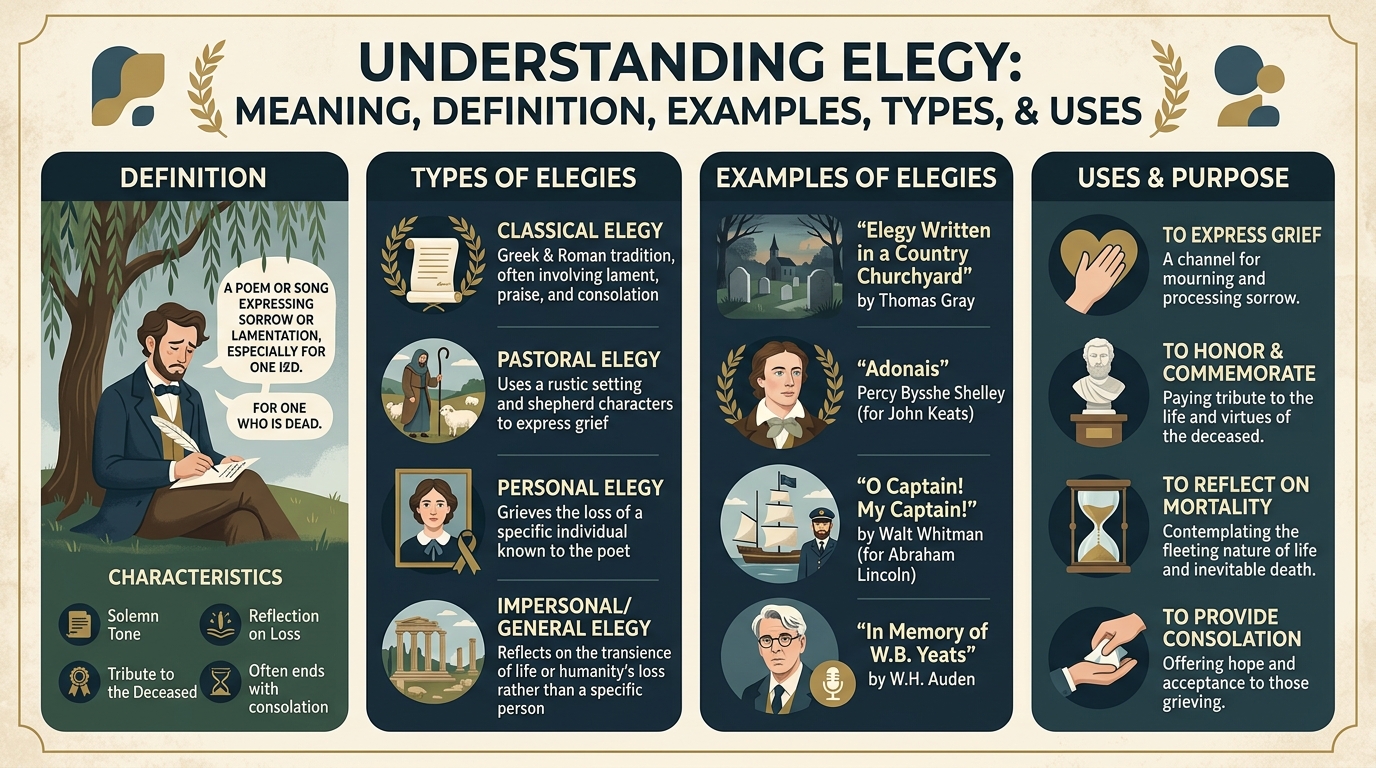
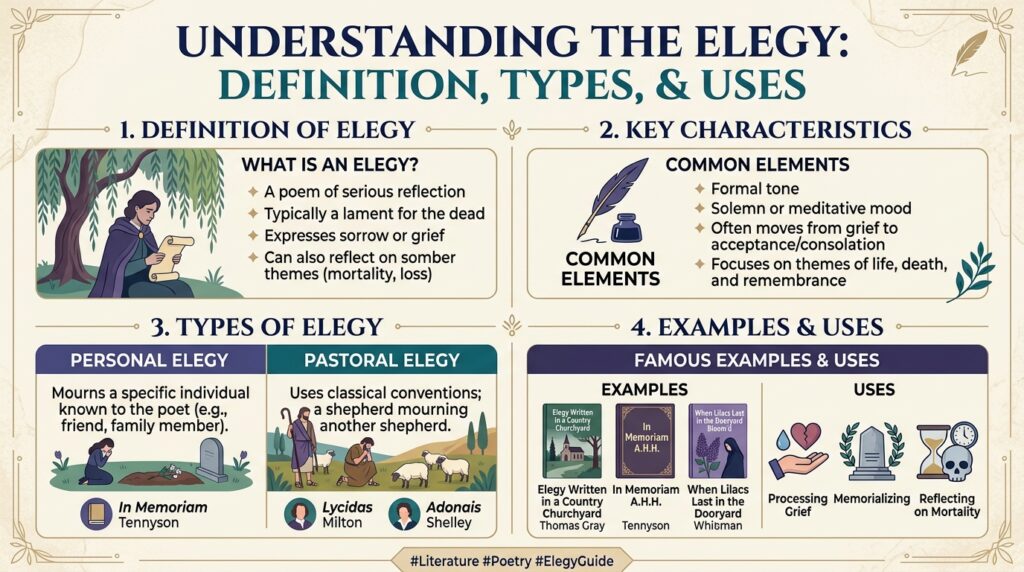
Literature contains many well-known works associated with the elegy tradition. One famous example is Thomas Gray’s Elegy Written in a Country Churchyard, which reflects on death, ordinary lives, and human mortality.
John Milton’s Lycidas is another major example. It mourns the death of Edward King and combines personal grief with religious and pastoral elements.
Walt Whitman’s When Lilacs Last in the Dooryard Bloom’d responds to the death of Abraham Lincoln and uses nature, memory, and mourning to explore national grief.
W. H. Auden’s In Memory of W. B. Yeats also belongs to the broad tradition of elegiac poetry, reflecting on the death of another poet and the relationship between death and artistic legacy.
These famous elegies show that the form can take different shapes. Some focus closely on one person, while others use a death or loss to explore much larger ideas.
Real-World Examples of the Word Elegy
The word elegy is most common in literary, academic, artistic, and formal contexts. It may describe a poem, book, essay, song, speech, or another work that mourns a loss.
Here are some natural examples:
Example 1:
“The poet wrote an elegy after the death of his closest friend.”
Meaning: The poet created a mournful work to remember his friend and express grief.
Example 2:
“The novel feels like an elegy for a disappearing neighborhood.”
Meaning: The novel mourns the loss of the neighborhood’s former character.
Example 3:
“Her final poem became an elegy for her childhood.”
Meaning: The poem reflects sadly on the end or loss of an earlier stage of life.
Example 4:
“The song has an elegiac quality, even though it is not technically an elegy.”
Meaning: The song has a mournful, reflective feeling associated with elegies.
The Tone and Emotional Meaning of Elegy
The emotional meaning of an elegy usually involves sadness, grief, remembrance, or reflection. However, an elegy can contain several emotions at once.
A writer may begin with intense mourning and then move toward gratitude, praise, acceptance, or peace. The emotional journey depends on the writer, subject, and literary style.
This is why elegiac does not simply mean “sad.” It often suggests a thoughtful response to loss. A work can feel quiet, respectful, nostalgic, or contemplative rather than openly sorrowful.
Is Elegy a Sad Word?
Yes, elegy usually carries a serious and mournful feeling because it is strongly connected with grief, death, and loss.
However, the word itself is not necessarily negative. An elegy can also express love, respect, gratitude, remembrance, and acceptance. Its emotional meaning depends on how the writer presents the loss.
Is Elegy the Same as a Eulogy?
No. An elegy and a eulogy can both involve death and remembrance, but they serve different purposes.
| Term | Meaning | Common Use |
|---|---|---|
| Elegy | A literary work expressing grief or reflection after a loss | Poetry and literature |
| Eulogy | A speech or written tribute honoring someone who has died | Funerals and memorial services |
| Dirge | A mournful song or piece associated with death | Music and ceremonial mourning |
| Lament | An expression of grief or sorrow | Literature and everyday language |
| Requiem | A work or service connected with remembrance of the dead | Religious, musical, or ceremonial contexts |
A eulogy usually focuses on honoring and remembering a particular person, especially during a funeral or memorial service. An elegy is more closely associated with literary expression, especially poetry, although the terms can overlap in broader usage.
How to Recognize an Elegy
Look for a clear sense of loss and a reflective response to that loss. The work may mourn someone who died, remember a meaningful past, or consider the effects of change.
An elegy often contains language connected with memory, absence, death, grief, nature, time, or mortality. It may praise the person or thing that has been lost and explore why that loss matters.
Not every poem about death is an elegy. A poem can mention death without focusing on mourning or remembrance. The overall purpose and emotional direction of the work matter.
When to Use the Word Elegy
Use elegy when discussing a literary or artistic work that mourns a death or meaningful loss. It works especially well in literary analysis, book reviews, poetry discussions, academic writing, and descriptions of memorial writing.
For example:
“Her poem is an elegy for her late father.”
“The film serves as an elegy for a changing rural community.”
“His collection includes several elegies about war and loss.”
The word is appropriate when you want to communicate both the subject of loss and the reflective nature of the work.
When to Avoid the Word Elegy
Avoid calling every sad poem, song, story, or speech an elegy. A work may be sad without focusing on mourning or significant loss.
You should also avoid using elegy when you simply mean eulogy. A speech given at a funeral is normally called a eulogy when its purpose is to honor the deceased.
Likewise, a poem about heartbreak is not automatically an elegy. If the poem does not focus on mourning a significant loss, another description may be more accurate.
Common Mistakes About Elegy
One common mistake is thinking that an elegy must always be about a person’s death. Death is central to many traditional elegies, but writers can also use the form for other significant losses.
Another mistake is assuming that every elegy must follow one exact poetic structure. Modern elegies can vary greatly in form, length, rhyme, and style.
It is also incorrect to treat elegy and eulogy as exact synonyms. Their meanings overlap around remembrance and death, but their literary and practical uses differ.
Finally, calling every mournful work an elegy can make the term too broad. The work should have a meaningful connection to mourning, loss, remembrance, or reflection.
Elegy vs. Similar Literary Terms
Elegy vs. eulogy: An elegy is primarily a literary work expressing grief or reflection, while a eulogy is usually a tribute delivered or written to honor someone who has died.
Elegy vs. lament: A lament is any strong expression of grief or sorrow. An elegy is a more specific literary form or work associated with mourning and reflection.
Elegy vs. dirge: A dirge is a mournful song or musical work connected with death. An elegy is generally associated with poetry or literary expression.
Elegy vs. ode: An ode is a formal poem that praises or addresses a person, object, idea, or subject. It does not have to involve grief or loss.
Elegy vs. requiem: A requiem is traditionally associated with prayers, religious services, or musical compositions for the dead. An elegy has a broader literary meaning.
These distinctions help explain why elegy literary meaning depends on both subject and purpose rather than simply on whether a work feels sad.
See Also : Huzz Meaning Slang | What Does Huzz Mean in Text?
Origin and Literary Tradition
The word elegy comes through Latin elegia from Greek elegeia, a term associated with poetry written in elegiac verse. In classical tradition, elegiac verse had a specific poetic structure.
Over time, the English literary tradition developed a broader understanding of the elegy as a poem of mourning, especially one responding to death. Later writers expanded the form to explore personal grief, social change, war, cultural loss, memory, and mortality.
Today, an elegy does not need to follow the strict structure associated with ancient poetry. Modern writers use the term more broadly for works that mourn and reflect on meaningful loss.
What Is an Elegy Poem?
An elegy poem is a poem that expresses grief, remembrance, or reflection after a death or meaningful loss. It may honor someone who died while also exploring feelings about memory, love, time, and mortality.
Elegy poems can be deeply personal or focus on a larger loss. A writer may mourn a person, place, relationship, tradition, or past period while using poetry to understand and express that loss.
What Are the Main Types of Elegy?
The main types of elegy are often described by their subject, style, or literary tradition. A personal elegy mourns a particular person, while a pastoral elegy uses rural or nature-based imagery to express grief.
Modern elegies can also focus on cultural, historical, or personal loss. These works may not follow an old poetic structure, but they still use mourning, remembrance, and reflection as central ideas.
Can Elegy Be Used Outside Poetry?
Yes, elegy can be used more broadly to describe a work that mourns a significant loss. A novel, essay, song, film, or other creative work may be described as an elegy when it reflects on something that has disappeared or changed.
For example, someone might call a film “an elegy for a fading town.” Here, the word does not mean a traditional poem; it describes the work’s mournful and reflective treatment of loss.
Why Is Elegy Important in Literature?
Elegy gives writers a way to express grief while preserving memories and reflecting on the meaning of loss. It can turn a personal experience of mourning into a thoughtful literary work that connects with wider human experiences.
The form also allows writers to explore difficult ideas such as death, change, remembrance, and acceptance. For this reason, elegiac poetry has remained an important part of literary tradition.
Quick Recap
The elegy meaning is a poem or literary work that expresses grief, mourning, remembrance, or reflection after a death or significant loss. It often combines sadness with praise, memory, and thoughts about mortality.
An elegy is not exactly the same as a eulogy, lament, dirge, ode, or requiem. The clearest way to recognize one is to look at its purpose: it uses literary or artistic expression to respond thoughtfully to something that has been lost.
FAQs
What is an elegy in simple words?
An elegy is a poem or literary work that expresses grief, remembrance, or reflection after a death or major loss.
It often honors what was lost while expressing sadness and thoughtful reflection.
What is the synonym of elegy?
Common synonyms include lament, mourning poem, and memorial poem.
These words can describe writing that expresses sorrow, remembrance, or grief over a loss.
What’s the difference between an elegy and eulogy?
An elegy is usually a poem or literary work that mourns a death or significant loss.
A eulogy is a speech or tribute that honors someone who has died, often at a funeral or memorial.
What is the main purpose of an elegy?
The main purpose of an elegy is to express grief while remembering and honoring what has been lost.
It may also reflect on death, memories, mortality, acceptance, and the meaning of loss.
Final Thoughts
The elegy meaning refers to a poem or literary work that expresses grief, remembrance, and reflection after a death or major loss. An elegy may honor someone who died, remember experiences, and explore ideas about mortality, sadness, acceptance, or change. It can also describe writing that mourns a lost place, time, relationship, tradition, or way of life. The key idea is thoughtful mourning and remembrance.
When using the word elegy, consider the context and tone in writing. A mournful poem may be an elegy, while a simple sad poem may not be. Knowing the difference between an elegy and eulogy helps you use each term correctly. These elegy examples show how writers can express loss with respect, memory, and reflection.