
Hubris Meaning | Definition, Examples, and Context
Hubris Meaning refers to excessive pride, arrogance, or overconfidence that makes someone feel overly superior. It goes beyond normal confidence because the person may ignore limits, warnings, or consequences. The Hubris Definition usually carries a negative or critical meaning.
In everyday English, hubris can describe arrogant behavior in conversations, workplaces, literature, or public commentary. Hubris Meaning in Texting and social media usually stays the same, but the tone may be serious, critical, or humorous. The word is closely related to arrogance, yet hubris often suggests excessive confidence that leads to poor judgment.
This article explains What Does Hubris Mean with clear examples and practical context. You will learn how to use hubris correctly, understand its tone, and distinguish Hubris vs Arrogance. You will also see how the word works in everyday English and literary contexts.
What Does Hubris Mean?
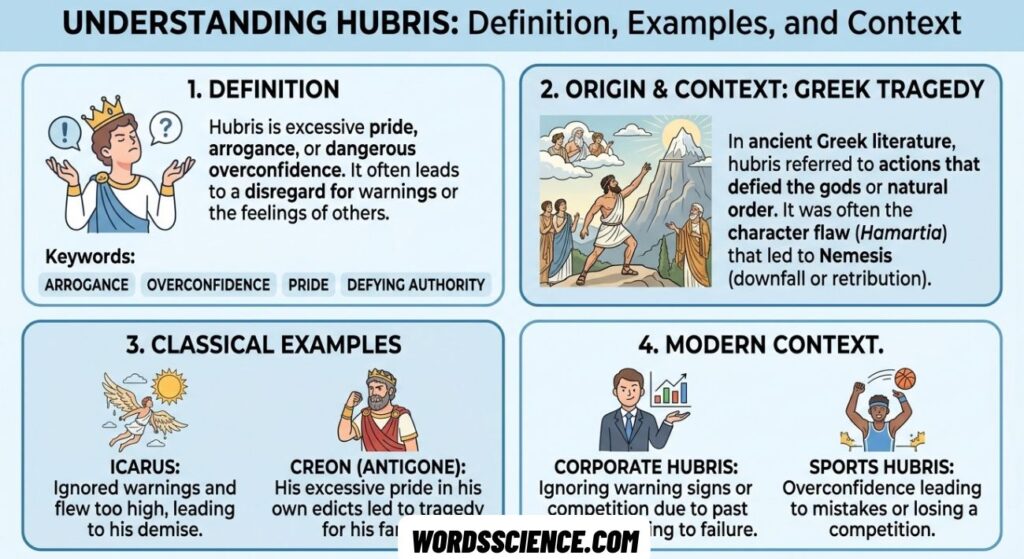
Hubris means excessive pride, arrogance, or an inflated sense of superiority that can cause a person to ignore limits, warnings, or consequences. It describes more than ordinary confidence because it often involves believing that you are more capable, important, or powerful than you really are.
The word is an English noun and usually has a negative or critical meaning. For example, if someone makes a risky decision because they believe they cannot fail, another person might describe that behavior as hubris.
In simple terms, hubris is excessive confidence that turns into unreasonable pride or arrogance. It can appear in everyday conversation, literature, workplace discussions, public commentary, and social media.
The Main Hubris Meaning Explained
The core hubris definition centers on excessive pride and an inflated belief in one’s own abilities or importance. A person showing hubris may disregard limitations, reject criticism, or ignore warnings because they feel certain that their judgment is superior.
Hubris is different from healthy self-confidence. Confidence allows someone to trust their abilities while still recognizing mistakes and limitations. Hubris goes further by creating an inflated sense of superiority or self-importance.
For example:
“His hubris made him ignore everyone’s warnings.”
This sentence suggests that his excessive pride or overconfidence prevented him from listening to others. The problem is not simply that he felt confident. His confidence contributed to poor judgment and potentially bad decisions.
The idea is especially common in Greek literature, where excessive pride can contribute to a character’s downfall. In modern English, however, people can use hubris more broadly to describe arrogant behavior and excessive confidence.
How Context Changes the Meaning
The basic meaning remains connected to excessive pride, but the tone and purpose can change depending on where the word appears.
1. Everyday conversation
In everyday conversation, hubris usually describes someone who acts as though they are better, smarter, or more capable than others.
For example:
“Thinking you can never make a mistake is pure hubris.”
This sounds serious and critical. It does not simply mean that the person has self-confidence. It suggests that their confidence has become unreasonable.
The word is less common than simple terms such as “arrogance” or “overconfidence,” so using it can make a statement sound more formal or deliberate.
2. Workplace discussions
At work, hubris can describe excessive confidence that affects decisions, teamwork, or leadership.
For example:
“The manager’s hubris led him to dismiss useful feedback.”
Here, hubris refers to an attitude of superiority that causes someone to disregard criticism. It may also suggest poor decision making when a person believes their experience or authority makes outside advice unnecessary.
In professional writing, the word can work well when discussing leadership criticism or a documented pattern of overconfidence. In casual workplace conversation, “arrogance” may sound more natural.
3. Literature or storytelling
Hubris meaning in literature is closely connected with excessive pride and a character’s downfall. In classical literature and Greek tragedy, a character may become so confident in their own power or judgment that they ignore important limits.
This is often discussed as a tragic flaw, although hubris and a tragic flaw are not exact synonyms. Hubris can be one trait that contributes to a character’s eventual downfall.
For example:
“The king’s hubris prevented him from accepting the warning.”
In literary analysis, the word can describe how a character’s excessive pride contributes to later consequences.
4. Political or public commentary
In public commentary, hubris can describe what a writer or speaker sees as excessive confidence, self-importance, or disregard for consequences by a public figure, leader, organization, or institution.
For example:
“Critics described the decision as an example of political hubris.”
The statement presents hubris as an interpretation or criticism of the decision rather than as a neutral description of a person’s personality. In this context, the surrounding evidence matters because “hubris” expresses a critical judgment about behavior.
Is Hubris the Same as Arrogance?
Hubris and arrogance are closely related, but they are not always interchangeable.
Arrogance generally means having an exaggerated sense of one’s importance, abilities, or status. Hubris usually suggests excessive pride or confidence that has gone beyond reasonable limits, often with a disregard for warnings, consequences, or one’s own limitations.
A simple distinction is:
Arrogance: “I am better than you.”
Hubris: “I am so certain of my superiority that I cannot fail, so I do not need to listen to anyone.”
This difference is not absolute in everyday English. People sometimes use hubris simply as a stronger or more formal way to describe arrogance. Still, the idea of overconfidence leading to poor judgment is especially important to the meaning of hubris.
Real Conversation Examples
1: Friends
Person A: “Jake said he could finish the entire project without any help.”
Person B: “That’s a little hubristic.”
Meaning: Person B thinks Jake has too much confidence in his own ability and may be underestimating the difficulty of the task.
2: Workplace
Person A: “She rejected every suggestion from the team and insisted her original plan could not fail.”
Person B: “That sounds like hubris.”
Meaning: The speaker sees excessive confidence and a refusal to consider criticism as a sign of hubris.
3: Social commentary
“The company’s decision to ignore repeated warnings was criticized as an act of corporate hubris.”
Meaning: The statement describes a critical view that excessive confidence caused the company to disregard potential consequences.
Is Hubris Rude or Insulting?
Calling someone “hubristic” or saying they show hubris can sound insulting because the word usually carries a negative meaning. It suggests that the person has excessive pride, arrogance, or unreasonable confidence.
However, hubris is not a swear word or inherently offensive term. It is a standard English word that can appear in serious discussions, academic writing, literary analysis, journalism, and everyday conversation.
Tone depends on the situation. Saying “His decision showed hubris” is a criticism of behavior. Saying “You’re full of hubris” directly to someone can sound much more confrontational.
Is Hubris Always Negative?
Hubris usually has a negative meaning, especially when it describes excessive pride that causes poor judgment or harmful consequences.
It is different from ordinary confidence. Someone can have strong self-confidence without being arrogant or dismissive of other people. Healthy confidence can coexist with humility and an awareness of personal limits.
The word can sometimes appear humorously or playfully. For example:
“My hubris made me think I could assemble this furniture without reading the instructions.”
The speaker is joking about their own excessive confidence. The negative idea remains, but the tone is humorous rather than harsh.
How to Use Hubris Correctly
Appropriate uses
Use hubris when you want to describe excessive pride, overconfidence, or an inflated belief in someone’s abilities or importance.
It works naturally in sentences such as:
“His hubris caused him to ignore the warning.”
“The novel explores the dangers of unchecked hubris.”
“Her confidence became hubris when she stopped listening to advice.”
The word is particularly useful when excessive confidence leads to poor judgment, bad decisions, or negative consequences.
When to avoid it
Avoid hubris when you simply mean confidence, pride in an achievement, or normal self-assurance.
For example, saying “She felt hubris after passing her exam” would not usually be appropriate if you only mean that she felt proud. “She felt proud of her achievement” is clearer.
Also avoid using hubris when a simpler word such as “confidence,” “pride,” or “arrogance” communicates the idea more precisely.
How to Describe Hubris in Different Situations
The exact description can change depending on what the person is doing.
In a personal situation, hubris may involve acting superior to friends or refusing to admit a mistake. At work, it can describe excessive confidence that causes someone to ignore useful feedback. In leadership discussions, it may refer to an inflated ego combined with poor decision making.
In literature, hubris often connects excessive pride with a character’s eventual downfall. In public commentary, it may describe criticism of a person’s decisions or behavior.
The central idea stays the same: confidence or pride has crossed a reasonable boundary and may lead to poor judgment or disregard for consequences.
How to Reply When Someone Says “Hubris”
If They Are Criticizing You
If someone says your behavior shows hubris, they are probably suggesting that you are being overly confident or dismissive of limitations.
You can respond calmly:
“I understand why it came across that way. I may have been too confident about the outcome.”
This acknowledges the criticism without automatically agreeing with every part of it.
If They Are Joking
Sometimes people use hubris humorously to describe their own overconfidence.
For example:
“My hubris convinced me I could fix the sink without watching a tutorial.”
A light response could be:
“That sounds like a lesson learned the hard way.”
The word does not always signal a serious personal attack.
If You Disagree
If you think the description is unfair, you can explain the difference between confidence and arrogance.
For example:
“I was confident in the plan, but I wasn’t trying to dismiss anyone’s concerns.”
This keeps the conversation focused on the behavior and context rather than turning the disagreement into a personal argument.
See Also ; WTV Meaning | What Does WTV Mean in Text?
When to Use the Word Hubris
Use hubris when the situation involves excessive pride, inflated confidence, or an exaggerated sense of superiority. It is especially appropriate when that attitude causes someone to ignore warnings, underestimate risks, or disregard consequences.
The word fits naturally in literary analysis, academic writing, public commentary, serious discussions, and some everyday conversations.
For a simple casual conversation, “arrogance” or “overconfidence” may be easier for the listener to understand.
When to Avoid Hubris
Avoid hubris when you only want to describe healthy confidence, ordinary pride, or satisfaction with an achievement.
For example, a student who feels confident before a test is not necessarily showing hubris. A person who celebrates a successful project is not automatically arrogant either.
The word becomes more appropriate when confidence turns into an inflated belief in one’s superiority or an unwillingness to recognize limitations.
Common Mistakes About Hubris
One common mistake is treating hubris as a direct synonym for confidence. Confidence can be healthy, while hubris usually describes confidence that has become excessive.
Another mistake is assuming that hubris always means simple arrogance. Although the concepts overlap, hubris often carries an additional sense of overconfidence that can produce poor judgment or serious consequences.
People also sometimes confuse hubris with pride. Pride can describe satisfaction in something you have accomplished. Hubris suggests excessive pride that goes beyond reasonable self-respect.
Finally, hubris is not normally a slang term. Hubris meaning in text, hubris meaning in texting, and hubris meaning on social media are generally the same as its standard English meaning. On platforms such as TikTok, someone may use the word seriously, sarcastically, or humorously depending on the post and surrounding context.
Hubris vs. Similar Terms
| Term | Basic meaning | Main difference |
|---|---|---|
| Hubris | Excessive pride or confidence | Often involves ignoring limits, warnings, or consequences |
| Arrogance | An exaggerated sense of superiority | Focuses strongly on feeling superior to others |
| Pride | Satisfaction in oneself or an achievement | Can be positive or negative depending on context |
| Confidence | Trust in one’s abilities | Can be healthy and realistic |
| Overconfidence | More confidence than the situation justifies | Focuses on confidence exceeding actual ability or certainty |
| Conceit | Excessive pride in oneself or abilities | Often emphasizes an inflated opinion of oneself |
| Self-assurance | Calm confidence in one’s abilities | Usually more positive and controlled than hubris |
The distinction between hubris vs. arrogance is especially useful. Arrogance focuses on superiority, while hubris often emphasizes excessive pride or confidence that leads to poor judgment or disregard for consequences.
Similarly, hubris vs. pride depends on degree and effect. Pride can be healthy, but hubris generally describes pride that has become excessive.
Where the Word Comes From
The English word hubris comes from an ancient Greek term commonly transliterated as hybris. The concept has a strong connection with ancient Greek literature and Greek tragedy, where excessive pride could have serious consequences for a character.
The word later became established in English as a literary and general term for extreme pride or self-confidence.
This historical connection explains why hubris is still common in discussions of classical literature and character downfall. However, modern English speakers also use it outside literature when describing excessive confidence in everyday, professional, or public situations.
Hubris full form is not a standard abbreviation expansion. Likewise, what does hubris stand for does not have an acronym-style answer. Hubris is simply a complete English noun rather than an abbreviation.
Hubris Meaning in Text and Texting
In text messages, hubris meaning in text is usually the same as its standard English meaning. It describes excessive pride, arrogance, or too much confidence in someone’s abilities. Because hubris is not common slang, the surrounding message helps show whether the person is being serious, critical, or humorous.
For example, someone might text, “His hubris is getting out of control,” to criticize a person’s arrogant behavior. In a joking conversation, someone might say, “My hubris made me think I could finish this project overnight,” to make fun of their own overconfidence.
Hubris Meaning on Social Media
Hubris meaning on social media generally refers to excessive confidence, arrogance, or an inflated sense of superiority. People may use the word when discussing a public figure, creator, company, or someone whose actions appear overly confident or dismissive of criticism.
The tone can be serious or humorous depending on the post. A comment such as “That is pure hubris” usually expresses criticism, while “My hubris said I could cook this without a recipe” may simply be a playful way to describe overconfidence.
Hubris Meaning in Literature
Hubris meaning in literature often refers to excessive pride that contributes to a character’s mistakes, suffering, or downfall. The idea appears frequently in classical literature and Greek tragedy, where a character’s excessive confidence can become an important part of the story.
In literary analysis, hubris can help explain why a character refuses advice, ignores warnings, or believes they are above normal limits. It can therefore connect a character’s pride with later consequences without meaning that hubris itself always represents the entire tragic flaw.
Hubris vs. Confidence
Hubris vs. confidence mainly comes down to whether confidence remains realistic and balanced. Confidence means trusting your abilities, while hubris suggests excessive confidence that may involve arrogance, poor judgment, or a disregard for limitations.
For example, saying “I believe I can handle this challenge” can show healthy self-confidence. Saying “Nobody could possibly do this better than me, and I don’t need anyone’s advice” suggests hubris because the confidence has developed into superiority and overconfidence.
Quick Recap
Hubris meaning centers on excessive pride, arrogance, or overconfidence. It describes a person who has an inflated sense of superiority or confidence and may ignore limitations, criticism, warnings, or consequences.
Hubris is usually negative, but speakers can use it humorously when talking about their own overconfidence. It is not normally slang, although its tone can change across everyday conversation, texting, social media, workplace discussions, and literary analysis.
The easiest way to remember the word is this: confidence says, “I can do this,” while hubris suggests, “I cannot fail, so I do not need to listen.”
FAQs
What does it mean if someone is hubris?
Hubris means excessive pride or overconfidence that makes someone feel superior or ignore their limits.
A close synonym is arrogance, but hubris often suggests that excessive pride leads to poor judgment or consequences.
What is a synonym for hubris?
Common synonyms for hubris include arrogance, conceit, overconfidence, excessive pride, and self-importance.
The best choice depends on the context and whether the focus is pride, superiority, or too much confidence.
Is hubris the same as arrogance?
Hubris and arrogance are closely related, but they are not exactly the same.
Arrogance means feeling superior, while hubris often includes excessive confidence and disregard for limits or consequences.
What is an example of hubris?
A manager ignores every warning because they believe their decision cannot possibly fail; this shows hubris.
The excessive confidence leads to poor judgment because the person refuses to recognize their limitations.
Final Thoughts
The Hubris Meaning centers on excessive pride, arrogance, or overconfidence that can make someone ignore limits, warnings, or consequences. Unlike healthy self-confidence, hubris suggests that a person feels overly superior or certain about their judgment. The word usually has a negative or critical tone, although people can use it humorously when describing their own overconfidence. In literature, hubris often connects pride with poor choices and downfall.
Use hubris when the context involves excessive pride or confidence beyond reasonable limits. In everyday speech, words such as arrogance or overconfidence may sound more natural, while hubris works well in serious discussion, writing, and literary analysis. The Hubris Definition stays consistent in text, texting, and social media, but the tone depends on context.