
Science Words That Start With T: 120+ Scientific Terms With Simple Meanings
T gives science some of its most trusted and time-tested words in science vocabulary. Science words that start with T reach from the giant moon Titan and the far-seeing telescope to the tectonic plates slowly moving under our feet. This glossary collects them in one clean word list with short and simple meanings.
The words below are sorted into easy groups, such as space, physics, chemistry, Earth and nature, living things, and the human body. Every word is beginner-friendly, and every meaning is written in plain, easy English. Students and teachers can use this list for lessons, homework, and quick revision.
Some T words, like thermosphere and trans-Neptunian object, may look hard at first. Once you read the one-line meaning next to each word, they become easy to understand and easy to remember. Words like temperature and tree also connect science class to weather reports, cooking, and garden walks, and science enthusiasts will enjoy how much of the natural world starts with this one letter.
Why Science Words That Start With T Matter
Strong science vocabulary makes every science lesson easier to follow. When students know the right scientific terms, they read textbooks faster, write better answers, and talk about science with confidence. For ESL learners, a clear word list with simple meanings takes away the fear of big, new words, and T is packed with everyday science words that are worth learning early.
Teachers can use these T words for spelling practice, quizzes, and classroom games, and writers gain because the right word makes any science text clearer and more exact. On the way, learners meet key ideas such as temperature in physics, the telescope in astronomy, and the tongue that helps you taste and speak. A strong letter like T builds a strong bridge to the rest of the science alphabet.
Space and Astronomy Words That Start With T
- Tarantula Nebula – A huge, bright cloud of gas and dust in a nearby galaxy, the most active star-forming region close to us.
- Taurus – A constellation in the northern sky pictured as a bull, home to the bright star Aldebaran and the Pleiades star cluster.
- Telescope – An instrument that makes distant objects appear closer and brighter, used to study planets, stars, and galaxies.
- Terminator – The moving line that divides the lit day side from the dark night side of a planet or moon.
- Terrestrial planet – A planet made mostly of rock and metal, such as Earth, Mars, Venus, or Mercury.
- Tidal force – The difference in a planet’s or star’s gravitational pull across an object, which can stretch it and raise tides.
- Tidal locking – When a moon always shows the same face to its planet because it turns exactly once during each orbit.
- Titan – The largest moon of Saturn, bigger than the planet Mercury, wrapped in a thick orange nitrogen atmosphere.
- Titania – The largest moon of Uranus, a world of ice and rock scarred by enormous canyons.
- Total eclipse – When the Moon passes exactly in front of the Sun and blocks its light completely for a short time.
- Totality – The brief period during a solar eclipse when the Sun is completely covered by the Moon.
- Trajectory – The path that a moving object follows through space, such as a rocket, a planet, or a thrown ball.
- Transit – When a planet passes in front of a star as seen from Earth, dimming the star’s light by a tiny amount.
- Trans-Neptunian object – A body in the solar system that orbits the Sun farther out than the planet Neptune.
- Triangulum Galaxy – A spiral galaxy about three million light-years away, one of the most distant objects the naked eye can see.
- Triton – The largest moon of Neptune, a captured icy world where geysers erupt through its frozen surface.
- Trojan asteroid – An asteroid that shares a planet’s orbit, staying near a stable point ahead of or behind the planet.
- T Tauri star – A very young star that is still shrinking and has not yet settled into burning steadily like the Sun.
- Twinkling – The quick flickering of a star’s light, caused by moving air in Earth’s atmosphere bending the light.
- Tycho – A bright impact crater near the south of the Moon, famous for the long rays that spread out from it.
Physics and Energy Words That Start With T
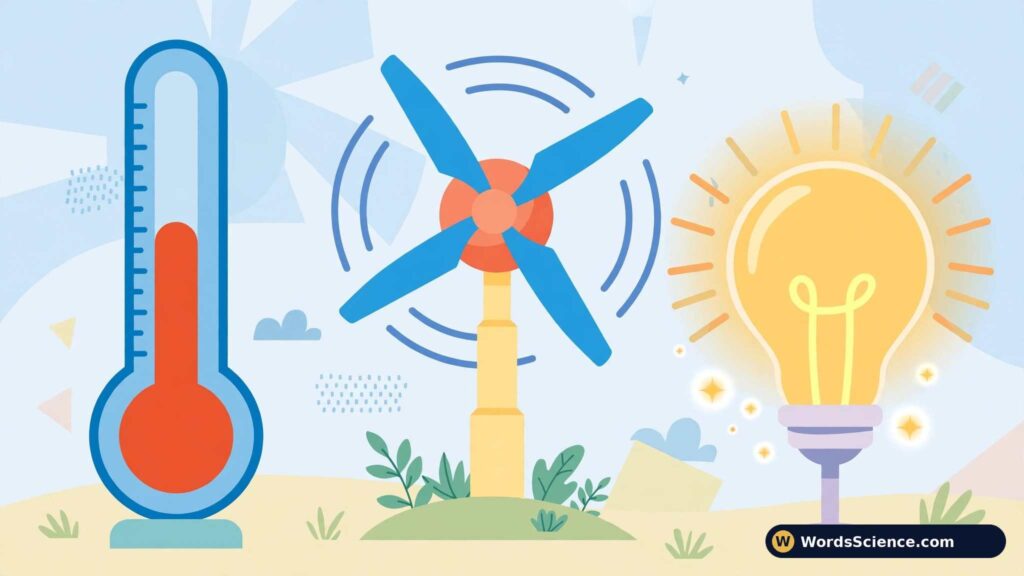
- Temperature – A measure of how hot or cold something is, linked to how fast its particles are moving.
- Tension – A pulling force that stretches an object, such as the force along a tight rope or cable.
- Tesla – The standard unit used to measure the strength of a magnetic field.
- Thermal energy – The energy stored in the jiggling motion of an object’s particles, which we feel as heat.
- Thermal expansion – The way most materials grow slightly larger when they are heated.
- Thermocouple – A device made of two different metals that produces a small electric voltage when heated, used to measure temperature.
- Thermometer – An instrument used to measure temperature, using a liquid column or a digital sensor.
- Thermosphere – A high layer of Earth’s atmosphere where temperatures climb sharply and auroras can appear.
- Thrust – A pushing force, especially the force from a rocket or jet engine that drives it forward.
- Tidal energy – Electricity generated from the rise and fall of ocean tides.
- Tone – The quality of a sound that lets you tell one instrument or voice from another playing the same note.
- Torque – A twisting force that makes an object rotate, such as the force a wrench applies to a bolt.
- Total internal reflection – When light traveling inside glass or water bounces completely off the inner surface instead of passing out.
- Transformer – A device that raises or lowers the voltage of an alternating electric current using coils of wire.
- Translucent – Letting some light pass through but scattering it, so you cannot see clearly through it, like frosted glass.
- Transmission – The passing of light, sound, or signals through a material or through space.
- Transparent – Letting light pass through clearly, so objects on the other side can be seen, like clean glass.
- Transverse wave – A wave in which the movement is side to side, at right angles to the direction the wave travels.
- Turbine – A machine with blades that spin when steam, water, or gas flows past, often used to generate electricity.
- Turbulence – Rough, swirling, uneven flow of air or water, like the bumps felt during an airplane flight.
Chemistry and Elements Words That Start With T
- Table salt – The common white seasoning used on food, a compound of sodium and chlorine with the chemical name sodium chloride.
- Tannin – A bitter natural chemical found in tea, bark, and unripe fruit that can stain materials and preserve leather.
- Tantalum – A very hard, blue-gray metal element that resists corrosion and is used in electronics and medical implants.
- Tar – A thick, dark, sticky liquid made by heating coal or wood without air.
- Technetium – The lightest element that has no stable form, because all of its isotopes are radioactive.
- Tellurium – A rare, brittle metalloid element used in solar panels and electronic devices.
- Terbium – A soft, silvery rare-earth metal element used in the green phosphors of screens and lamps.
- Test tube – A thin glass tube open at one end, used to hold, mix, and heat small amounts of chemicals.
- Thallium – A soft metal element that is highly poisonous and was once used in rat poison.
- Thermal decomposition – The breaking down of a substance into simpler parts by heating it.
- Thermite – A mixture of metal powders that burns extremely hot once lit, producing enough heat to melt steel.
- Thorium – A weakly radioactive metal element found in rocks that could one day be used as a nuclear fuel.
- Thulium – A rare-earth metal element, the least abundant of the rare earths that occur naturally.
- Tin – A soft, silvery metal element used to coat steel cans and to make solder for joining wires.
- Titanium – A strong, light metal element that resists rust and is used in aircraft, ships, and medical implants.
- Titration – A laboratory method that adds one solution slowly to another to measure exactly how much of a substance is present.
- Toluene – A clear liquid chemical made from petroleum, used as a solvent in paints and glues.
- Transition metal – One of the elements in the middle block of the periodic table, such as iron, copper, or titanium.
- Tritium – A rare radioactive form of hydrogen that has two neutrons in its nucleus, used in some glowing watch dials.
- Tungsten – A very hard metal element with the highest melting point of all metals, used in light bulb filaments.
Earth and Nature Words That Start With T
- Taiga – The vast belt of conifer forests that stretches across cold northern lands just below the tundra.
- Talc – The softest mineral on Earth, ground into the fine powder used in talcum powder.
- Talus – A sloping pile of broken rock pieces that collects at the base of a cliff or steep slope.
- Tarn – A small mountain lake left behind in a hollow carved out by a glacier.
- Tectonic plates – The huge slabs of rock that make up Earth’s outer shell and move very slowly over time.
- Tephra – The pieces of rock and ash thrown into the air by an erupting volcano.
- Terrace – A flat step cut into a hillside, formed by nature or built by farmers to grow crops on slopes.
- Thaw – The melting of ice and snow that happens when temperatures rise above freezing.
- Thermocline – A layer in a lake or ocean where the temperature drops quickly as you go deeper.
- Thunderstorm – A storm with thunder, lightning, and heavy rain, sometimes with strong wind or hail.
- Tidal flat – A muddy or sandy shore area that is covered by water at high tide and exposed at low tide.
- Tide – The regular rise and fall of the sea level, caused mainly by the pull of the Moon’s gravity.
- Till – A jumbled mixture of clay, sand, and stones dropped directly by a melting glacier.
- Topography – The shape and features of a land surface, such as its hills, valleys, and plains.
- Topsoil – The upper, dark layer of soil, rich in nutrients, where most plants grow.
- Tornado – A violent, spinning column of air that stretches from a thunderstorm cloud down to the ground.
- Trade winds – Steady winds in the tropics that blow from the east toward the equator.
- Trench – A long, deep valley in the ocean floor, formed where one tectonic plate slides under another.
- Tributary – A smaller river or stream that flows into a larger river.
- Tropics – The warm region of Earth around the equator, lying between two imaginary lines called the Tropic of Cancer and the Tropic of Capricorn.
- Tsunami – A series of huge ocean waves caused by an underwater earthquake, landslide, or volcanic eruption.
- Tundra – A cold, treeless land near the poles where the ground below the surface stays frozen all year.
Animal and Plant Words That Start With T
- Tadpole – The swimming young stage of a frog or toad, which has a tail and no legs.
- Taproot – A thick main root that grows straight down into the soil, like the root of a carrot.
- Tarantula – A large, hairy spider, some kinds of which live in burrows in warm, dry places.
- Termite – A small, pale insect that lives in large colonies and feeds on wood and other plant material.
- Tern – A slim seabird with long wings and a forked tail, known for making very long migration flights.
- Terrapin – A small turtle that lives in fresh or slightly salty water.
- Thicket – A dense group of bushes and small trees growing closely together.
- Thistle – A prickly plant with spiny leaves and purple, brush-like flowers.
- Thorn – A sharp, pointed growth on a plant stem that helps protect the plant from hungry animals.
- Thrush – A songbird known for its rich, flute-like song, some kinds of which have speckled breasts.
- Tick – A tiny blood-sucking arachnid that attaches itself to animals and people and can spread disease.
- Tiger – The largest wild cat in the world, an orange hunter with black stripes that lives in Asia.
- Toad – A frog-like amphibian with dry, warty skin that spends most of its life on land.
- Tortoise – A land turtle with a high, domed shell and a slow, steady walk.
- Toucan – A rainforest bird of Central and South America with a huge, brightly colored beak.
- Tree – A tall plant with a single woody trunk and branches that can live for many years.
- Tendril – A thin, curling stem or leaf part that a climbing plant uses to grip onto supports.
- Trilobite – An extinct sea animal with a segmented, armored body, one of the earliest animals with a hard shell.
- Trout – A freshwater fish related to salmon, prized as food and in sport fishing.
- Trunk – An elephant’s long nose, used for breathing, smelling, drinking, and grabbing things.
- Tulip – A spring garden flower with cup-shaped blooms that grows from a bulb.
- Tuna – A large, fast-swimming ocean fish that is popular as food around the world.
- Turkey – A large North American bird raised for food, known for its fan-shaped tail feathers.
- Turtle – A reptile with a hard shell that protects its body, living on land or in water.
Human Body and Health Words That Start With T
- Taste – The sense that lets you tell flavors apart, using the tongue and working together with smell.
- Taste buds – Tiny sense organs on the tongue that detect sweet, salty, sour, bitter, and umami flavors.
- Tears – The salty liquid made by glands near the eyes that keeps the eyes moist and washes away dust.
- Teeth – The hard, white structures in the mouth used for biting and chewing food.
- Tendon – A tough cord of tissue that connects a muscle to a bone.
- Testes – The male reproductive organs that make sperm and the hormone testosterone.
- Tetanus – A dangerous illness caused by bacteria entering a wound, which makes the muscles lock stiff.
- Thalamus – A structure deep in the brain that relays signals from the senses to other parts of the brain.
- Thermoregulation – The body’s process of keeping its internal temperature steady, by sweating, shivering, and adjusting blood flow.
- Thorax – The chest part of the body, between the neck and the abdomen, which holds the heart and lungs.
- Throat – The front part of the neck and the passage inside it that carries both air and food.
- Thymus – A small gland behind the breastbone where certain white blood cells mature and learn to fight germs.
- Thyroid – A butterfly-shaped gland in the front of the neck that makes hormones controlling how fast the body uses energy.
- Tibia – The larger of the two bones in the lower leg, also called the shinbone.
- Tissue – A group of similar cells in the body that work together to do one particular job.
- Toes – The five small digits at the end of each foot that help the body balance and walk.
- Tongue – The strong muscle in the mouth used for tasting, speaking, and moving food around.
- Tonsils – Two soft lumps of tissue at the back of the throat that help trap germs entering the body.
- Trachea – The tube that carries air from the throat down to the lungs, also called the windpipe.
- Triceps – The large muscle at the back of the upper arm that straightens the elbow.
- Tumor – An abnormal lump of tissue that grows when body cells multiply out of control.
- Typhoid – A serious illness caused by bacteria spread through dirty water or food.
Science Words That Start With T at a Glance
| Category | Number of Words | One Example |
|---|---|---|
| Space and Astronomy | 20 | Telescope |
| Physics and Energy | 20 | Temperature |
| Chemistry and Elements | 20 | Titanium |
| Earth and Nature | 22 | Tide |
| Animals and Plants | 24 | Tiger |
| Human Body and Health | 22 | Tongue |
Keep building your science vocabulary letter by letter. Step back to science words that start with S to review the letter before T, then move on to science words that start with U to keep your word list growing.
Frequently Asked Questions
What is the most common science word that starts with T?
Temperature is one of the most common, because people check it every day for weather, cooking, and health. Tree, teeth, and tide are also used very often in school science.
How many science words start with the letter T?
T is one of the richest letters in science vocabulary, and this glossary lists 128 useful scientific terms. Most learners study one category at a time, starting with the group they need for school.
What does temperature mean in simple words?
Temperature tells you how hot or cold something is, and it depends on how fast the tiny particles inside it are moving. The faster the particles move, the higher the temperature.
What is a telescope in simple words?
A telescope is a tool that gathers light to make faraway objects look bigger and brighter. It lets scientists study planets, stars, and galaxies that the eye alone cannot see clearly.
What is a fun T science word for kids?
Many learners enjoy the tiger, the largest wild cat in the world, with its bright orange coat and black stripes. The giant moon Titan and the swimming tadpole are also fun words to learn early.
Conclusion
T is only the twentieth letter of the alphabet, but its scientific terms already reach every branch of science, from the telescopes watching distant galaxies to the tongue inside your mouth. Use three simple steps: first, learn the everyday words, such as temperature, tree, and teeth; next, study one category each day and say every word aloud; last, write one short sentence with each new word so the meanings stay in your memory. Students, teachers, and ESL learners who review a little every day build strong science vocabulary fast. To explore the most important T tool in depth, read the full encyclopedia guide to the telescope and how this single invention opened the universe to human eyes.