
Mashallah Meaning | What It Means in Text and Chat
The Mashallah meaning is commonly understood as “what God has willed” or “as God has willed.” It is an Arabic expression used to show admiration, appreciation, or praise for something good. The phrase carries a religious and cultural meaning in many Muslim communities.
In everyday conversation, people may say Mashallah after seeing a beautiful child, hearing good news, or celebrating an achievement. The Mashallah meaning in text is usually the same as in spoken conversation. On social media, it can also express a warm and respectful positive reaction.
This article explains what does Mashallah mean and how people use the phrase naturally. You will learn when to say it, how to reply, and how its tone can change with context. You will also see how Mashallah works in chat, social media, and everyday communication.
What Does Mashallah Mean?
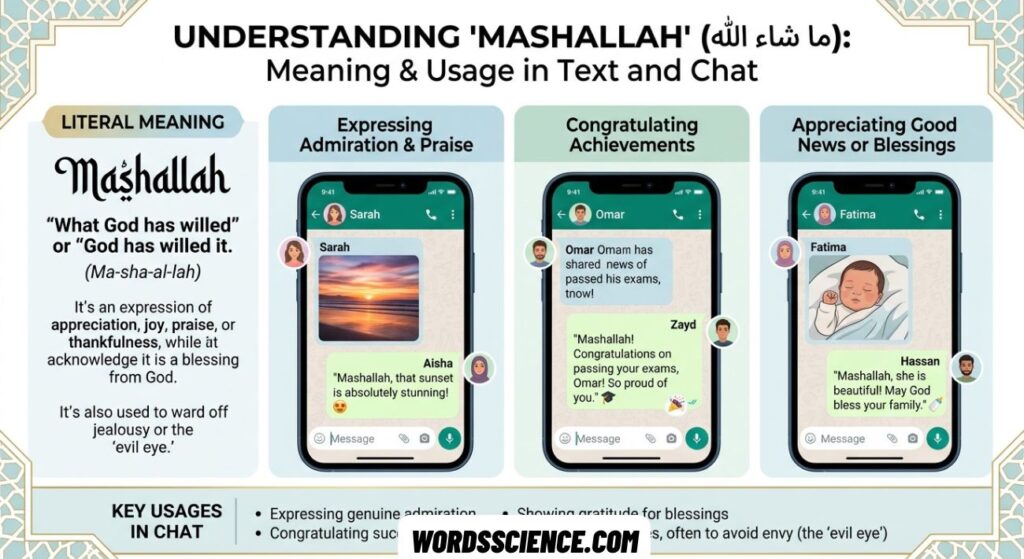
What does Mashallah mean? The phrase expresses admiration for something while acknowledging that it exists or happened according to God’s will. In simple English, it can convey an idea such as “How wonderful,” “What God has willed,” or “God has willed it.”
The phrase has both a religious expression and a cultural expression in many Muslim communities. Someone might say it after seeing a beautiful child, hearing about a person’s success, admiring a new home, or looking at a family photo.
Mashallah is not simply a synonym for “beautiful” or “congratulations.” Its meaning includes a religious dimension. The speaker is expressing positive appreciation while connecting the good thing being admired with God’s will.
Mashallah Meaning in Text and Chat
Mashallah meaning in text is usually similar to its meaning in spoken conversation. A person may type “Mashallah!” after receiving a photo, hearing positive news, or seeing someone’s achievement.
For example:
“I finally finished my degree!”
A friend might reply:
“Mashallah! Congratulations!”
Here, the word shows admiration, praise, and congratulations. It can make the response feel warmer and more respectful, especially between people who understand its Islamic or cultural meaning.
In Mashallah meaning in chat, capitalization, punctuation, and emojis can change the tone slightly. “Mashallah!” may sound enthusiastic, while “Mashallah 😊” can feel warm and friendly. The basic meaning remains the same.
What Does Mashallah Stand For?
What does Mashallah stand for? It comes from the Arabic phrase mā shāʾ Allāh, which is commonly translated as “what God has willed” or “as God has willed.”
The phrase is associated with recognizing God’s will when reacting positively to something. It is therefore more than casual praise. In Islamic usage, it can express admiration without treating the admired person or thing as independent of God.
You may also see the phrase written in different ways, including Masha Allah, Ma Sha Allah, Mā shāʾ Allāh, or Mashallah. These spellings refer to the same Arabic expression in English-language writing.
When Do People Say Mashallah?
People say Mashallah when they want to show sincere admiration or appreciation for something positive. The situation can range from an everyday compliment to a meaningful family or religious occasion.
It is commonly associated with a positive reaction to a child’s growth, someone’s appearance, a new home, academic success, professional achievement, or other good news. The speaker’s intention is usually respectful rather than casual slang.
1. Admiration
Someone may say Mashallah when admiring something beautiful or impressive.
For example, a person might see a friend’s new house and say, “Mashallah, your home looks beautiful.”
In this situation, the expression communicates appreciation while recognizing God’s will. It can function as a respectful form of praise.
2. Congratulations
Mashallah can also appear alongside congratulations when someone achieves something important.
For example:
“Mashallah! You graduated with honors. Congratulations!”
The phrase does not replace the word “congratulations.” Instead, both expressions can work together. “Congratulations” focuses on the achievement, while Mashallah adds the religious or cultural expression of admiration.
3. Appreciation for a Child
Parents, relatives, and friends may use Mashallah when admiring a child.
Someone seeing a family photograph might write:
“Mashallah, your little one has grown so much!”
Here, the phrase expresses warm appreciation for the child. In many Muslim communities, this is a familiar way to respond positively to a child’s appearance, growth, or accomplishments.
4. Appreciation for an Achievement
Mashallah may also be used after academic, professional, athletic, or personal achievements.
For example:
“Mashallah, you worked so hard and finally passed the exam!”
The phrase communicates admiration for the person’s success without treating the achievement as separate from God’s will.
Mashallah on Social Media and Different Platforms
Mashallah on social media is often used as a short positive comment. People may post it under photographs, achievement announcements, family updates, or other good news.
On Instagram, someone might comment “Mashallah” under a graduation picture. On TikTok, the phrase may appear in comments when viewers admire someone’s talent, appearance, family, or achievement. It can also appear on Snapchat and WhatsApp in messages between friends and relatives.
Mashallah meaning on TikTok is generally not a special TikTok definition. It usually keeps its ordinary Arabic and Islamic meaning, although the surrounding video, caption, emojis, and conversation can affect the tone.
Likewise, Mashallah meaning in chat does not change simply because the phrase is typed instead of spoken. The platform changes the format, not the basic meaning.
See Also : Caveat Meaning | What Does Caveat Mean?
Real Conversation Examples
The following examples show how Mashallah can sound in different everyday situations.
1: Friends
Person A: “I finally got my first job!”
Person B: “Mashallah! That’s amazing. Congratulations!”
Meaning: Person B is showing admiration and congratulating their friend on the achievement.
2: Family
Person A: “Here’s a photo of my daughter on her first day of school.”
Person B: “Mashallah, she looks so happy!”
Meaning: The speaker is expressing warm appreciation for the child.
3: Social Media
Person A posts: “Graduation day! 🎓”
Person B comments: “Mashallah! Congratulations on this achievement.”
Meaning: The comment combines admiration, praise, and congratulations in a respectful way.
Is Mashallah Rude?
Is Mashallah rude? Usually, no. It is generally a respectful and positive expression, especially when used appropriately in an Islamic or Muslim cultural context.
However, context matters. A person who does not understand the phrase might interpret an unfamiliar religious expression differently. Tone can also change if someone uses the word sarcastically or mockingly.
The phrase itself is not inherently rude. Its effect depends on the speaker’s intention, the situation, and the relationship between the people communicating.
Is Mashallah a Compliment?
Is Mashallah a compliment? It can function as part of a compliment, but it has a broader meaning than an ordinary compliment.
For example, saying “Mashallah, your new home is beautiful” combines admiration for the home with recognition of God’s will. The expression therefore adds a religious or cultural meaning to the positive reaction.
A person can also use Mashallah with congratulations, praise, or appreciation. It does not necessarily describe exactly what is being praised; the surrounding sentence usually provides that detail.
How to Reply to Mashallah
There is no single required response to Mashallah. The best reply depends on the situation, the relationship between the speakers, and how religious or casual the conversation is.
Friendly Replies
In a casual conversation, a simple response can work well:
“Thank you!”
“Thanks, I really appreciate it.”
“Thank you! That means a lot.”
If the conversation is between people who commonly use Arabic or Islamic phrases, the response may also include another familiar expression.
Warm or Respectful Replies
In a more religious or culturally familiar setting, someone might respond with a respectful expression such as “Alhamdulillah,” meaning “praise be to God.”
For example:
Person A: “Mashallah, you did a great job.”
Person B: “Alhamdulillah, thank you!”
The two expressions can appear together naturally, but they do not mean exactly the same thing. The appropriate response depends on the speaker and context.
When to Use Mashallah
Use Mashallah when you want to express sincere admiration, appreciation, or praise while acknowledging God’s will. It can fit naturally when responding to positive news, a beautiful family moment, a child’s achievement, a new home, an academic success, or another good thing.
It is especially natural when speaking with people who understand its Islamic phrase and cultural meaning. If you are not part of the relevant religious or cultural context, it is also reasonable to learn how the expression is used before adopting it.
The key is sincerity and respect. Mashallah should sound like a genuine positive reaction rather than a random word added to a sentence.
When to Avoid Mashallah
Avoid using Mashallah as a joke, insult, or deliberately exaggerated reaction. Because it has religious significance, using it in a mocking way can be disrespectful.
You should also avoid assuming that every Arabic speaker or Muslim uses the phrase in exactly the same situations. Religious practices and everyday language can vary among individuals, families, cultures, and communities.
If you are unsure whether it fits a particular conversation, a simple phrase such as “That’s wonderful” or “Congratulations” may be clearer.
Common Mistakes About Mashallah
One common mistake is treating Mashallah as ordinary slang. It is a meaningful Muslim expression with religious and cultural associations.
Another mistake is assuming that Mashallah always means “beautiful.” It can express admiration for beauty, but it can also accompany congratulations, appreciation, or praise for an achievement.
Some people also confuse Mashallah with Alhamdulillah, Inshallah, and Subhanallah. These are related expressions within Islamic culture, but they have different meanings and uses.
Another mistake is assuming that writing Mashallah online gives it a completely different meaning. Whether it appears on Instagram, TikTok, Snapchat, WhatsApp, or in a private text, the basic expression remains connected to its original meaning.
Similar Expressions and Their Differences
Several Arabic and Islamic expressions may appear in similar conversations, but they are not interchangeable.
Mashallah is commonly used when expressing admiration for something that exists or has happened, with recognition of God’s will.
Alhamdulillah means “praise be to God” and is commonly used to express gratitude or praise to God, including after receiving good news or when describing one’s condition positively.
Inshallah means “if God wills” and is generally used when discussing a hoped-for or planned future event.
Subhanallah is commonly translated as “glory be to God” and can express awe, wonder, or recognition of God’s perfection.
For example, someone might say “Mashallah” when admiring a child’s achievement, “Alhamdulillah” when expressing gratitude for good news, and “Inshallah” when talking about something they hope will happen in the future.
Origin and Meaning in Islamic Usage
Mashallah comes from Arabic and is written as مَا شَاءَ ٱللَّٰهُ in Arabic script. The transliteration mā shāʾ Allāh reflects the Arabic wording more closely than the simplified English spelling “Mashallah.”
The phrase has a recognized place in Islamic usage and is associated with acknowledging God’s will. It is also widely familiar as a cultural expression among many Muslim communities.
Its use should therefore be understood in both a religious context and a cultural context. English speakers may encounter it in everyday conversation, family messages, online comments, and other settings where Arabic or Muslim expressions are common.
The exact way people use religious terminology can vary. Some people use Mashallah frequently in everyday speech, while others use it less often. Understanding the basic meaning is more useful than assuming that everyone follows one identical pattern.
Mashallah Meaning for Different Situations
Mashallah can be used when someone wants to show admiration for a person’s success, appearance, family, or another positive moment. The expression connects that appreciation with the idea of God’s will.
The exact meaning can depend on the situation. In a friendly chat, it may sound warm and casual, while in a religious setting, it can carry a deeper spiritual meaning.
Mashallah Meaning for Beauty and Appearance
People may say Mashallah when they admire someone’s appearance, a beautiful child, or a lovely family photo. It can express sincere appreciation without being limited to one specific type of compliment.
For example, someone might comment “Mashallah, you look beautiful” on a photo. In this use, Mashallah adds a respectful religious or cultural meaning to the compliment.
Mashallah Meaning After Good News
Mashallah can be used after hearing positive news about school, work, family, or personal achievements. It can show that the speaker is happy about the person’s success and recognizes God’s will.
For example, a friend might say, “Mashallah, you got the promotion!” This combines praise and congratulations while keeping the expression respectful and positive.
Mashallah Meaning in Everyday Conversation
In everyday conversation, Mashallah may appear naturally when people talk about something they admire or appreciate. It can be used between friends, relatives, coworkers, or members of a wider Muslim community.
The expression is not limited to formal religious conversations. It can also appear in texts, social media comments, and casual chats, as long as the speaker uses it sincerely and understands its cultural and religious meaning.
Quick Recap
Mashallah meaning is commonly understood as “what God has willed” or “as God has willed.” It is an Arabic expression used to show admiration, appreciation, praise, or a positive reaction while recognizing God’s will.
In text, chat, and social media, Mashallah usually keeps the same basic meaning. It can appear after good news, a child’s achievement, a beautiful family photo, a new home, or another positive moment. It is generally respectful rather than rude, but context and personal religious or cultural practice still matter.
FAQs
Do I say Mashallah or Alhamdulillah?
Say Mashallah when admiring something good, while Alhamdulillah is used to express gratitude or praise to God.
When can you say Mashallah?
You can say Mashallah when admiring someone’s beauty, success, child, home, or another positive thing while recognizing God’s will.
Why do Muslims always say Mashallah?
Many Muslims use Mashallah as a respectful religious expression of admiration that acknowledges God’s will when reacting to something positive.
Does Mashallah mean beautiful?
No, Mashallah does not literally mean “beautiful”; it means “what God has willed” and can be used when praising something beautiful.
Final Thoughts
The Mashallah meaning centers on “what God has willed” or “as God has willed.” It is an Arabic religious and cultural expression used to show admiration, appreciation, praise, or a positive reaction to something good. People may use it for a beautiful child, family moment, new home, success, or achievement. In text and chat, the meaning usually stays the same.
When using Mashallah, context and tone matter. It is generally respectful when used sincerely and appropriately, especially among people familiar with its Islamic meaning. The phrase can appear in conversation, comments, or messages, including Mashallah on social media. If someone says it to you, “Thank you” can also work well. Understanding the context helps you use Mashallah naturally and respectfully.