Agnostic Meaning | What Does Agnostic Mean?
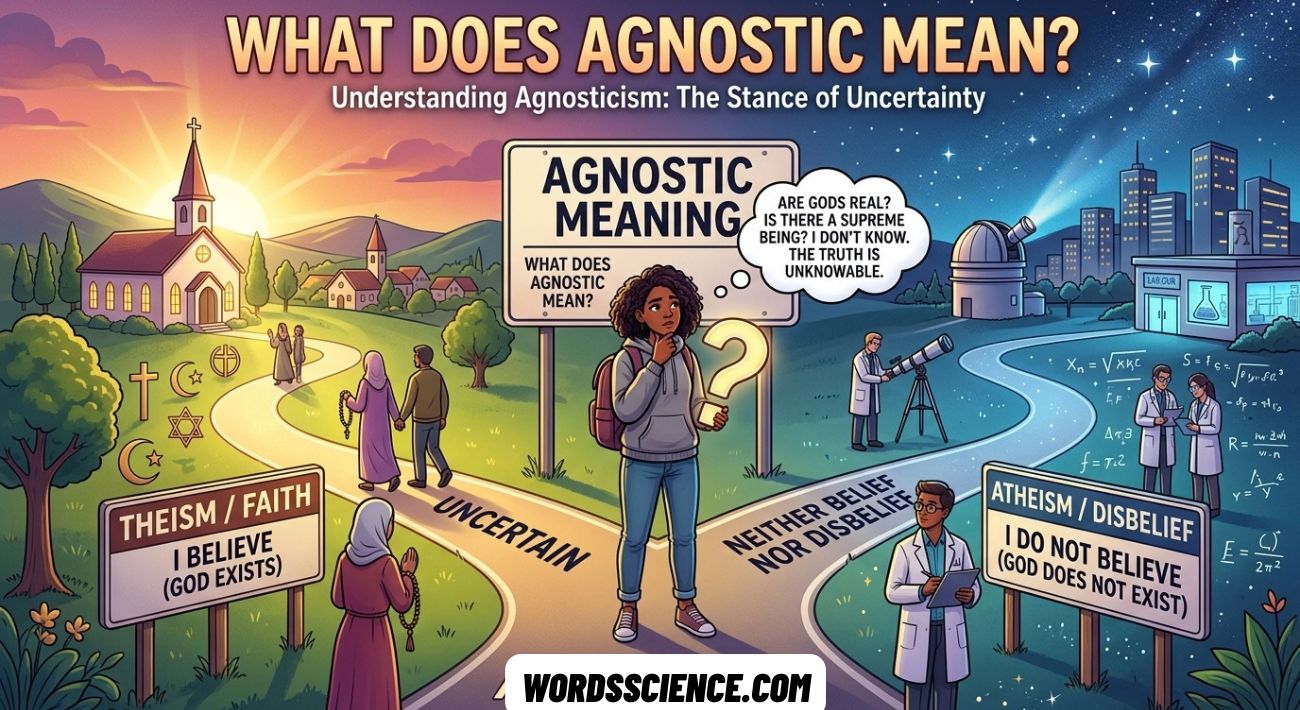
Agnostic meaning refers to a position of uncertainty about whether God, gods, or other supernatural realities exist. An agnostic person does not claim to have certain knowledge about these questions. The term focuses mainly on the limits of knowledge rather than a simple religious belief.
In everyday conversations, “agnostic” usually describes someone who is unsure about religious questions or does not believe the answer can be known with certainty. In texting and social media, it generally keeps the same meaning, although context can change how the word is understood. Outside religion, agnostic can also describe something independent of a particular platform, system, or option.
This article explains what does agnostic mean with simple definitions and real conversation examples. It also covers agnostic vs atheist, common uses, tone, and how to reply when someone says, “I’m agnostic.” You will also learn how the term works in different contexts, including texting, social media, religion, and technology.
What Does Agnostic Mean?
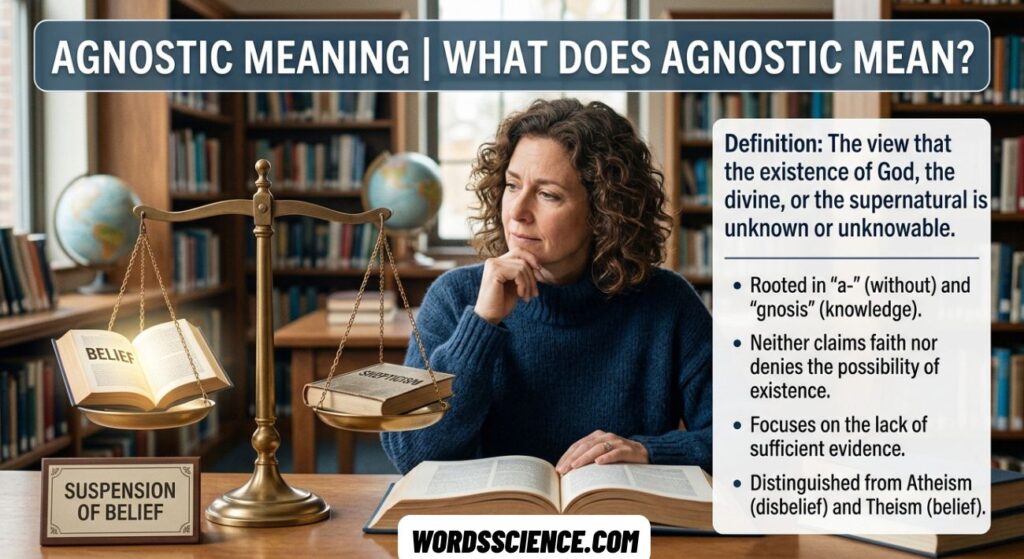
Agnostic describes a person or position that does not claim certain knowledge about whether God, gods, or other supernatural realities exist. The agnostic meaning is mainly connected to uncertainty about what humans can know, rather than a simple yes-or-no statement about religious belief.
An agnostic person may feel that there is not enough evidence to know whether God exists. Some people use the term because they remain uncertain, while others use it as a philosophical position about the limits of human knowledge.
For example, someone might say, “I don’t know if God exists, and I don’t think anyone can prove it.” That person may describe themselves as agnostic. The word itself does not automatically mean that the person follows a particular religion or rejects all religion.
Agnostic Meaning in Religion and Philosophy
In a religious context, agnostic usually refers to uncertainty about the existence of God or gods. An agnostic person may participate in religious traditions, avoid organized religion, or simply remain undecided.
In philosophy, agnosticism focuses more specifically on knowledge and certainty. It asks whether humans can know the answer to questions about supernatural claims. This makes an agnostic position different from simply saying, “I believe” or “I do not believe.”
There can also be different combinations of belief and knowledge. An agnostic atheist does not believe in God but does not claim to know with absolute certainty that no God exists. An agnostic theist believes in God while acknowledging that the existence of God cannot be known with complete certainty.
A Simple Example
Imagine two people discussing religion.
Person A: “I believe God exists.”
Person B: “I don’t know whether God exists, so I consider myself agnostic.”
Person B is expressing religious uncertainty. The statement does not necessarily mean that Person B thinks God does not exist. It means they do not claim certainty about the answer.
What Does Agnostic Mean Outside Religion?
The word agnostic can also describe a neutral or independent approach outside religious discussions. In these situations, it often means that something is not tied to one particular system, platform, device, technology, or option.
For example, platform-agnostic software is designed to work independently of a specific platform. Device-agnostic technology is not limited to one type of device. A vendor-agnostic approach does not depend on one particular technology provider.
These uses share the basic idea of independence. A person or system does not commit itself to one particular choice simply because that choice is available.
The meaning therefore depends strongly on the context. In a religious discussion, agnostic usually concerns knowledge about God or gods. In a technology context, it can mean independent of a particular system or provider.
How Context Changes the Meaning of Agnostic
Context helps readers understand which sense of agnostic is intended. In a conversation about religion, “I’m agnostic” normally refers to uncertainty about religious or supernatural questions.
In a technology discussion, “This tool is platform-agnostic” has nothing to do with religion. It means the tool is designed to operate independently of a particular platform.
The same general idea appears in phrases such as technology-agnostic, cloud-agnostic, vendor-agnostic, and ideology-agnostic. Each phrase describes something that is not restricted to one particular system, provider, or viewpoint.
For this reason, readers should look at the surrounding words before interpreting agnostic meaning. The topic of the conversation usually makes the intended sense clear.
Agnostic Meaning in Text and Chat
In texting, chat, or a casual conversation, “agnostic” usually keeps its standard English meaning. It is not normally a special texting abbreviation or slang term.
If someone texts, “I’m agnostic,” they are most likely saying that they are uncertain about whether God or gods exist or that they do not claim to know the answer.
For example:
“Are you religious?”
“Not really. I’m agnostic.”
Here, the person is sharing a belief or philosophical position related to religion and knowledge.
On social media, including TikTok, the meaning is generally the same. Agnostic meaning on social media depends on the post and conversation, but the word itself does not have a separate secret meaning. A technology-related post can use agnostic in a completely different way.
Real Conversation Examples
1: Friends Discussing Religion
Person A: “Do you believe there is a God?”
Person B: “I’m agnostic. I don’t know enough to say for sure.”
Meaning: Person B is expressing uncertainty about the existence of God rather than claiming definite knowledge.
2: Workplace Technology Discussion
Person A: “Does this application work only with one operating system?”
Person B: “No, it’s platform-agnostic.”
Meaning: The application is designed to work independently of a particular platform.
3: Choosing Between Options
Person A: “Which software provider do you recommend?”
Person B: “Our process should be vendor-agnostic.”
Meaning: The decision should not depend on one specific vendor. The same standards can be applied to different options.
Is Agnostic Rude or Offensive?
No, agnostic is not inherently rude or offensive. It is a standard English term used to describe a philosophical or religious position, as well as certain forms of technological independence.
However, the tone of a conversation can affect how a statement is received. Religious discussions can involve deeply personal beliefs, so a dismissive or mocking comment may sound disrespectful even when the word agnostic itself is neutral.
Saying “I’m agnostic” is generally a straightforward way to describe your own position. It does not automatically criticize another person’s religion or belief.
Is Agnostic the Same as Atheist?
No. Agnostic vs atheist describes two different ideas, although one person can identify as both.
Agnosticism is primarily concerned with knowledge or certainty. Atheism is generally concerned with belief in God or gods. An agnostic person may say, “I don’t know whether God exists.” An atheist may say, “I don’t believe in God.”
Because knowledge and belief are not exactly the same thing, someone can be an agnostic atheist. That person does not believe in God but also does not claim absolute knowledge that no God exists.
Likewise, an agnostic theist may believe in God while accepting that God’s existence cannot be established with complete certainty.
| Term | Main idea |
|---|---|
| Agnostic | Uncertain about what can be known about God or gods |
| Atheist | Does not hold a belief in God or gods |
| Theist | Believes in God or gods |
| Agnostic atheist | Does not believe in God but does not claim certainty that no God exists |
| Agnostic theist | Believes in God while acknowledging uncertainty about knowledge |
So, “Is agnostic the same as atheist?” has a simple answer: no. The terms address different aspects of a person’s position.
How to Reply to Someone Who Says “I’m Agnostic”
A respectful response depends on the situation and your relationship with the person. You do not need to debate their position. If the conversation is casual, a simple acknowledgment can be enough.
Friendly Replies
You can respond naturally with phrases such as:
“That makes sense.”
“Thanks for sharing.”
“I understand.”
“That’s a personal choice, and I respect it.”
These replies keep the conversation friendly without assuming what the person believes.
Polite Replies When You Are Curious
If you genuinely want to understand their position, you can ask an open and respectful question.
You could say, “What led you to that view?” or “Do you mean you’re unsure, or that you don’t think the answer can be known?”
The second question can be especially useful because people use the word agnostic in slightly different ways. Asking for clarification is better than assuming what someone means.
When to Use the Term Agnostic
Use agnostic when you want to describe uncertainty or a position about the limits of knowledge, especially in discussions involving God, gods, religion, or philosophy.
It can also be appropriate in technical language when something is designed to remain independent of a particular system. For example, platform-agnostic and vendor-agnostic are common ways to describe technology or decision-making approaches that are not tied to one option.
In everyday conversation, use the word when it accurately describes the situation. If the audience may not know the term, a short explanation can make your meaning clearer.
See Also ; WTV Meaning | What Does WTV Mean in Text?
When to Avoid the Term
Avoid using agnostic when you actually mean a different idea. For example, someone who simply dislikes organized religion is not automatically agnostic. Likewise, someone who has never thought about religion is not necessarily agnostic.
In technology, avoid using the word if you mean that a product works with only one specific platform or provider. Calling something platform-agnostic when it is platform-dependent can create confusion.
The safest approach is to use the term when its meaning matches the situation and explain your intended meaning when the context is unclear.
Common Mistakes About Agnostic
One common mistake is assuming that an agnostic person is automatically an atheist. The two concepts can overlap, but they are not identical.
Another mistake is thinking that agnostic means “I don’t believe in God.” That statement describes a belief position, while agnosticism focuses on uncertainty or the limits of knowledge. A person can believe in God and still describe themselves as agnostic.
It is also incorrect to assume that every use of agnostic concerns religion. In technology and other fields, the word can mean independent of a particular system, platform, or provider.
A final mistake is treating agnosticism as simply refusing to make a decision. For some people, uncertainty is a deliberate philosophical position based on what they believe can or cannot be known.
Similar Terms to Agnostic
Several terms are related to agnostic, but they are not interchangeable.
Skeptic usually refers to someone who questions claims and looks for sufficient evidence. A skeptic can be religious, nonreligious, agnostic, or atheist.
Atheist generally refers to someone who does not hold a belief in God or gods. This differs from agnostic, which focuses more directly on knowledge and certainty.
Theist refers to someone who believes in God or gods. An agnostic theist combines belief with an acknowledgment of uncertainty about knowledge.
Uncertain is a broader everyday word. Someone can be uncertain about almost anything, while agnostic is commonly used for a particular philosophical or religious position.
These terms can overlap, but their meanings should not be treated as identical.
Origin and Broader Use of Agnostic
The word agnostic is associated with the English biologist and philosopher Thomas Henry Huxley, who introduced the term in the nineteenth century. It comes from Greek roots related to the idea of not knowing or lacking knowledge.
Huxley’s use of the term was connected to questions about what humans can know, especially regarding religious and supernatural claims. Over time, agnostic became a widely used term in religious and philosophical discussions.
Its broader meaning developed through the same basic idea of independence from a fixed position. That is why modern expressions such as platform-agnostic, technology-agnostic, and vendor-agnostic can describe systems or approaches that do not depend on one particular option.
Understanding the origin of agnostic helps explain why both its religious and nonreligious uses are connected to uncertainty, neutrality, or independence.
Agnostic Meaning in Simple Words
Agnostic means a person is not certain whether God or gods exist. They may believe the answer cannot be known with complete certainty, so they remain open or uncertain.
In simple words, an agnostic person does not claim to know the truth about religious questions. Their position can be based on uncertainty, personal reasoning, or the limits of human knowledge.
Can Agnostic Have Different Meanings?
Yes, agnostic can have different meanings depending on the context. In religion and philosophy, it usually describes uncertainty about the existence of God or what humans can know about supernatural claims.
Outside religion, agnostic can mean independent of a particular system or choice. For example, a technology-agnostic tool is not limited to one technology, while a vendor-agnostic approach is not tied to one company.
Agnostic Meaning on Social Media
On social media, agnostic meaning usually stays close to its standard English meaning. Someone may write “I’m agnostic” in a post, comment, or profile to explain that they are uncertain about religious questions.
On platforms such as TikTok, the surrounding conversation helps explain the intended meaning. A religious video may use agnostic to discuss belief and knowledge, while a technology post may use it to mean independent of a particular platform or system.
Agnostic Full Form
Agnostic does not have a full form because it is a regular English word, not an abbreviation or acronym. The term comes from Greek roots connected with the idea of not knowing.
In religious and philosophical discussions, agnostic describes a position involving uncertainty about knowledge, especially concerning God or gods. It can also describe independence from a particular system in technical contexts.
Quick Recap
The agnostic meaning usually refers to uncertainty about whether God, gods, or other supernatural realities exist, especially when discussing the limits of human knowledge. It is not exactly the same as atheist, although a person can be both agnostic and atheist.
Outside religion, agnostic can describe something independent of a particular platform, technology, vendor, or system. In texting and social media, the word normally keeps its standard English meaning, so context is the best way to understand what someone intends.
FAQs
What Does “Agnostic” Mean in Simple Terms?
An agnostic is someone who is unsure whether God exists or believes this cannot be known for certain.
What Is the Difference Between Atheist and Agnostic?
An atheist does not believe in God, while an agnostic is unsure whether God exists.
Can Agnostics Believe in God?
Yes, some agnostics believe in God while also admitting they cannot know for certain that God exists.
What Does Agnosticism Mean?
Agnosticism is the view that the existence of God or a higher power is unknown or may be impossible to know for sure.
Final Thoughts
The agnostic meaning describes a position of uncertainty about whether God, gods, or supernatural realities exist. An agnostic person does not claim certain knowledge about these questions. The term focuses on the limits of knowledge, so it is not automatically the same as atheism or a specific religion.
In everyday English, texting, and social media, agnostic usually keeps this meaning, while context can give it a broader sense. It can also describe something independent of a particular platform, system, or option. Knowing the context helps you understand the intended meaning and tone. This guide explains what does agnostic mean through simple examples, common uses, and clear differences. It also helps with agnostic vs atheist, replies, and correct everyday usage clearly.