Science Words That Start With S: 120+ Scientific Terms With Simple Meanings
S is one of the biggest letters in science vocabulary. Science words that start with S appear in almost every topic, from the solar system high above us to the soil under our feet. This glossary collects them in one clean word list with short and simple meanings.
The words below are sorted into easy groups, such as space, energy, materials, the human body, Earth, and living things. Every word is beginner-friendly, and every meaning is written in plain, easy English. Students and teachers can use this list for lessons, homework, and quick revision.
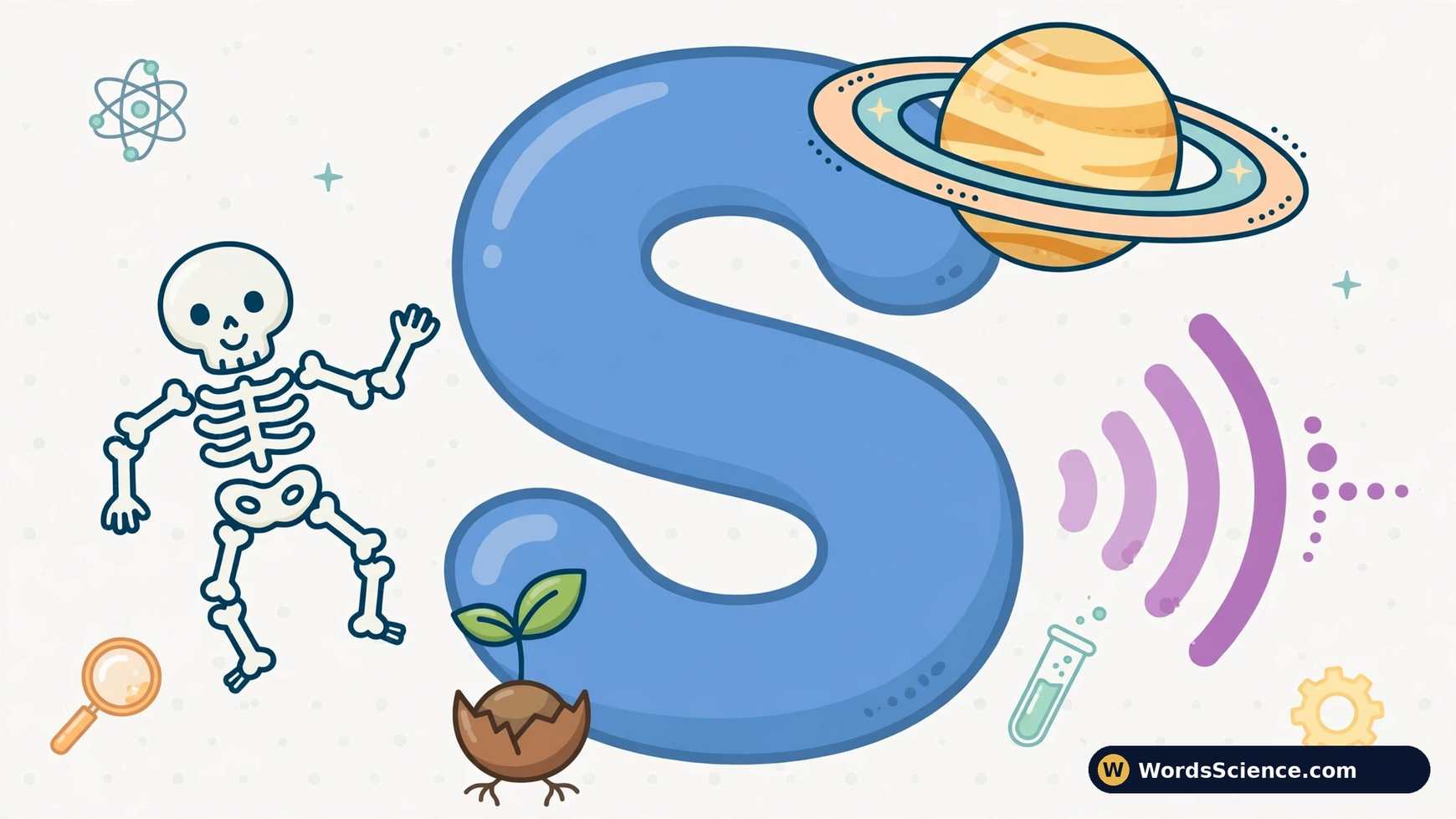
Some S words, like the skeleton, Saturn, and sound, appear in nearly every science class. Others, such as seed, sediment, and species, help you read science books and news with confidence.
Why Science Words That Start With S Matter
Strong science vocabulary makes every science lesson easier to follow. When students know the right scientific terms, they read textbooks faster, write better answers, and talk about science with confidence. For ESL learners, a clear word list with simple meanings takes away the fear of big, new words.
Teachers can use these S words for spelling practice, quizzes, and lab work, and science enthusiasts can enjoy how one letter covers everything from a tiny seed to the whole solar system. Writers also gain, because knowing exact terms like species for a group of living things and skeleton for the body’s frame makes any science text clearer and more correct.
Space and Astronomy Words That Start With S

- Sun – The star at the center of our solar system that gives Earth heat and light.
- Solar system – The Sun and all the planets, moons, and other objects that travel around it.
- Star – A huge ball of hot, glowing gas in space, like the Sun.
- Saturn – The sixth planet from the Sun, famous for its wide rings.
- Satellite – An object that travels around a planet, such as the Moon or a machine made by people.
- Solar eclipse – The event when the Moon moves in front of the Sun and blocks its light for a short time.
- Supernova – The huge explosion of a very large star at the end of its life.
- Shooting star – A bright streak of light made when a small piece of rock from space burns up in the air.
- Space – The huge, mostly empty area beyond Earth’s air where the planets and stars are found.
- Spacecraft – A vehicle made to travel and work in space.
- Space station – A large spacecraft where astronauts can live and work for a long time.
- Solar wind – A stream of tiny charged particles that flows out from the Sun into space.
- Sunspot – A dark, cooler patch that appears on the surface of the Sun.
- Solar flare – A sudden, bright burst of energy from the surface of the Sun.
- Sphere – A perfectly round, ball-shaped object, like a planet or a marble.
- Solstice – One of the two days each year when daytime is the longest or the shortest.
- Sirius – The brightest star that can be seen in the night sky.
- Starlight – The light that comes from a star.
- Supermoon – A full moon that looks bigger and brighter because it is nearer to Earth than usual.
- Sky – The space above Earth where the clouds, the Sun, the Moon, and the stars appear.
Physics and Energy Words That Start With S
- Sound – Vibrations that travel through air or water and can be heard by the ears.
- Speed – How fast something moves, measured as the distance covered in a set time.
- Solar energy – Energy that comes from the light and heat of the Sun.
- Static electricity – Electric charge that builds up on the surface of an object and can give a small shock.
- Switch – A device that opens or closes a circuit to turn electric current on or off.
- Short circuit – A fault in a circuit that lets electric current take a wrong, uncontrolled path.
- Sound wave – The wave of vibrations that carries sound through air, water, or solid objects.
- Shadow – A dark shape made when an object blocks light.
- Spring – A coil of metal wire that can be stretched or squeezed and pushes back with force.
- Steam – Water in the form of a hot gas, made when water boils.
- Solid – A state of matter with a fixed shape and size, like ice, wood, or rock.
- Spectrum – The band of colors made when light is spread out, as in a rainbow.
- Speed of light – The speed at which light travels, about 300,000 kilometers per second.
- Soundproof – Made in a way that stops sound from passing through.
- Solar cell – A device that turns sunlight directly into electricity.
- Series circuit – A circuit in which all the parts are joined in one single path.
- Simple machine – A basic tool with few or no moving parts, such as a lever or a pulley, that makes work easier.
- Screw – A simple machine made of a sloped plane wrapped around a pole, used to hold things together.
- Sonar – A system that uses sound waves to find objects under water.
- Sensor – A device that notices a change, such as light, heat, or movement, and sends a signal.
Chemistry and Materials Words That Start With S
- Salt – A white mineral compound, made from sodium and chlorine, used to flavor and preserve food.
- Sodium – A soft, silvery metal element that reacts strongly with water.
- Sulfur – A yellow element found near volcanoes, used in matches, medicines, and fertilizers.
- Silver – A shiny white metal used for jewelry, coins, and electrical parts.
- Silicon – An element used to make computer chips and glass.
- Steel – A strong metal made from iron mixed with a small amount of carbon.
- Solution – A mixture made when one substance dissolves evenly into a liquid.
- Solvent – The liquid that dissolves another substance to make a solution.
- Solute – The substance that gets dissolved in a liquid to make a solution.
- Suspension – A mixture in which tiny bits of a solid float in a liquid and slowly sink over time.
- Surface tension – The skin-like tightness on the surface of water that lets some insects walk on it.
- Soap – A substance that mixes with water and oil to lift dirt away from surfaces.
- Starch – A white substance in plants such as potatoes and rice that stores energy.
- Sugar – A sweet substance made by plants that gives the body quick energy.
- Synthetic – Made by people in a lab or factory instead of being found ready-made in nature.
- Smoke – Tiny bits of solid and gas that rise into the air when something burns.
- Sublimation – The change of a solid straight into a gas without first becoming a liquid.
- Saturated solution – A solution that cannot dissolve any more of a substance at that temperature.
- Soot – The black powder left behind when wood, coal, or oil burns.
- Soluble – Able to dissolve in a liquid, the way sugar dissolves in water.
Human Body and Health Words That Start With S
- Skeleton – The full set of bones that supports the body and protects the organs inside.
- Skull – The bone that forms the head and protects the brain.
- Skin – The soft outer layer that covers and protects the whole body.
- Spine – The long chain of small bones down the middle of the back.
- Spinal cord – The thick bundle of nerves inside the spine that carries messages between the brain and the body.
- Stomach – The organ where food is mixed and broken down after it is swallowed.
- Sense – One of the five ways the body picks up information: sight, hearing, smell, taste, and touch.
- Sight – The sense that lets the eyes see light, color, and shape.
- Smell – The sense that lets the nose notice odors in the air.
- Skeletal muscle – A muscle joined to bones that moves the body when you decide to move.
- Smooth muscle – A muscle inside organs such as the stomach that works on its own without thinking.
- Sweat – The salty liquid the skin makes to cool the body when it gets hot.
- Saliva – The liquid in the mouth that softens food and starts digestion.
- Shinbone – The long bone at the front of the lower leg.
- Shoulder – The joint where the arm joins the top of the body.
- Symptom – A sign of an illness, such as a cough, a fever, or pain.
- Sneeze – A sudden burst of air from the nose and mouth that pushes out dust or germs.
- Sprain – An injury that happens when a joint is twisted and the bands holding it are stretched.
- Sterile – Completely free of living germs, like the cleaned tools a doctor uses.
- Sunburn – Red, sore skin caused by staying in strong sunlight for too long.
Earth and Nature Words That Start With S
- Soil – The top layer of Earth where plants grow, made of broken rock, dead plant matter, air, and water.
- Sediment – Small bits of rock, sand, and mud that settle at the bottom of water.
- Sedimentary rock – Rock formed slowly when layers of sediment are pressed together over a long time.
- Sand – Tiny grains of broken rock found on beaches, in deserts, and at the bottom of rivers.
- Sandstone – A rock made from grains of sand that were pressed and stuck together.
- Slate – A grey rock that splits easily into thin, flat sheets.
- Shale – A soft rock made from mud that splits into thin layers.
- Stream – A small, flowing body of water, smaller than a river.
- Sea – A large body of salt water that is smaller than an ocean.
- Seafloor – The ground at the bottom of a sea or an ocean.
- Season – One of the four parts of the year, spring, summer, autumn, and winter, caused by Earth’s tilt.
- Snow – Soft white flakes of frozen water that fall from the sky in cold weather.
- Sleet – Tiny grains of ice or a mix of rain and snow that falls from the sky.
- Storm – Strong weather with heavy rain or snow, powerful winds, and sometimes thunder and lightning.
- Stratosphere – The layer of Earth’s air above the weather clouds, where the ozone layer sits.
- Seismograph – A machine that measures and records the shaking of the ground during an earthquake.
- Seismic wave – A wave of energy that travels through the ground during an earthquake.
- Sinkhole – A hole that opens in the ground when the rock below it wears away or falls in.
- Swamp – Land that is mostly covered with shallow water and thick plants.
- Savanna – A wide, flat grassland with few trees, found in warm regions such as Africa.
Animal and Plant Words That Start With S
- Seed – The small part of a plant that can grow into a new plant.
- Species – A group of living things of the same kind that can have young together.
- Stem – The main stalk of a plant that holds it up and carries water to the leaves.
- Stomata – Tiny openings in a leaf that let air and gases move in and out.
- Sap – The liquid that flows inside plants and carries water and food.
- Spore – A tiny cell from which ferns, mushrooms, and some plants can grow.
- Sunflower – A tall plant with a large yellow flower that turns to face the Sun.
- Sequoia – One of the tallest trees in the world, growing in western North America.
- Shark – A large fish with sharp teeth and a skeleton made of bendy material instead of hard bone.
- Snail – A small animal with a soft body and a spiral shell on its back.
- Snake – A long, thin reptile with no legs that moves by sliding on the ground.
- Spider – A small animal with eight legs that often spins webs to catch insects.
- Squid – A sea animal with a soft body, eight arms, and two long tentacles.
- Seal – A sea animal with flippers that swims well and rests on ice or beaches.
- Swan – A large white water bird with a long, curved neck.
- Sparrow – A small, common brown bird found in many parts of the world.
- Salmon – A fish that is born in rivers, swims to the sea, and returns to rivers to lay eggs.
- Scorpion – A small animal with eight legs, two claws, and a stinging tail.
- Seahorse – A small sea fish that swims upright and has a head shaped like the head of a horse.
- Shrimp – A small sea animal with a thin shell and ten legs, often eaten as food.
Science Words That Start With S at a Glance
| Category | Number of Words | One Example |
|---|---|---|
| Space and Astronomy | 20 | Saturn |
| Physics and Energy | 20 | Sound |
| Chemistry and Materials | 20 | Salt |
| Human Body and Health | 20 | Skeleton |
| Earth and Nature | 20 | Soil |
| Animals and Plants | 20 | Seed |
| Total | 120 |
Keep building your science vocabulary with the letters around S. Read our list of science words that start with R for the letter before S, then move on to science words that start with U to keep your word list growing.
Frequently Asked Questions
What is the most common science word that starts with S?
Sound and soil are used in nearly every science class, and the solar system is one of the first topics children study in space science. Saturn and skeleton are also seen very often in school books.
How many science words start with the letter S?
S is one of the richest letters in science vocabulary, and this glossary lists 120 useful scientific terms. The full set across all of science is much bigger, so this word list is a strong place to start.
What is the solar system in simple words?
The solar system is the Sun plus everything that travels around it, including Earth, the other planets, and their moons. Saturn, the ringed planet, is one of its best-known members.
What does species mean in simple words?
A species is a group of living things of the same kind that can have young together. Dogs are one species, and horses are another.
What is a fun S science word for kids?
Many learners enjoy the word seed, because they can plant one in a small pot and watch science grow. Sound experiments, like making a string telephone, are also fun and easy to try at home.
Conclusion
S is a giant letter in science. Its scientific terms run from a tiny seed to the edge of the solar system, and they appear in every subject you study. Use three simple steps: first, learn the everyday words, such as sound, soil, and the skeleton; next, study one category each day and say every word aloud; last, write one short sentence with each new word so the meanings stay in your memory. Students, teachers, and ESL learners who review a little every day build strong science vocabulary fast, and this glossary gives you 120 terms to start with. To explore the biggest S topic of all, read the full story of the solar system and how its planets were formed.