Science Words That Start With V: 100+ Scientific Terms With Simple Meanings
V gives science some of its most vivid and powerful words in science vocabulary. Science words that start with V reach from the burning surface of Venus to the shaking power of a volcano and the silent vacuum of deep space. This glossary collects them in one clean word list with short and simple meanings.
The words below are sorted into easy groups, such as space, physics, chemistry, Earth and nature, living things, and the human body. Every word is beginner-friendly, and every meaning is written in plain, easy English. Students and teachers can use this list for lessons, homework, and quick revision.
Some V words, like variable stars and vapor pressure, may look hard at first. Once you read the one-line meaning next to each word, they become easy to understand and easy to remember. Words like vine and vulture also connect science class to garden walks, nature shows, and holiday trips, and science enthusiasts will enjoy how much of the natural world starts with this one letter.
Why Science Words That Start With V Matter
Strong science vocabulary makes every science lesson easier to follow. When students know the right scientific terms, they read textbooks faster, write better answers, and talk about science with confidence. For ESL learners, a clear word list with simple meanings takes away the fear of big, new words, and V is packed with everyday science words that are worth learning early.
Teachers can use these V words for spelling practice, quizzes, and classroom games, and writers gain because the right word makes any science text clearer and more exact. On the way, learners meet key ideas such as velocity in physics, vanadium in chemistry, and the vaccines that guard the body against disease. A strong letter like V builds a strong bridge to the rest of the science alphabet.
Space and Astronomy Words That Start With V
- Valles Marineris – A huge system of canyons on Mars, one of the largest in the whole solar system.
- Van Allen belts – Two doughnut-shaped zones of charged particles trapped around Earth by its magnetic field.
- Variable star – A star whose brightness rises and falls over time instead of shining steadily.
- Vega – One of the brightest stars in the night sky, found in the constellation Lyra.
- Vela – A constellation in the southern sky, pictured as the sails of a ship.
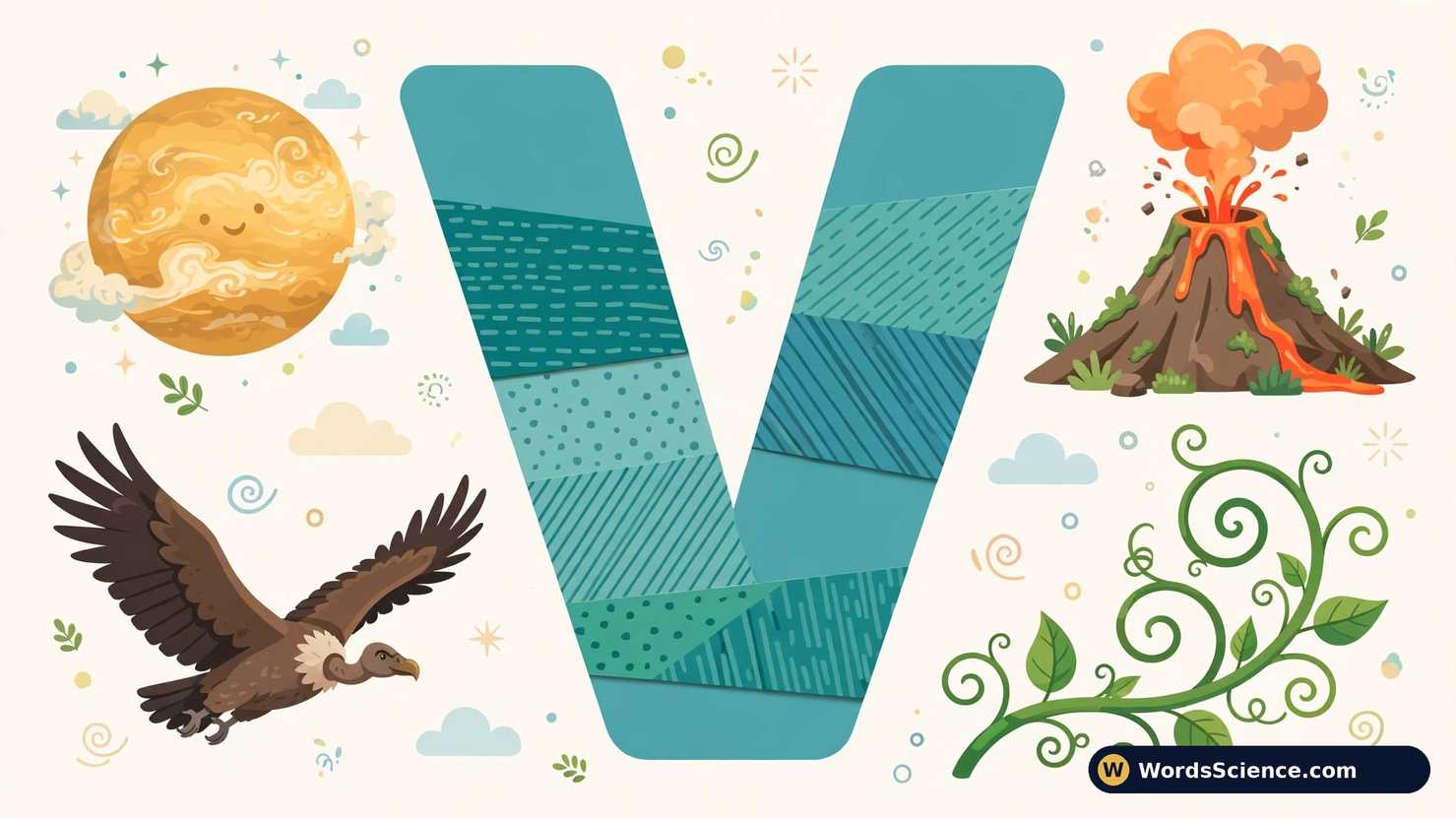
- Venus – The second planet from the Sun and the hottest planet in the solar system, wrapped in thick clouds.
- Venus transit – The rare event in which Venus passes between Earth and the Sun and appears as a small dark dot crossing the Sun’s face.
- Vernal equinox – The day in March when day and night are nearly equal in length and spring begins in the northern half of Earth.
- Vesta – One of the largest asteroids in the asteroid belt between Mars and Jupiter.
- Viking – A pair of NASA spacecraft that landed on Mars in 1976 and searched for signs of life.
- Virgo – A large constellation in the spring sky, pictured as a young woman holding ears of wheat.
- Virgo Cluster – A huge group of more than a thousand galaxies, the nearest large galaxy cluster to our own.
- Void – An enormous region of space that contains very few galaxies.
- Volans – A small, faint constellation in the southern sky, pictured as a flying fish.
- Vostok 1 – The Soviet spacecraft that carried Yuri Gagarin, the first person to travel into space, in 1961.
- Voyager – A pair of NASA space probes launched in 1977 that are now the farthest human-made objects from Earth.
- Vulpecula – A faint constellation in the northern sky, pictured as a little fox.
Physics and Energy Words That Start With V
- Vacuum – A space that contains almost no matter at all, not even air.
- Vacuum flask – A container with a vacuum sealed between its double walls, which keeps drinks hot or cold for hours.
- Van de Graaff generator – A machine that builds up a large static electric charge on a hollow metal dome.
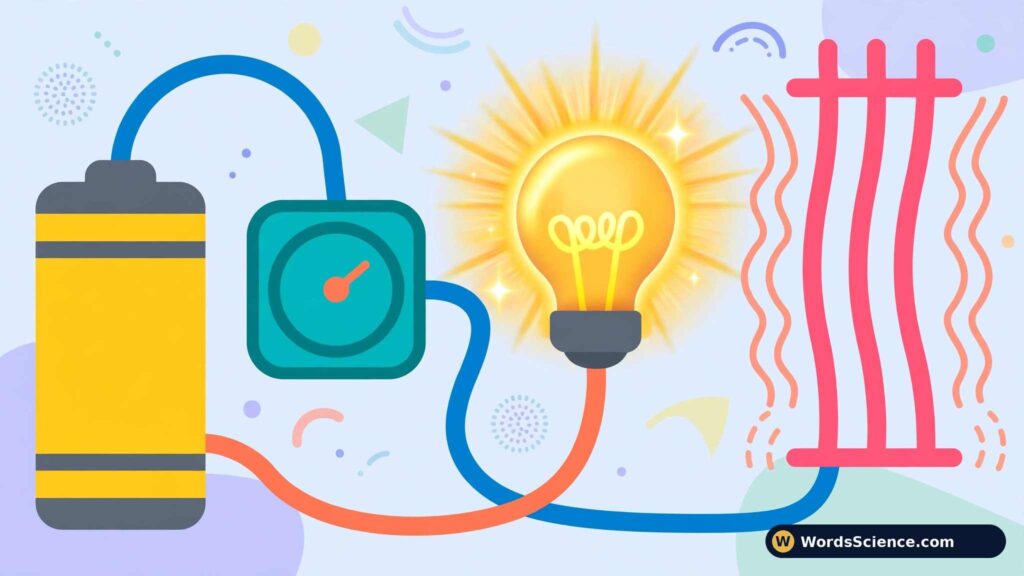
- Variable resistor – An electrical part whose resistance can be adjusted to control the flow of current in a circuit.
- Vector – A quantity that has both a size and a direction, such as velocity or force.
- Velocity – The speed of a moving object in a particular direction.
- Venturi effect – The drop in pressure that happens when a moving fluid speeds up through a narrow part of a pipe.
- Vernier caliper – A measuring tool that can measure the length and width of small objects very precisely.
- Vibration – A quick back-and-forth shaking movement, like the motion of a plucked guitar string.
- Virtual image – An image formed by a mirror or lens that appears to sit in a place where the light does not actually reach.
- Viscosity – A measure of how thick and slow-flowing a liquid is, such as honey compared with water.
- Visible light – The small part of the light spectrum that human eyes can see, showing all the colors of the rainbow.
- Volt – The unit used to measure voltage, the push that moves electric current through a circuit.
- Voltage – The electrical push that drives current through a wire, measured in volts.
- Voltmeter – An instrument used to measure the voltage in an electric circuit.
- Volume – The amount of space that an object or a substance takes up.
- Vortex – A spinning flow of air or liquid that whirls around a center, like water circling down a drain.
Chemistry and Elements Words That Start With V
- Valence electron – An electron in the outermost shell of an atom, which takes part in forming chemical bonds.
- Valency – The combining power of an element, telling how many bonds one of its atoms can form.
- Van der Waals force – A weak attraction between molecules that helps some liquids and solids hold together.
- Vanadium – A hard, silvery metal element used to make steel stronger, especially for tools and springs.
- Valine – An amino acid that the body cannot make on its own and must take in from protein foods.
- Vanillin – The main chemical that gives vanilla pods their sweet flavor and smell.
- Vapor – The gas form of a substance that is usually a liquid or a solid at room temperature.
- Vapor pressure – The pressure made by the vapor above a liquid in a closed space, which rises as the liquid warms up.
- Vaporization – The process by which a liquid or solid changes into a gas or vapor.
- Verdigris – The green layer that forms on copper and brass after long exposure to air and moisture.
- Vermilion – A bright red pigment made from mercury sulfide, a compound also found in the mineral cinnabar.
- Vinegar – A sour liquid made when alcohol ferments, containing acetic acid and used in cooking and cleaning.
- Vitriol – An old name for sulfuric acid, a strong acid once called oil of vitriol.
- Volatile – Describes a liquid that turns into vapor very easily at room temperature, such as rubbing alcohol.
- Vulcanization – A process that heats rubber with sulfur to make it stronger, harder, and stretchier.
Earth and Nature Words That Start With V
- Valley – A low area of land between hills or mountains, often with a river running through it.
- V-shaped valley – A narrow valley with steep sides, carved into the land by a fast-flowing river.
- Vapor trail – A white line of condensed water vapor left in the sky behind a high-flying airplane, also called a contrail.
- Varve – A pair of thin layers of mud and silt laid down at the bottom of a lake during a single year.
- Vegetation – All the plants that grow in an area, taken together.
- Veld – Open grassland country in southern Africa, covered with grass and scattered trees.
- Vent – An opening in Earth’s surface through which lava, steam, or gases escape from a volcano.
- Vermiculite – A soft mineral that swells up when heated and is mixed into garden soil and insulation.
- Vernal pool – A shallow pond that fills with water in spring and dries out later in the year, giving frogs a safe place to breed.
- Virga – Rain or snow that falls from a cloud but dries up before it reaches the ground.
- Volcanic ash – Tiny pieces of rock and glass blown high into the air during a volcanic eruption.
- Volcanic bomb – A lump of molten rock thrown out of a volcano that hardens as it flies through the air.
- Volcanic glass – A natural glass that forms when lava cools so quickly that crystals have no time to grow, also known as obsidian.
- Volcanic island – An island built up by volcanoes erupting under the sea until their lava rises above the waves.
- Volcanic winter – A period of worldwide cooling caused by the ash and gases that a huge volcanic eruption throws into the air.
- Volcano – An opening in Earth’s crust through which lava, ash, and hot gases can burst out.
Animal and Plant Words That Start With V
- Vampire bat – A small bat of Central and South America that feeds on the blood of sleeping animals.
- Vampire squid – A small, dark sea creature with webbed arms that open like a cloak, living deep in the ocean.
- Vanilla – A climbing orchid whose long seed pods provide the popular vanilla flavor.
- Vascular plant – A plant that has special tubes inside it for carrying water and food, such as a tree or a flowering plant.
- Vegetative propagation – A way of growing new plants from parts of a parent plant, such as a stem cutting or a potato tuber, without using seeds.
- Venation – The pattern formed by the veins in a leaf.
- Venom – A poisonous liquid that some animals, such as snakes and spiders, inject through a bite or a sting.
- Venus flytrap – A meat-eating plant whose hinged leaves snap shut to trap insects.
- Verbena – A garden plant that grows clusters of small, colorful flowers.
- Vertebrate – An animal that has a backbone and an inner skeleton, such as a fish, a bird, or a mammal.
- Vervet monkey – A small African monkey with a black face and gray-green fur.
- Vetch – A climbing plant in the pea family, often grown as food for farm animals.
- Viburnum – A flowering shrub grown in gardens, some kinds of which bear berries that birds eat.
- Viceroy butterfly – A North American butterfly that copies the orange-and-black look of the monarch butterfly to stay safe from hunters.
- Vinca – A trailing garden plant, also called periwinkle, with blue or purple flowers.
- Vine – A plant with a long, thin stem that climbs up supports or trails along the ground.
- Violet – A small plant with purple, blue, or white flowers, often grown in gardens and woods.
- Viper – A venomous snake with long, folding fangs, such as the adder.
- Vixen – A female fox.
- Vole – A small rodent that looks like a mouse with a shorter tail.
- Vulture – A large bird of prey that feeds mainly on animals that are already dead.
Human Body and Health Words That Start With V
- Vaccine – A substance given to train the body’s immune system to fight a disease before it can make you ill.
- Vagus nerve – A long nerve that runs from the brain to many organs, helping to control the heartbeat and digestion.
- Varicose veins – Swollen, twisted veins, usually in the legs, caused by weak valves inside them.
- Vein – A blood vessel that carries blood back toward the heart.
- Vena cava – The large vein that carries blood from the body into the heart.
- Ventilation – The movement of air into and out of the lungs when breathing.
- Ventricle – One of the two lower chambers of the heart, which pump blood out to the lungs and the body.
- Venule – A very small vein that collects blood from the tiniest blood vessels in the body.
- Vermiform appendix – The full scientific name of the appendix, a small finger-like tube joined to the large intestine.
- Vertebra – One of the small bones that stack together to form the backbone.
- Vesicle – A tiny sac inside a cell that stores and carries substances from place to place.
- Vestibular system – The balance system inside the inner ear that tells the brain how the head is moving.
- Villi – Tiny finger-like bumps lining the small intestine that soak up nutrients from food.
- Virus – A tiny particle that can multiply only inside living cells and can cause diseases such as the flu and the common cold.
- Vision – The sense of sight, which happens when the eyes collect light and send signals to the brain.
- Vitamin – A nutrient that the body needs in small amounts to stay healthy, such as vitamin C or vitamin D.
- Vitreous body – The clear jelly that fills the large space inside the eyeball and helps it keep its round shape.
- Vocal cords – Two folds of tissue in the throat that vibrate to make the sounds of the voice.
- Voice box – The part of the throat that holds the vocal cords, also called the larynx.
Science Words That Start With V at a Glance
| Category | Number of Words | One Example |
|---|---|---|
| Space and Astronomy | 17 | Venus |
| Physics and Energy | 17 | Velocity |
| Chemistry and Elements | 15 | Vanadium |
| Earth and Nature | 16 | Volcano |
| Animals and Plants | 21 | Vulture |
| Human Body and Health | 19 | Vaccine |
Keep building your science vocabulary letter by letter. Step back to science words that start with U to review the letter before V, then move on to science words that start with W to keep your word list growing.
Frequently Asked Questions
What is the most common science word that starts with V?
Venus is one of the most common, because it shines as the brightest planet in our sky and appears in every space lesson. Virus, vitamin, and volcano are also used very often in school science.
How many science words start with the letter V?
V is a mid-sized letter in science vocabulary, and this glossary lists 105 useful scientific terms. Most learners study one category at a time, starting with the group they need for school.
What does velocity mean in simple words?
Velocity is the speed of an object together with the direction it is moving in. A car traveling at 60 kilometers per hour toward the north has a velocity, not just a speed.
What is a vacuum in simple words?
A vacuum is a space with almost nothing in it, not even air. Sound cannot travel through a vacuum, which is why space is completely silent.
What is a fun V science word for kids?
Many learners enjoy the Venus flytrap, a plant that snaps its leaves shut to catch insects. The tiny vampire bat and the soaring vulture are also fun words to learn early.
Conclusion
V is only the twenty-second letter of the alphabet, but its scientific terms already reach every branch of science, from the volcanoes that build new land to the viruses too small for the eye to see. Use three simple steps: first, learn the everyday words, such as Venus, vine, and vitamin; next, study one category each day and say every word aloud; last, write one short sentence with each new word so the meanings stay in your memory. Students, teachers, and ESL learners who review a little every day build strong science vocabulary fast. To explore the most dramatic V word in depth, read the full encyclopedia guide to volcano and how these fiery openings in Earth’s crust build mountains, islands, and whole new stretches of land.