Science Words That Start With P: 120+ Scientific Terms With Simple Meanings
P gives science some of its most powerful and useful words in science vocabulary. Science words that start with P reach from the planets that circle the Sun to the photosynthesis that feeds nearly all life on Earth and the tiny protons inside every atom. This glossary collects them in one clean word list with short and simple meanings.
The words below are sorted into easy groups, such as space, physics, chemistry, Earth and nature, living things, and the human body. Every word is beginner-friendly, and every meaning is written in plain, easy English. Students and teachers can use this list for lessons, homework, and quick revision.
Some P words, like photosynthesis and plate tectonics, may look hard at first. Once you read the one-line meaning next to each word, they become easy to understand and easy to remember. Words like planet and penguin also connect science class to night skies, zoos, and weather reports, and science enthusiasts will enjoy how much of the natural world starts with this one letter.
Why Science Words That Start With P Matter
Strong science vocabulary makes every science lesson easier to follow. When students know the right scientific terms, they read textbooks faster, write better answers, and talk about science with confidence. For ESL learners, a clear word list with simple meanings takes away the fear of big, new words, and P is packed with everyday science words that are worth learning early.
Teachers can use these P words for spelling practice, quizzes, and classroom games, and writers gain because the right word makes any science text clearer and more exact. On the way, learners meet key ideas such as pressure in physics, the periodic table in chemistry, and photosynthesis in plant science. A strong letter like P builds a strong bridge to the rest of the science alphabet.
Space and Astronomy Words That Start With P
- Parallax – The small apparent shift in a star’s position as Earth moves around the Sun, used to measure how far away the star is.
- Partial eclipse – An event in which only part of the Sun or Moon is covered by a shadow.
- Penumbra – The lighter outer part of a shadow, where the light is only partly blocked.
- Perigee – The point in the Moon’s orbit when it is closest to Earth.
- Perihelion – The point in a planet’s orbit when it is closest to the Sun.
- Perseids – A bright meteor shower each August whose streaks seem to spread out from the Perseus constellation.
- Phase – The changing shape of the lit part of the Moon or a planet as seen from Earth, such as new, crescent, or full.
- Photosphere – The glowing visible surface of the Sun, from which most of its light escapes into space.
- Planet – A large ball of rock or gas that orbits a star and has cleared its path of other large objects.
- Planetary nebula – A glowing shell of gas thrown off by a dying star near the end of its life.
- Planetoid – A small rocky body that orbits the Sun, another name for a large asteroid or minor planet.
- Plasma – A super-hot state of matter made of charged particles, found in stars and in lightning.
- Pleiades – A bright cluster of young stars in the Taurus constellation, often called the Seven Sisters.
- Pluto – A small dwarf planet in the Kuiper Belt that was counted as the ninth planet until 2006.
- Polaris – The North Star, which sits almost directly above Earth’s North Pole in the sky.
- Prominence – A huge loop of glowing gas that arches out from the surface of the Sun.
- Protoplanet – A growing clump of rock and gas in a young solar system that is on its way to becoming a planet.
- Protostar – A young star that is still gathering gas and dust before it begins to shine steadily.
- Proxima Centauri – The closest star to the Sun, a small red dwarf a little over four light-years away.
- Pulsar – A spinning neutron star that sends out beams of radio waves like a lighthouse.
Physics and Energy Words That Start With P
- Pascal – The standard unit for measuring pressure, named after the scientist Blaise Pascal.
- Particle – A tiny piece of matter, such as an atom, an electron, or a photon of light.
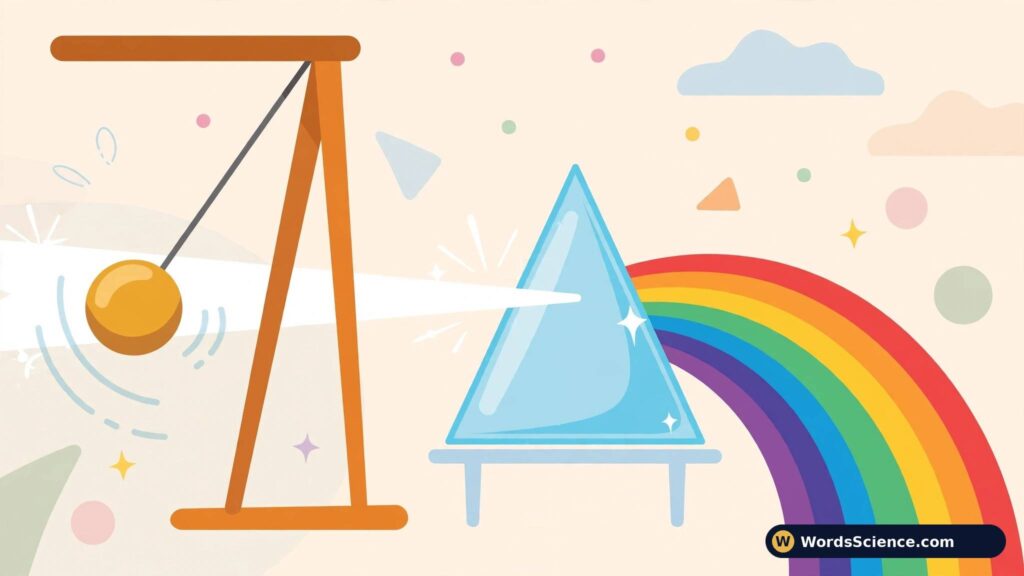
- Pendulum – A weight hanging from a fixed point that swings back and forth in a steady rhythm.
- Period – In physics, the time taken for one complete cycle of a repeating motion, such as one full swing of a pendulum.
- Photon – A tiny packet of light energy, the smallest possible unit of light.
- Photovoltaic cell – A device that changes sunlight directly into electricity, used in solar panels.
- Pitch – How high or low a sound seems, set by how fast the sound waves vibrate.
- Pivot – The fixed point around which a lever turns.
- Polarization – The process of lining up light waves so that they vibrate in a single direction.
- Potential energy – The stored energy an object has because of its position or shape, ready to be released.
- Power – The rate at which energy is used or work is done, measured in watts.
- Pressure – The force pushing on a surface, spread out over its area.
- Primary color – One of the three colors of light, red, green, and blue, that can be mixed to make all other colors.
- Prism – A clear glass or plastic block that splits white light into a rainbow of colors.
- Projectile – Any object thrown or fired through the air that keeps moving under the pull of gravity.
- Propagate – To travel or spread through a material, the way sound spreads through air.
- Proton – A heavy particle with a positive electric charge, found in the nucleus of every atom.
- Pulley – A wheel with a rope looped over it that makes lifting heavy loads easier.
- Pull – A force that draws an object closer to the thing applying it.
- Push – A force that moves an object away from the thing applying it.
Chemistry and Elements Words That Start With P
- Periodic table – A chart that arranges all the chemical elements in order, grouped by how they behave.
- Pesticide – A chemical used to kill insects and other pests that damage crops or spread disease.
- Petroleum – A dark, thick oil from underground that is refined into fuels such as gasoline and diesel.
- Petrochemical – A chemical made from petroleum or natural gas, used to make plastics, medicines, and fabrics.
- pH – A scale from 0 to 14 that shows how acidic or alkaline a substance is.
- Phase change – A change from one state of matter to another, such as ice melting into liquid water.
- Phosphorus – An element that glows faintly in the dark and that living things need for bones, teeth, and DNA.
- Physical change – A change that alters how a substance looks but does not turn it into a new substance.
- Pigment – A substance that gives color to a material, such as the green pigment in leaves.
- Plastic – A man-made material built from long chains of molecules that can be molded into many shapes.
- Platinum – A rare, heavy metal element that resists rust and tarnish, used in jewelry and catalytic converters.
- Pollution – Harmful substances added to air, water, or land that make the environment dirty or unsafe.
- Polyethylene – The most common plastic in the world, used for shopping bags, bottles, and containers.
- Polymer – A material made of very long chains of repeated small molecules, such as plastic or nylon.
- Polymerization – The process in which many small molecules join together to build one very long polymer chain.
- Potassium – A soft metal element that the body needs for healthy muscles and nerves, found in foods like bananas.
- Precipitate – A solid that forms and settles out of a liquid during a chemical reaction.
- Propane – A gas stored as a liquid in tanks and burned as a fuel for cooking and heating.
- Protein – A large molecule built from amino acids that living things use for growth, repair, and energy.
- Pure substance – A material made of only one kind of particle, such as pure water or pure gold.
Earth and Nature Words That Start With P
- Pacific Ring of Fire – The belt of volcanoes and earthquake zones that circles the Pacific Ocean.
- Paleontology – The study of fossils and the ancient life that once lived on Earth.
- Pangaea – The ancient supercontinent that held all of Earth’s land together before it slowly split apart.
- Pass – A low gap in a mountain range that lets people and animals cross to the other side.
- Peat – A dark, spongy layer of partly rotted plant matter found in wet bogs.
- Pebble – A small, smooth, rounded stone worn down by water in a river or on a beach.
- Peninsula – A piece of land almost completely surrounded by water and joined to the mainland on one side.
- Permafrost – Ground that stays frozen all year round, found in the far north and far south.
- Permeable – Describes a material that lets water pass through it, such as gravel or sandy soil.
- Petrified wood – Ancient wood that has slowly turned to stone as minerals replaced its cells.
- Plain – A broad, flat area of land with few trees, often used for farming.
- Plate tectonics – The theory that Earth’s outer shell is made of huge moving plates that carry the continents.
- Plateau – A wide, flat area of land that stands high above the land around it.
- Polar ice cap – A thick sheet of ice that covers the land or sea around one of Earth’s poles.
- Polar night – The long winter period near the poles when the Sun never rises above the horizon.
- Polar region – The cold area of Earth around the North Pole or the South Pole.
- Pollutant – A harmful substance that makes air, water, or soil dirty and unsafe.
- Pond – A small, still body of fresh water, smaller than a lake.
- Prairie – A wide, flat grassland of North America with very few trees.
- Precipitation – Any water that falls from the sky, including rain, snow, sleet, and hail.
- Pumice – A very light volcanic rock full of tiny air holes that can float on water.
- Pyrite – A shiny, brassy-yellow mineral often called fool’s gold because it looks like real gold.
Animal and Plant Words That Start With P
- Panda – A large black-and-white bear that lives in the bamboo forests of China.
- Panther – A name used for large wild cats such as the black leopard and the cougar of the Americas.
- Parasite – A living thing that lives on or inside another living thing and feeds on it.
- Parrot – A bright, colorful bird with a curved beak, some kinds of which can copy human speech.
- Peacock – A male bird famous for its huge fan of bright blue and green tail feathers.
- Pelican – A large water bird with a long beak and a stretchy pouch for scooping up fish.
- Penguin – A flightless bird of the cold southern seas that swims with flipper-like wings.
- Petal – The colorful part of a flower that attracts bees and other pollinators.
- Photosynthesis – The process green plants use to make their own food from sunlight, water, and air.
- Phytoplankton – Tiny plant-like living things that float in sunlit surface waters and make much of Earth’s oxygen.
- Pine – An evergreen tree with needle-like leaves and woody cones that stays green all year.
- Pioneer species – The first living things to grow in a bare new place, such as lichens on fresh lava rock.
- Pistil – The female part of a flower, which forms the seeds after pollination.
- Plankton – Tiny living things that drift in oceans and lakes and form the base of many food chains.
- Polar bear – A huge white bear of the Arctic that hunts seals on the sea ice.
- Pollen – The fine powder made by flowers that carries the male cells needed to make seeds.
- Pollination – The movement of pollen from one flower to another, which allows plants to make seeds.
- Pollinator – An animal, such as a bee or a butterfly, that carries pollen from flower to flower.
- Pond skater – A light insect that can walk across the surface of still water without sinking.
- Porcupine – A slow rodent covered in sharp quills that protect it from predators.
- Prairie dog – A small burrowing rodent of the North American grasslands that lives in large colonies.
- Predator – An animal that hunts and eats other animals.
- Prey – An animal that is hunted and eaten by another animal.
- Pupa – The resting stage in an insect’s life when it changes inside a case, as a caterpillar turns into a butterfly.
- Python – A very large snake that kills its prey by squeezing it tightly.
Human Body and Health Words That Start With P
- Pacemaker – A small device placed in the chest that keeps the heartbeat steady with tiny electrical signals.
- Palate – The roof of the mouth, which separates the mouth from the nose.
- Pancreas – An organ behind the stomach that makes insulin and juices that help digest food.
- Patella – The kneecap, a small round bone that protects the front of the knee joint.
- Pathogen – A germ, such as a bacterium or a virus, that can cause disease.
- Pelvis – The ring of bones at the base of the spine that connects the legs to the upper body.
- Penicillin – A famous antibiotic medicine, first made from a mold, that kills many harmful bacteria.
- Peristalsis – The wave-like squeezing of muscles that pushes food through the digestive tract.
- Perspiration – Sweat, the salty water the skin releases to cool the body down.
- Pharynx – The throat passage behind the mouth and nose through which both air and food pass.
- Physiology – The science of how the bodies of living things work.
- Pituitary gland – A pea-sized gland under the brain that makes hormones controlling growth and many body jobs.
- Placenta – The organ in pregnancy that passes food and oxygen from the mother to the growing baby.
- Platelet – A tiny blood fragment that helps the blood clot and seal cuts.
- Pneumonia – A lung illness in which the tiny air sacs fill with fluid and make breathing hard.
- Poison – A substance that can harm or kill a living thing when it enters the body.
- Pore – A tiny opening in the skin through which sweat escapes.
- Posture – The way a person holds their body when standing, sitting, or moving.
- Psychology – The science that studies the mind and human behavior.
- Pulse – The steady throbbing of blood through the arteries that can be felt at the wrist or neck with each heartbeat.
- Pupil – The black opening in the center of the eye that lets light in.
Science Words That Start With P at a Glance
| Category | Number of Words | One Example |
|---|---|---|
| Space and Astronomy | 20 | Planet |
| Physics and Energy | 20 | Prism |
| Chemistry and Elements | 20 | Potassium |
| Earth and Nature | 22 | Plateau |
| Animals and Plants | 25 | Penguin |
| Human Body and Health | 21 | Pancreas |
Keep building your science vocabulary letter by letter. Step back to science words that start with O to review the letter before P, then move on to science words that start with Q to keep your word list growing.
Frequently Asked Questions
What is the most common science word that starts with P?
Planet is one of the most common, because it is used in space science, news, and everyday talk about the solar system. Power, pressure, and plastic are also used very often in school science.
How many science words start with the letter P?
P is one of the richest letters in science vocabulary, and this glossary lists 128 useful scientific terms. Most learners study one category at a time, starting with the group they need for school.
What does photosynthesis mean in simple words?
Photosynthesis is the way green plants make their own food using sunlight, water, and air. The plant takes in carbon dioxide, uses light energy, and releases oxygen as it builds its food.
What is plate tectonics in simple words?
Plate tectonics says that the outer shell of Earth is split into huge plates that move very slowly. Their movement builds mountains, opens oceans, and causes earthquakes and volcanoes over millions of years.
What is a fun P science word for kids?
Many learners enjoy the penguin, a bird that cannot fly but swims like a torpedo through icy seas. The spiky porcupine and the colorful peacock are also fun words to learn early.
Conclusion
P is only the sixteenth letter of the alphabet, but its scientific terms already reach every branch of science, from the planets high above us to the pancreas inside our bodies. Use three simple steps: first, learn the everyday words, such as planet, power, and penguin; next, study one category each day and say every word aloud; last, write one short sentence with each new word so the meanings stay in your memory. Students, teachers, and ESL learners who review a little every day build strong science vocabulary fast. To explore the most life-giving P word in depth, read the full encyclopedia guide to photosynthesis and how this one process feeds nearly every living thing on Earth.