Opposite of Benefit: Disadvantage and Other Antonyms Explained
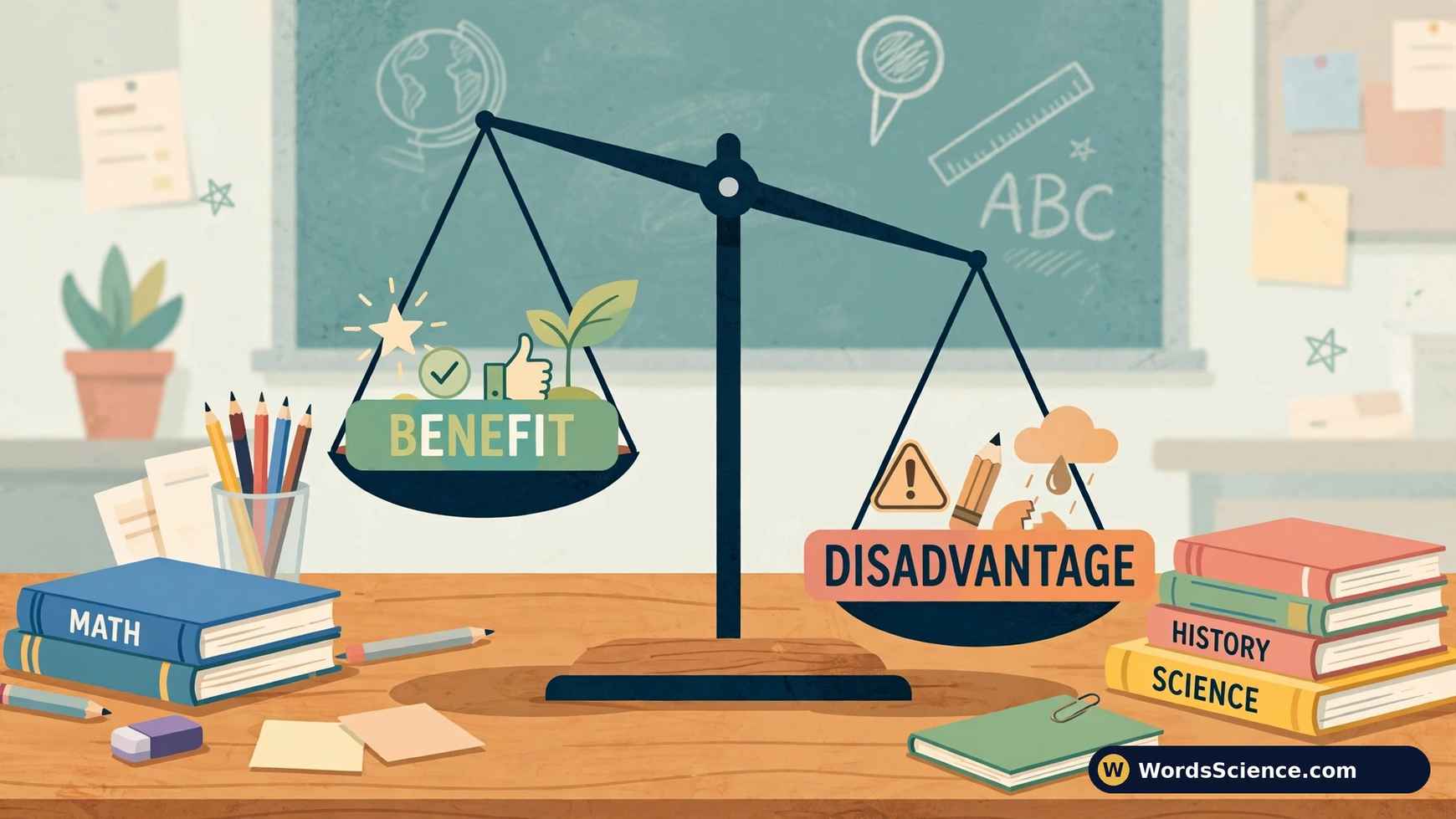
The main opposite of benefit is disadvantage. A benefit is something good that helps you, and a disadvantage is something that makes a situation worse or harder for you. Students see this pair in the common phrase “advantages and disadvantages” in school essays.
Benefit has more than one antonym, though. Words like drawback, downside, detriment, and harm also stand against it, but each one is strong in a different way and fits a different kind of writing. Picking the wrong one can make your sentence sound too weak or too strong.
This guide explains each real opposite in simple words. You will learn what each word means, where it fits best, and how to choose the right one for everyday speech, school work, and business writing.
Why the Opposite of Benefit Matters
Students and teachers meet these words in essays, debates, and exam questions, where they must weigh the good side and the bad side of an idea. Knowing the exact opposite of benefit helps them build clear, balanced arguments instead of repeating the same word again and again.
Writers and ESL learners also need this choice. In formal writing, one strong, correct word is better than a long, unclear sentence. Learning how these opposites differ in strength — from the mild downside to the strong detriment — makes English sound natural and precise in class, at work, and online.
What Does Benefit Mean?
Before we look at the opposites, it helps to see the word itself clearly. Benefit works as both a noun and a verb, and its opposites change a little with each use.
As a noun, a benefit is a good result or an advantage that something gives you. Exercise has many benefits for your health. A job may offer benefits such as paid holidays and health insurance. As a verb, to benefit means to receive help or gain something good: students benefit from regular reading practice.
So the opposite of benefit must point the other way: something bad, something lost, or something that holds you back. The words below all do that job, but not in the same way.
The Main Opposites of Benefit
Disadvantage – The Direct Opposite
Disadvantage is the truest and most common opposite of benefit. It means a condition or fact that makes something less successful or less pleasant. It fits almost everywhere: everyday speech, school essays, and business reports. If you are not sure which opposite to use, disadvantage is the safe choice.
Example: The main disadvantage of living far from school is the long bus ride every morning.
Drawback – A Mild, Common Opposite
A drawback is a problem or disadvantage that comes with something that is mostly good. It is a little milder than disadvantage, and it is very common in everyday and business English. People often use it when they still like the thing overall.
Example: The new phone is fast, but its only drawback is the high price.
Downside – The Everyday Partner of Upside
The downside is the negative side of a situation. It is the direct partner of “upside,” the positive side, and it is mild and friendly in tone. You will hear it in conversation, news, and office talk more than in formal reports.
Example: The downside of working from home is that I miss my friends at the office.
Detriment – A Strong, Formal Opposite
A detriment is serious harm or damage caused to someone or something. This word is stronger than disadvantage and belongs mostly to formal writing, law, and health topics. The common phrase is “to the detriment of,” meaning “in a way that harms.”
Example: Skipping sleep every night is a detriment to your health and your memory.
Harm – Damage, Not Just a Weak Point
Harm means physical or mental damage. Where benefit means something helps, harm means something hurts or damages. Harm is a true opposite when benefit is about health, safety, or well-being, but it is too strong for small, everyday problems.
Example: Too much sun can cause real harm to your skin.
Loss – When the Benefit Disappears
A loss is the act of losing something, or the thing that is lost. Benefit and loss appear together in money and business: a company counts its gains and its losses. As an opposite, loss works best when something good is taken away or when money goes down instead of up.
Example: The shop closed early and made a loss during the winter months.
Hindrance – Something That Slows You Down
A hindrance is anything that makes a job or a plan harder or slower. It opposes benefit in the sense of help: a benefit helps you move forward, and a hindrance holds you back. It is a little formal and appears in reports and official writing.
Example: Bad roads were a hindrance to the rescue teams after the storm.
Liability – A Burden or a Legal Duty
A liability can mean a legal duty to pay for damage, or, in everyday speech, a person or thing that causes problems instead of helping. Both senses stand against benefit: a liability costs you, while a benefit helps you. It is common in business, law, and insurance, and in the phrase “more of a liability than an asset.”
Example: The old car became a liability because the repair bills never stopped.
Cost – The Opposite Inside Cost–Benefit
In the phrase cost–benefit analysis, cost is the working opposite of benefit. A cost is what you must give — money, time, or effort — to get something. A project is worth doing when its benefits are greater than its costs. Cost is not a general antonym for benefit in every sentence, but inside this common pairing it does the opposite job exactly.
Example: The cost of the new road was high, but the benefit to local farmers was greater.
Opposite of Benefit at a Glance
| Opposite | Simple Meaning | Best Used For |
|---|---|---|
| Disadvantage | A fact or condition that makes something worse or harder | All writing; the safest general opposite |
| Drawback | A problem inside something that is mostly good | Everyday and business English |
| Downside | The negative side of a situation | Conversation, news, office talk |
| Detriment | Serious harm or damage | Formal writing, law, health topics |
| Harm | Physical or mental damage | Health, safety, and well-being |
| Loss | Something good that is lost, or money lost | Money, business, and results |
| Hindrance | Something that slows or blocks progress | Reports and official writing |
| Liability | A legal duty to pay, or a burden that causes problems | Business, law, and insurance |
| Cost | What you give (money, time, effort) to gain something | Cost–benefit analysis and decisions |
How to Choose the Right Opposite of Benefit
Think about two things: how strong the bad side is, and where you are writing. For a small weak point in something good, choose drawback or downside. For a clear, general opposite in an essay or report, choose disadvantage. For real damage, especially to health, choose detriment or harm. For money questions, loss and cost fit best.
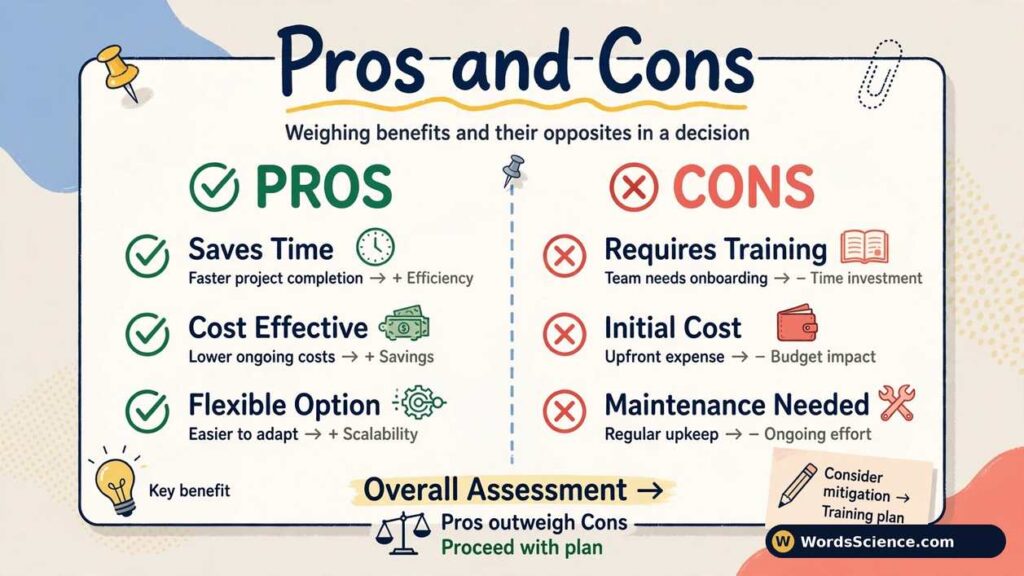
Notice the fixed pairs English speakers use again and again. Essays weigh advantages and disadvantages. Decisions list pros and cons, where the pros match the benefits and the cons match the drawbacks. Workers compare costs and benefits. Using the pair your reader expects makes your writing sound natural at once.
One more tip: match the grammar. Benefit is often a countable noun — “one benefit,” “many benefits” — and disadvantage, drawback, and loss follow the same pattern. Harm and detriment are usually uncountable nouns, so we do not say “a harm” in careful writing; we say “cause harm” or “a detriment to.”
Words That Are Not True Opposites of Benefit
Some words look like opposites but are not exact. Problem is the most common example. A problem is any difficult situation, so it is too general: it does not point back at benefit the way disadvantage does. You can say “the problem with this plan,” but in a pair with benefit, disadvantage is the correct partner.
Weakness is another near-miss. A weakness is a fault inside a person or thing, while a disadvantage is a condition that works against you. The two ideas are close, but they are not the same pair. Honest word lists keep these near-miss words out of the antonym list and use them only where they truly fit.
Opposites are only one part of strong English. Keep building your word power with lively comparisons in similes for strong, then grow your vocabulary further with science words that start with B.
Frequently Asked Questions
What is the main opposite of benefit?
The main opposite of benefit is disadvantage. It works in almost every sentence, from school essays to business reports, and it is the standard partner in the phrase “advantages and disadvantages.”
What is the difference between a drawback and a disadvantage?
A drawback is usually milder: it is one problem inside something that is mostly good. A disadvantage is the fuller, more general opposite and can be serious. Both are correct, but drawback sounds softer.
Is “harm” the opposite of benefit?
Yes, when benefit means help for health, safety, or well-being, harm is a real opposite, because it means damage. For small everyday problems, harm is too strong, and disadvantage or drawback fits better.
What is the opposite of benefit in business writing?
In business writing, the common opposites are disadvantage, drawback, liability, and loss. In a cost–benefit analysis, the working opposite of benefit is cost: a plan is good when the benefits are greater than the costs.
Is “problem” an antonym of benefit?
Not exactly. Problem is too general, because any difficult situation can be called a problem. The true antonym of benefit is disadvantage, with drawback and downside as milder choices.
Conclusion
Remember one main word and one simple rule. The main opposite of benefit is disadvantage, the safe choice for almost every sentence. Around it stand milder words like drawback and downside, stronger words like detriment and harm, and special words like cost and liability for money and business topics.
Choose your opposite by strength and by setting: mild words for small weak points, strong words for real damage, and disadvantage when you want the clear, general partner. To see how English builds these word pairs, read the encyclopedia article on antonym and how opposites work.