Zionist Meaning | What Does Zionist Mean?
The Zionist Meaning refers to support for Zionism, a political movement centered on Jewish national self-determination and a Jewish homeland in the historic Land of Israel. A Zionist is generally someone who supports this idea or identifies with the related political position. The term has a political meaning and does not simply mean Jewish or Israeli.
In everyday conversations, the word can appear in discussions about Israel, Jewish identity, Palestinian statehood, or government policies. Its meaning and tone can change with the context, especially on social media or during political arguments. A person can support Zionism while disagreeing with particular Israeli government policies.
This article explains What Does Zionist Mean in simple, clear language for everyday readers. It covers the Zionist definition, historical context, common uses, and differences between Zionist, Jewish, and Israeli. It also explains how to understand the term respectfully when you see it in conversations or online posts.
What Does Zionist Mean?
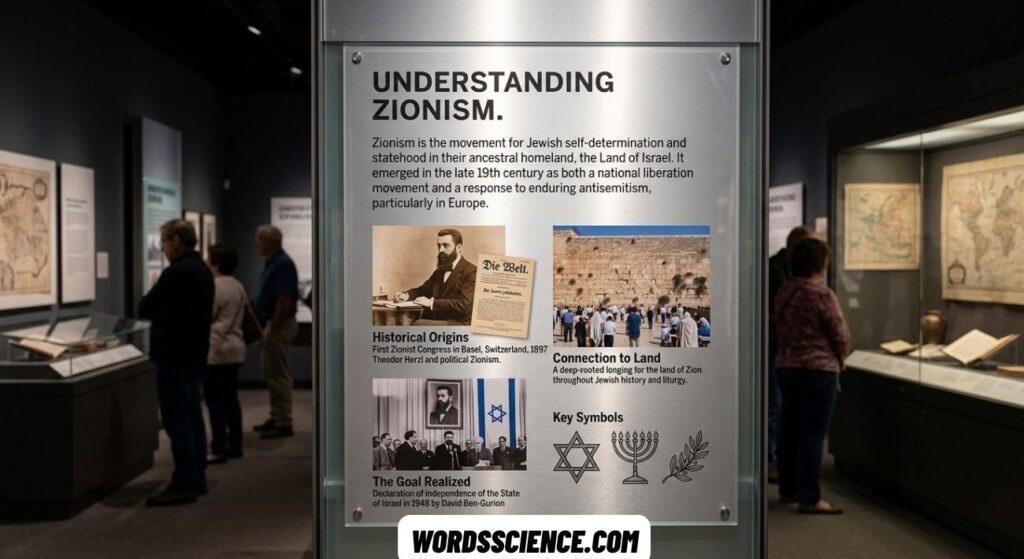
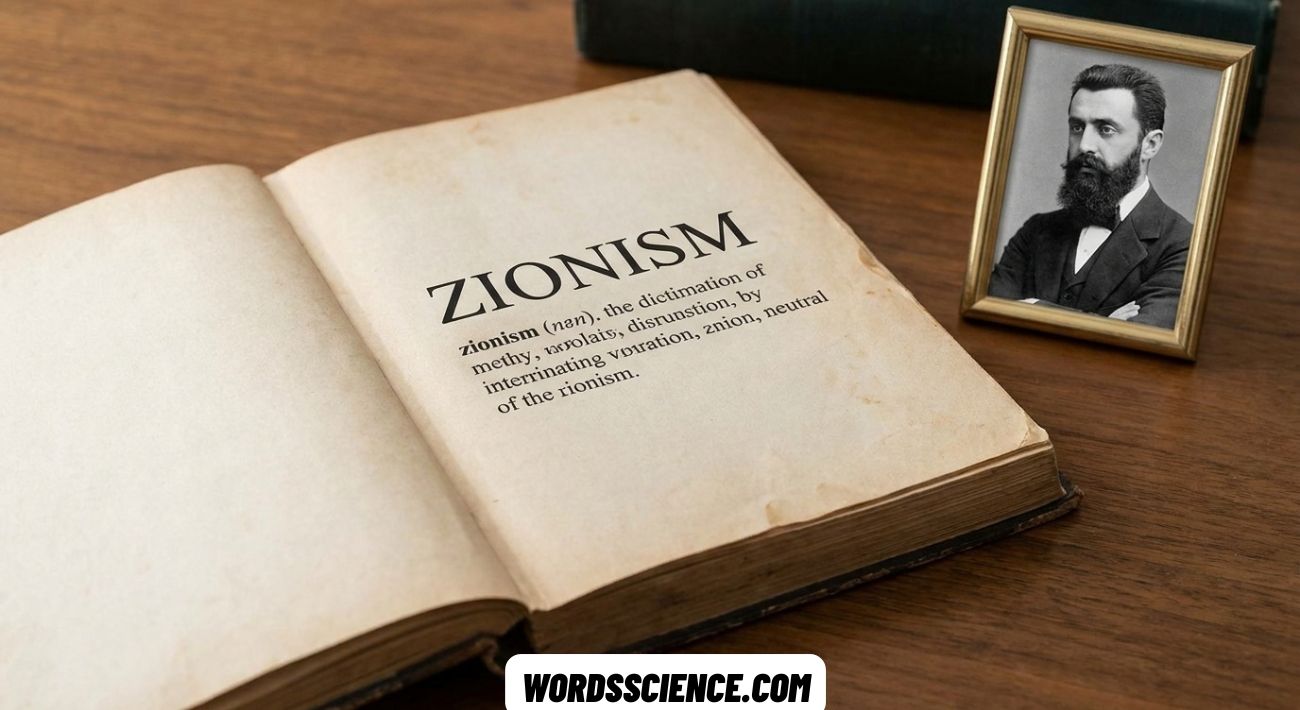
A Zionist is generally a person who supports Zionism, the idea that the Jewish people have a right to national self-determination in a Jewish homeland or state in the historic Land of Israel. Modern Zionism developed as a political movement in the late 19th century, with Theodor Herzl becoming one of its best-known leaders. The First Zionist Congress took place in 1897.
The term can describe different political positions. Some Zionists focus mainly on the existence and security of Israel as a Jewish state. Others have particular views about territory, Palestinian statehood, settlements, borders, or Israeli government policies. Therefore, calling someone a Zionist does not by itself tell you what every other political position that person holds.
In simple usage, Zionist means someone who supports Jewish national self-determination associated with Israel. The word can describe a political identity rather than a religious belief.
What Is the Zionist Meaning in Simple Terms?
In Zionist meaning in simple terms, a Zionist is someone who supports the idea that Jewish people should have national self-determination in their historic homeland.
The word comes from Zion, a biblical term associated with Jerusalem and the Land of Israel. Modern Zionism turned an older Jewish connection to the land into a modern political movement during the late 19th century. The movement eventually became closely connected with the establishment of the State of Israel in 1948.
This does not mean that all Zionists agree with one another. Zionist beliefs can differ considerably on politics, religion, territory, and the relationship between Israel and Palestinians.
What Is Zionism?
Zionism is a political movement and ideology centered on Jewish national self-determination and the establishment and support of a Jewish national home in the historic Land of Israel. Modern political Zionism emerged in Europe in the late 19th century, partly in response to antisemitism and the rise of nationalist movements.
Theodor Herzl played a major role in organizing modern political Zionism. In 1897, he convened the First Zionist Congress in Basel, Switzerland. The movement later became one of the major forces involved in the political and social developments that preceded the creation of Israel in 1948.
Zionism and Judaism are related in history and identity, but they are not identical concepts. Judaism is a religion and also has ethnic, cultural, and historical dimensions. Zionism is primarily a political and national idea. Jewish communities and individuals have held different positions on Zionism, including support, criticism, and opposition.
Zionist Meaning in Different Contexts
The meaning of Zionist can stay broadly connected to Zionism while the intended focus changes with the situation. A history textbook, political debate, religious discussion, and social-media argument may use the same word in very different ways.
Historical Context
In a historical context, Zionist often refers to people involved in the Zionist movement of the late 19th and early 20th centuries. These individuals and organizations promoted Jewish national self-determination and worked toward establishing a Jewish national home.
The movement developed against a background that included antisemitism in Europe, Jewish political nationalism, and longstanding Jewish historical and religious connections to the Land of Israel. The U.S. Holocaust Memorial Museum describes modern Zionism as a political movement founded in the late 19th century that advocated an autonomous Jewish state.
Political Context
In politics, Zionist can describe someone’s support for Israel’s existence as a Jewish state or support for Jewish national self-determination.
However, the label does not automatically identify a person’s views on every Israeli policy. Two people who both call themselves Zionists may disagree about borders, settlements, Palestinian statehood, military policy, or the actions of a particular Israeli government.
For that reason, political context matters when interpreting the word.
Social Media Context
On social media, Zionist is often used in discussions about Israel, Palestine, Jewish identity, the Israeli-Palestinian conflict, and current events.
The word can be used descriptively, but it can also appear in arguments where people use it as a political label or accusation. A post saying “She is a Zionist” could simply describe someone’s political position, while another post may use the term while criticizing that person’s views.
On TikTok, Instagram, X, or another platform, the meaning still depends on the surrounding conversation. The platform itself does not give the word a separate dictionary definition.
Religious Context
The relationship between Zionism and religion is more complicated than simply saying they are the same thing. Some Zionists understand Jewish national self-determination partly through religious ideas, while others approach Zionism from secular political or cultural perspectives.
Some religious Jews support Zionism, while some religious Jewish groups have historically opposed particular forms of Zionism. Jewish identity itself also varies widely in religious practice, culture, politics, and personal beliefs.
How Context Changes the Meaning
Context can tell you whether Zionist is being used as a neutral description, a political criticism, or part of a broader argument.
For example, a historian might write, “Herzl was a major figure in the early Zionist movement.” Here, the word identifies a historical political movement.
In a political discussion, someone might say, “I am Zionist, but I disagree with this government’s policy.” In this case, the speaker is separating support for Zionism from support for a particular government decision.
On social media, the same word can be used much more loosely. A person may use “Zionist” to describe someone they believe strongly supports Israel, while another person may use the term more specifically to mean support for Jewish national self-determination.
Because of these differences, it is useful to look at what the speaker means rather than assuming that every use has exactly the same meaning.
Is Zionist the Same as Jewish or Israeli?
No. Zionist, Jewish, and Israeli are different terms.
| Term | Basic meaning |
|---|---|
| Zionist | A person who supports Zionism or Jewish national self-determination associated with Israel |
| Jewish | Relating to Judaism or to Jewish identity, people, culture, or heritage |
| Israeli | A person who is a citizen or national of Israel |
A Jewish person may or may not be Zionist. An Israeli person may or may not identify as Zionist. A Zionist does not have to be Jewish.
Judaism includes religious, cultural, historical, and communal dimensions, while Zionism is primarily a political and national concept. Israeli identity refers to nationality and citizenship rather than automatically indicating a person’s religion or political position.
This is why Zionist vs Jewish and Zionist vs Israeli are useful distinctions. They describe different aspects of a person’s identity or political beliefs.
Real Conversation Examples
The following examples show how the word can function differently depending on the conversation.
1: Historical Discussion
Person A: “Why was Herzl important to the Zionist movement?”
Person B: “He helped organize modern political Zionism and convened the First Zionist Congress in 1897.”
Meaning: Here, “Zionist” is being used as a historical and political term.
2: Political Conversation
Person A: “Are you Zionist?”
Person B: “I support Israel’s existence, but I have different views about current government policies.”
Meaning: The conversation is about political identity. The speaker is making a distinction between support for Israel’s existence and agreement with every policy of its government.
3: Social Media Argument
Person A: “You called yourself a Zionist. What do you mean by that?”
Person B: “I mean that I support Jewish national self-determination and Israel’s continued existence.”
Meaning: The second person is defining the political label instead of assuming that everyone understands it in exactly the same way.
Is Zionist a Neutral or Offensive Word?
Zionist is not automatically an offensive word. It is a legitimate political term used in historical, academic, religious, journalistic, and everyday discussions.
However, the tone can change depending on how the word is used. A neutral sentence such as “The organization had Zionist roots” is different from using “Zionist” as an insult or attaching unrelated negative claims to Jewish people.
The broader conversation also matters because criticism of Zionism, Israel, or Israeli government policies can involve legitimate political debate, while antisemitic language targets Jews as Jews. These concepts should not automatically be treated as identical.
At the same time, disputes about where criticism of Israel or Zionism crosses into antisemitism are real and can be politically and socially contested. The safest approach is to examine the specific statement, its target, and its context rather than treating one word as automatically offensive or automatically harmless.
See Also : 230+ Science Words That Start With A: The Complete A-List Glossary
Is Zionist the Same as Supporting the Israeli Government?
No. A person can identify as Zionist while strongly disagreeing with the policies or decisions of a particular Israeli government.
Zionism is a broader political idea concerning Jewish national self-determination and Israel’s existence. A government is a specific political administration whose policies can change over time.
For example, someone could support Israel’s existence as a Jewish state while opposing a particular military decision, settlement policy, law, or government leader. Another Zionist could hold different views on those same issues.
This distinction is especially important in political conversations because disagreement with an Israeli government policy does not automatically establish someone’s position on Zionism.
How to Respond When Someone Uses “Zionist”
A useful response depends on whether the term was used descriptively, critically, or simply because the other person wants to understand your political position.
Polite Clarification
If you are unsure what someone means, ask for clarification.
You could say, “When you say Zionist, what definition are you using?” This keeps the conversation focused on the actual meaning instead of assuming the person’s intention.
If You Agree With the Label
If you identify with the term, you can explain what it means to you.
For example: “Yes, I consider myself a Zionist because I support Jewish national self-determination, although I have my own views on Israeli politics.”
This makes your position more specific without suggesting that every Zionist shares your views.
If You Disagree
If someone calls you a Zionist and you do not use that label for yourself, you can calmly explain your position.
For example: “I don’t describe myself as a Zionist. I support some aspects of Israel’s existence, but I don’t use that political label for myself.”
A clear explanation is usually more useful than arguing over the label alone.
When to Use the Term
Use Zionist when you are specifically discussing Zionism, Jewish national self-determination, the Zionist movement, or someone’s stated political identity.
The term works naturally in historical and political writing, such as “The First Zionist Congress was held in 1897” or “The article examines different Zionist political views.”
When discussing an individual, it is better to use the label when it accurately reflects their stated position or when the context clearly establishes it.
When to Avoid the Term
Avoid using Zionist as a blanket replacement for words such as “Jewish,” “Israeli,” “government,” or “supporter of Israel.” Those words do not mean the same thing.
You should also avoid assuming that every Jewish person is Zionist or that every Israeli shares one political position. Such assumptions can erase important differences in religion, nationality, culture, and political identity.
If you are discussing a particular policy, it is often clearer to name the policy or position directly rather than using “Zionist” as a broad label.
Common Mistakes About the Word Zionist
One common mistake is treating Zionist and Zionism as completely separate ideas. A Zionist is generally a person who supports Zionism, while Zionism is the broader political movement or ideology.
Another mistake is assuming that Zionist means “Jewish.” Judaism is a religion and also encompasses cultural, historical, and communal identities, while Zionism is a political and national concept.
It is also inaccurate to assume that every Zionist supports every Israeli government or every Israeli policy. Political movements contain people with different views.
Another common error is treating “Israeli” and “Zionist” as interchangeable. Israeli is primarily a nationality or citizenship term, while Zionist describes a political position.
Finally, people sometimes assume that the word is always either neutral or offensive. Its tone depends heavily on the sentence, speaker, audience, and political context.
Similar Terms and Their Differences
| Term | Meaning |
|---|---|
| Zionist | A person who supports Zionism or Jewish national self-determination associated with Israel |
| Zionism | A political movement or ideology centered on Jewish national self-determination |
| Jewish | Relating to Judaism or Jewish religious, cultural, historical, or communal identity |
| Israeli | Relating to Israel or a person who is Israeli by nationality or citizenship |
| Anti-Zionist | A person or position that opposes Zionism |
| Anti-Zionism | Opposition to Zionism as a political movement or ideology |
The anti-Zionist meaning therefore describes opposition to Zionism, but anti-Zionist positions also vary. People may oppose Zionism for different political, historical, religious, or ideological reasons.
Likewise, being Jewish does not automatically make someone Zionist, and being anti-Zionist does not by itself describe every other political belief a person holds.
Origin and Historical Background
The word Zionist comes from Zion, a biblical name associated with Jerusalem and the Land of Israel. Jewish attachment to the Land of Israel existed long before modern political Zionism. The modern Zionist movement developed in the late 19th century as a political form of Jewish nationalism and national self-determination.
Theodor Herzl became one of the central figures in modern Zionism. In 1897, he convened the First Zionist Congress, where delegates discussed the political future of the Jewish people and the goal of establishing a recognized national home.
The history of Zionism is closely connected to the establishment of the State of Israel in 1948. Israel’s Declaration of Independence identifies the historic connection between the Jewish people and the Land of Israel and declares the establishment of the State of Israel.
The history is also connected to the displacement and conflict experienced by Palestinians and to continuing disagreements over territory, statehood, security, rights, and political arrangements. For this reason, Zionist history and meaning cannot be understood only through the history of the Zionist movement itself; the broader history of the region is also essential.
Today, Zionism is used to describe a range of political positions rather than one single policy program. People who identify as Zionists can disagree strongly about what Jewish self-determination should look like, how Israel should relate to Palestinians, and which government policies they support.
How Is Zionist Used in Modern Discussions?
Today, the word Zionist is commonly used when people discuss Israel, Jewish national self-determination, and the Israeli-Palestinian conflict. People who identify as Zionist can hold different political views about borders, Palestinian statehood, Israeli government policies, and the future of the region, so the label does not describe one single political position.
The term can also appear in academic, historical, religious, and social-media conversations. Its meaning is best understood from the speaker’s specific words and the surrounding political context rather than assuming that every person who uses the label means exactly the same thing.
Why Do People Use the Term Zionist?
People use Zionist to describe support for Zionism or Jewish self-determination connected to the historic Land of Israel. Modern Zionism developed as a political movement in the late 19th century, partly in response to antisemitism and debates about Jewish national identity and security.
The term can therefore describe a person’s political identity, but it does not automatically explain all of that person’s beliefs. Different Zionist movements and organizations have held different positions on religion, territory, culture, and politics, which is why the word should be interpreted within its historical or political context.
What Does Anti-Zionist Mean?
Anti-Zionist generally describes a person or position that opposes Zionism. However, people who describe themselves as anti-Zionist can have different reasons for that position, including political, religious, historical, or ideological reasons. The term does not by itself explain every belief a person holds about Israel or Jewish people.
Anti-Zionism and antisemitism are also not identical concepts. Antisemitism refers to prejudice or hostility toward Jews, while anti-Zionism concerns opposition to Zionism as a political movement or ideology. Because these subjects can overlap in political debates, the specific language and context of a statement matter.
Quick Recap
The Zionist meaning is generally connected to support for Zionism, a political movement centered on Jewish national self-determination and a Jewish national home in the historic Land of Israel. Modern political Zionism developed in the late 19th century and became closely connected with the establishment of Israel in 1948.
A Zionist is not automatically the same thing as a Jewish person or an Israeli person, and being Zionist does not mean supporting every Israeli government policy. Because the word can carry different meanings in historical, political, religious, and social-media contexts, the surrounding conversation matters. Understanding these distinctions makes the term easier to interpret accurately and respectfully.
FAQs
What is a Zionist in simple terms?
A Zionist is someone who supports Jewish national self-determination and the existence of a Jewish homeland or state in the historic Land of Israel.
What is the main goal of Zionism?
The main goal of Zionism is Jewish national self-determination, historically expressed through support for a Jewish homeland and later the State of Israel.
Who is the founder of Zionism?
Theodor Herzl is widely regarded as a founder of modern political Zionism and organized the First Zionist Congress in 1897.
Does Zionism mean supporting Israel?
Generally, Zionism means supporting Israel’s existence as a Jewish state, but it does not necessarily mean supporting every Israeli government or its policies.
Final Thoughts
The Zionist Meaning refers to support for Zionism, a movement centered on Jewish national self-determination and a Jewish homeland in the Land of Israel. Modern Zionism developed in the late nineteenth century and became connected with the State of Israel. A Zionist can hold views about territory, Palestinian statehood, and government policies. The term does not mean Jewish or Israeli.
When you see Zionist Meaning, read the words before deciding what the speaker means. The term can describe an identity or position in a debate, and its tone depends on how it is used. Someone may support Zionism while disagreeing with a government or policy. Context helps distinguish Zionism from Judaism, Israeli nationality, and anti-Zionism, making conversations easier to understand.