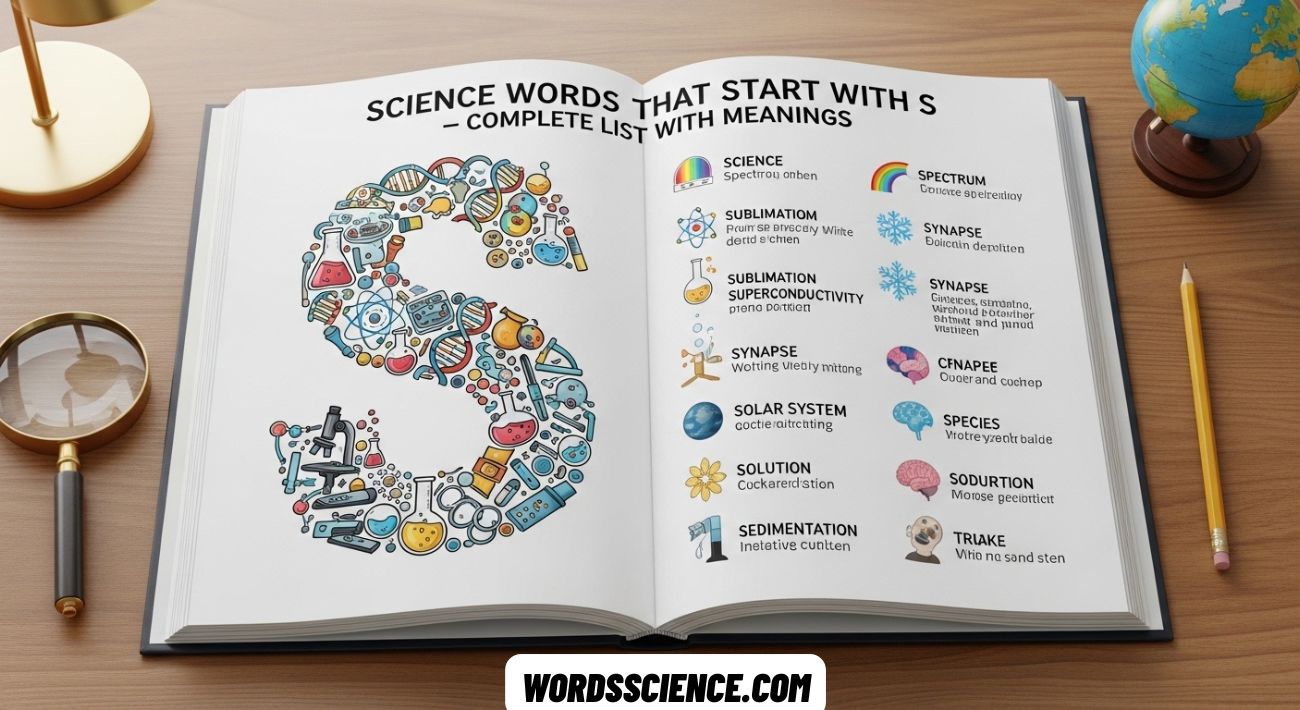
200+ Science Words That Start With S – Complete List With Meanings
Science Words That Start With S are terms from scientific fields that begin with the letter S. These words cover subjects like physics, chemistry, biology, astronomy, and earth science. They help students, teachers, and learners understand the language of science in a clear and simple way.
Imagine learning words that unlock the secrets of stars, the human brain, and the ground beneath your feet. The letter S holds some of the most exciting and powerful words in all of science. Once you know them, you start seeing the world like a real scientist does every single day.
Scientists use these words to describe everything from tiny cells to giant solar systems. A strong list of Science Words That Start With S builds your knowledge step by step. You can use them in class, during experiments, or while exploring nature around you.
Why These Science Words That Start With S Matter
Building a strong science vocabulary helps students succeed in school and beyond. Knowing scientific definitions makes reading textbooks, taking tests, and doing lab work much easier. Teachers use these science terms to explain complex ideas in simple ways, and students who master STEM vocabulary gain confidence in their learning journey.
Writers, ESL learners, and science enthusiasts also benefit greatly from understanding science terminology. Clear communication about science concepts requires accurate words. This collection of scientific meanings serves as a handy reference tool. It supports science education and makes science learning accessible to everyone, regardless of their background.
Easy Science Words That Start With S
These beginner-friendly science words with S are perfect for young learners and anyone new to science. Each word is simple, common, and essential for building a basic scientific vocabulary. These S science words appear often in elementary and middle school lessons.
- Science – The study of the natural world through observation and experiment.
- Sun – The star at the center of our solar system.
- Star – A glowing ball of gas in space that produces light and heat.
- Sky – The space above the Earth where clouds, birds, and planes are seen.
- Soil – The top layer of Earth where plants grow.
- Sand – Tiny grains of broken rock found on beaches and deserts.
- Sea – A large body of saltwater smaller than an ocean.
- Seed – The part of a plant that can grow into a new plant.
- Stem – The main support part of a plant that holds leaves and flowers.
- Shell – The hard outer covering of an animal like a turtle or clam.
- Skin – The outer covering of a human or animal body.
- Skull – The bone structure that protects the brain.
- Spine – The backbone made up of small bones called vertebrae.
- Sense – A way the body receives information, like sight or smell.
- Sight – The ability to see with the eyes.
- Smell – The ability to detect odors with the nose.
- Sound – Vibrations that travel through air and can be heard.
- Solid – A state of matter with a fixed shape and volume.
- Space – The vast area beyond Earth where stars and planets exist.
- Surface – The outermost layer or top of an object.
Physics Science Words That Start With S
Physics explains how matter and energy work in the universe. These scientific terms starting with S cover motion, forces, waves, and the properties of materials. Understanding these science concepts helps students grasp the laws of nature.
- Scalar – A quantity having only size or magnitude, not direction.
- Semiconductor – A material that partly conducts electricity under certain conditions.
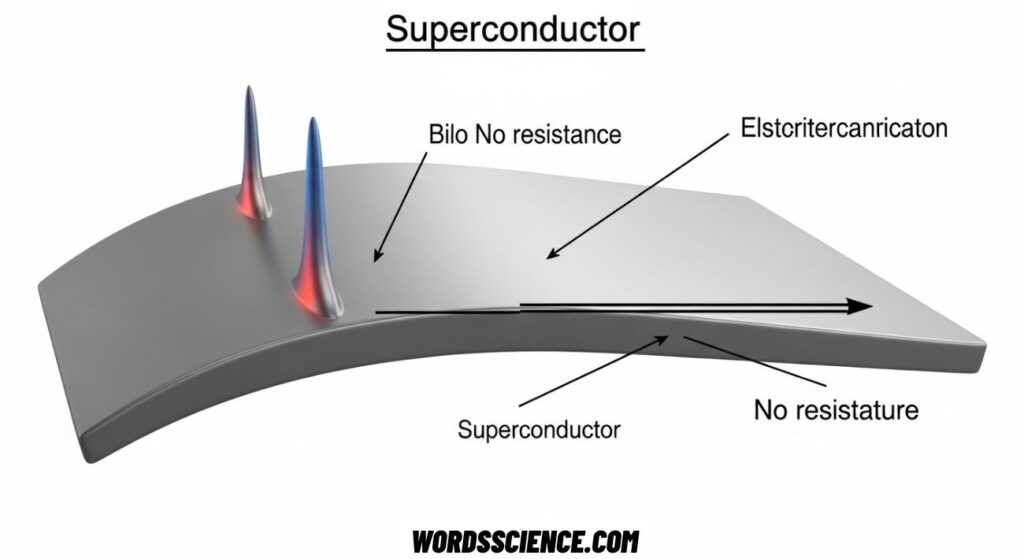
- Superconductivity – The ability of some materials to conduct electricity with zero resistance at very low temperatures.
- Speed – The rate at which an object moves, measured as distance over time.
- Superposition – A quantum principle where a particle exists in multiple states at once until observed.
- Spectrum – The range of colors or wavelengths of light and other electromagnetic waves.
- Spectroscopy – The study of how matter interacts with light.
- Shear – A force that pushes parts of a material in opposite directions.
- Strain – The change in shape of a material when stress is applied.
- Stress – The force applied per unit area on a material.
- Surface tension – The force that makes the surface of a liquid resist external pressure.
- Solenoid – A coil of wire that creates a magnetic field when electricity passes through it.
- Sublimation – The process where a solid turns directly into a gas without becoming liquid.
- Specific heat – The amount of heat needed to raise the temperature of one gram of a substance by one degree Celsius.
- Static electricity – Electric charge that builds up on a surface due to friction.
- Series circuit – An electrical circuit where components are connected one after another in a single path.
- Shadow – A dark area formed when an object blocks light.
- Siphon – A tube used to move liquid from one container to another using gravity.
- Sonic boom – The loud sound created when an object travels faster than the speed of sound.
- String theory – A theoretical idea in physics that tiny vibrating strings make up all particles.
Chemistry Science Words That Start With S
Chemistry studies substances, their properties, and how they change. This list of chemistry science terms includes important words about elements, reactions, solutions, and laboratory processes. Mastering these terms supports strong science learning.
- Solution – A mixture where one substance dissolves completely into another.
- Solute – The substance that gets dissolved in a solution.
- Solvent – The substance that does the dissolving in a solution.
- Solubility – The ability of a substance to dissolve in a solvent.
- Saturation – The point where no more solute can dissolve in a solution.
- Sublimation – The direct change from solid to gas without the liquid phase.
- Synthesis – The process of combining simpler substances to make a more complex compound.
- Stoichiometry – The calculation of reactants and products in chemical reactions.
- Substrate – The substance on which an enzyme acts during a reaction.
- Surfactant – A substance that lowers the surface tension of a liquid.
- Saponification – The chemical process of making soap from fat and an alkali.
- Salinity – The measure of salt content dissolved in water.
- Suspension – A mixture where small particles are spread through a liquid but do not dissolve.
- Sulfur – A yellow nonmetallic element with the symbol S and atomic number 16.
- Silicon – A chemical element with the symbol Si, widely used in electronics and glass.
- Silver – A shiny white metallic element with the symbol Ag, used in jewelry and electronics.
- Sodium – A soft silvery reactive metal with the symbol Na.
- Sodium chloride – The chemical name for common table salt.
- Standard solution – A solution with a precisely known concentration used in chemical analysis.
- State of matter – One of the forms in which matter exists, such as solid, liquid, gas, or plasma.
Biology Science Words That Start With S
Biology is the study of living things and life processes. This section covers biology science words with S related to cells, organisms, ecosystems, genetics, and body systems. These science vocabulary words are essential for understanding the living world.
- Species – A group of similar living things that can breed and produce fertile offspring.
- Symbiosis – A close relationship between two different organisms living together.
- Stimulus – A change in the environment that causes an organism to respond.
- Synapse – The tiny gap between nerve cells where signals pass from one to another.
- Stem cell – An unspecialized cell that can develop into many different cell types.
- Spore – A tiny reproductive cell that can grow into a new organism without fertilization.
- Stamen – The male reproductive part of a flower that produces pollen.
- Stigma – The sticky part of a flower that receives pollen during pollination.
- Stoma – A tiny opening on a leaf surface that allows gas exchange.
- Saprophyte – An organism that feeds on dead and decaying matter.
- Selective breeding – The process of choosing parent organisms with desired traits to produce offspring.
- Skeleton – The framework of bones that supports and protects the body.
- Smooth muscle – Involuntary muscle found in internal organs like the stomach and blood vessels.
- Skeletal muscle – Voluntary muscle attached to bones that enables body movement.
- Sensory neuron – A nerve cell that carries signals from sense organs to the brain.
- Saliva – The watery liquid in the mouth that helps with chewing and digestion.
- Starch – A carbohydrate stored in plants and used as an energy source.
- Sucrose – A type of sugar found in many fruits and plants.
- Stomach – The digestive organ where food is broken down by acid and enzymes.
- Spleen – An organ that filters blood and helps fight infection.
Astronomy and Space Science Words With S
Astronomy explores stars, planets, galaxies, and everything beyond Earth. These space science terms starting with S help describe the wonders of the universe. Learning these words supports science education about the cosmos.
- Solar system – The Sun and all the objects that orbit around it, including planets and moons.
- Star – A massive glowing ball of gas held together by gravity that produces energy.
- Sun – The closest star to Earth and the center of our solar system.
- Satellite – An object that orbits a planet, either natural like a moon or artificial.
- Supernova – The powerful explosion of a dying star that releases huge amounts of energy.
- Singularity – A point in space where gravity is so strong that space and time break down.
- Solar flare – A sudden bright burst of energy from the surface of the Sun.
- Solar wind – A stream of charged particles released from the upper atmosphere of the Sun.
- Spectrum – The band of colors produced when white light is split by a prism.
- Space – The vast nearly empty area between celestial bodies.
- Spacecraft – A vehicle designed for travel outside Earth’s atmosphere.
- Space station – A large satellite where astronauts can live and work in space for long periods.
- Space telescope – A telescope placed in outer space to observe distant objects without atmospheric interference.
- Solar eclipse – An event where the Moon passes between Earth and the Sun, blocking sunlight.
- Saturn – The sixth planet from the Sun, known for its beautiful ring system.
- Stellar – Relating to stars.
- Supercluster – A large group of galaxy clusters held together by gravity.
- Synodic period – The time it takes a celestial body to return to the same position relative to the Sun.
- Sidereal – Measured with respect to the distant fixed stars rather than the Sun.
- Spiral galaxy – A galaxy with a flat rotating disk, central bulge, and spiral arms, like the Milky Way.
See Also : 200+ Science Words That Start With W – List With Meanings
Earth and Environmental Science Words Starting With S
Earth science studies our planet, its materials, and its processes. Environmental science focuses on how living things interact with their surroundings. These science words that start with S cover geology, weather, ecology, and sustainability.
- Sediment – Small pieces of rock, soil, and organic matter carried by water, wind, or ice.
- Seismology – The scientific study of earthquakes and seismic waves.
- Seismograph – An instrument that detects and records earthquake waves.
- Soil – The loose upper layer of Earth’s surface where plants grow.
- Strata – Layers of rock that have formed over time.
- Stratosphere – The layer of Earth’s atmosphere above the troposphere containing the ozone layer.
- Sustainability – Using resources in a way that meets current needs without harming future generations.
- Solar energy – Energy from the Sun converted into heat or electricity.
- Smog – A thick haze caused by air pollution, often made of smoke and fog.
- Subduction – The process where one tectonic plate slides under another.
- San Andreas Fault – A major fracture in Earth’s crust running through California.
- Savanna – A grassy plain with scattered trees found in tropical regions.
- Steppe – A large area of flat unforested grassland.
- Swamp – A wetland area with trees and standing water.
- Salinization – The buildup of salt in soil, often harming plant growth.
- Silt – Fine particles of soil carried and deposited by water.
- Spring – A place where groundwater flows naturally out of the ground.
- Storm surge – An abnormal rise of seawater during a storm, pushed by strong winds.
- Surface runoff – Water that flows over the land surface into streams and rivers.
- Sea level – The average height of the ocean’s surface used as a base for measuring elevation.
Medical and Health Science Words That Start With S
Medical science focuses on the human body, diseases, and treatments. These health science words with S are widely used in hospitals, research, and public health. Building this scientific vocabulary helps understand wellness and medicine.
- Symptom – A sign or feeling that indicates a disease or health problem.
- Syndrome – A group of symptoms that consistently occur together.
- Surgery – A medical treatment where doctors cut into the body to repair or remove tissue.
- Stethoscope – A tool used by doctors to listen to heart, lung, and body sounds.
- Systole – The phase of the heartbeat when the heart muscle contracts and pumps blood.
- Diastole – The phase of the heartbeat when the heart muscle relaxes and fills with blood.
- Sedative – A medicine that calms a person or induces sleep.
- Sepsis – A serious condition where the body responds dangerously to an infection.
- Sterilization – The process of killing all germs and bacteria on medical tools.
- Suture – A stitch used to close a wound or surgical cut.
- Saline – A solution of salt in water used medically for hydration and cleaning.
- Spine – The column of bones that supports the body and protects the spinal cord.
- Scoliosis – A sideways curve of the spine.
- Stroke – A medical emergency where blood flow to the brain is blocked or bleeding occurs.
- Sinus – An air-filled space in the skull connected to the nasal cavity.
- Spleen – An organ in the upper left abdomen that helps filter blood.
- Small intestine – The long tube-like organ where most digestion and nutrient absorption happens.
- Skeletal system – The body system made of bones, cartilage, and joints.
- Subcutaneous – Located or placed just under the skin.
- Screening – Testing a group of people to find a disease early when it is easier to treat.
Technology and Applied Science Words With S
Technology applies scientific knowledge to solve real-world problems. These science words that start with S cover computing, engineering, and modern innovation. Knowing these scientific terms helps navigate the digital age.
- Software – The programs and instructions that tell a computer what to do.
- Software engineering – The systematic approach to designing, developing, and testing software.
- Sensor – A device that detects and measures physical input like heat, light, or motion.
- Simulation – A computer model that imitates a real process or system.
- Supercomputer – An extremely fast computer used for complex calculations and data processing.
- Semiconductor – A material like silicon used in computer chips and electronic devices.
- Superconductivity – The property of zero electrical resistance in some materials at very low temperatures.
- Server – A computer that provides data, services, or programs to other computers over a network.
- Storage – The technology used to save digital data for later use.
- Smart device – An electronic gadget that connects to the internet and can be controlled remotely.
- Satellite – An artificial object placed in orbit for communication, navigation, or observation.
- Solar panel – A device that captures sunlight and converts it into electrical energy.
- Solar cell – The basic unit of a solar panel that generates electricity from light.
- Steam engine – A heat engine that uses steam to generate mechanical work.
- Solenoid – A cylindrical coil of wire that becomes a magnet when carrying electric current.
- Switch – A component that opens or closes an electrical circuit.
- Signal – An electrical impulse or radio wave used to carry information.
- Spectrum – A range of frequencies used for wireless communication.
- Scanner – A device that captures images or reads barcodes and converts them into digital form.
- Search engine – A software system that finds and retrieves information from the internet.
Advanced and Technical Science Words With S
Advanced science concepts require precise and specialized vocabulary. These technical science words starting with S appear in higher education, research papers, and professional discussions. Understanding them deepens science knowledge and analytical thinking.
- Singularity – In physics, a point in space-time where density and gravitational forces become infinite.
- Superposition – The quantum mechanical principle stating that particles exist in multiple states until observed.
- Superconductivity – The phenomenon where certain materials conduct electricity without resistance at ultra-low temperatures.
- Stoichiometry – The mathematical relationship between reactants and products in chemical reactions.
- Spectroscopy – The analytical technique that studies the interaction between matter and electromagnetic radiation.
- Sonoluminescence – The emission of light from bubbles collapsing in a liquid when excited by sound.
- Superfluidity – A state of matter where liquid flows without any friction or viscosity.
- Supersaturation – A solution state where more solute is dissolved than normally possible.
- Sympatric speciation – The evolution of new species from a common ancestor living in the same geographic area.
- Synchrotron – A large circular machine that accelerates particles to very high speeds using magnetic fields.
- Synteny – The conserved order of genes on chromosomes across different species.
- Stochastic – A process or system that is randomly determined and follows probabilistic patterns.
- Schrödinger equation – The fundamental equation of quantum mechanics describing how quantum states change over time.
- Siderophore – A molecule produced by bacteria to capture iron from the environment.
- Somatic mutation – A genetic change that occurs in body cells and is not passed to offspring.
- Sclerophyll – A type of vegetation with hard, thick leaves adapted to dry conditions.
- Semelparity – A reproductive strategy where an organism reproduces once and then dies.
- Stratigraphy – The study of rock layers and the sequence of events they record.
- Subclinical – A disease stage that shows no noticeable symptoms.
- Supramolecular – Relating to chemical structures made of multiple molecules held together by intermolecular forces.
See Also : 230+ Science Words Start With F – List Of F Scientific Words
Scientific Method and Process Words That Start With S
The scientific method is the step-by-step process scientists use to explore questions and test ideas. These science words that start with S describe how experiments are designed, data is analyzed, and conclusions are drawn. Understanding these scientific terms starting with S helps students think like real researchers.
- Scientific method – A systematic approach to asking questions, testing ideas, and drawing conclusions.
- Sample – A small part taken from a larger population for testing or observation.
- Sampling – The process of selecting individuals or items from a group to study.
- Survey – A method of collecting information by asking people questions.
- Study – A detailed investigation and analysis of a subject or phenomenon.
- Simulation – An imitation of a real process or system used for experimentation.
- Statistical significance – The likelihood that a result is not caused by random chance.
- Standard deviation – A measure of how spread out numbers are in a data set.
- Standard error – An estimate of the uncertainty in a sample statistic.
- Scalar measurement – A measurement that has only magnitude, not direction.
- Single-blind study – An experiment where participants do not know which treatment group they are in.
- Double-blind study – An experiment where neither participants nor researchers know group assignments.
- Systematic observation – The careful and organized watching of phenomena to gather data.
- Synthesis – The combination of separate ideas or findings into a coherent whole.
- Summarize – To briefly restate the main points of research or data.
- Skepticism – The habit of questioning claims and demanding evidence before accepting them.
- Source – The origin of information or data used in research.
- Secondary source – A document or recording that analyzes or interprets primary sources.
- Subject – An individual participant in a scientific study or experiment.
- Statistical analysis – The process of collecting and interpreting numerical data to find patterns.
Psychology and Brain Science Words That Start With S
Psychology explores the mind, behavior, and mental processes. These science words with S describe how the brain works, how people think, and why they act the way they do. This science vocabulary is useful for students of human behavior.
- Sensation – The process of receiving information from the environment through the five senses.
- Perception – The way the brain organizes and interprets sensory information.
- Synapse – The junction between two neurons where chemical signals are transmitted.
- Stimulus – Any event or object that triggers a response in an organism.
- Serotonin – A chemical in the brain that affects mood, sleep, and appetite.
- Stress – The body’s response to a demand, pressure, or threat.
- Self-concept – The idea a person has about who they are and their qualities.
- Self-esteem – A person’s overall sense of personal value and worth.
- Social psychology – The study of how people’s thoughts and behaviors are influenced by others.
- Stimulus-response – The basic unit of learning where a reaction follows a trigger.
- Sleep cycle – The repeating pattern of brain activity stages during sleep.
- Short-term memory – The ability to hold a small amount of information for a brief period.
- Sensory memory – The shortest-term memory that briefly stores sensory input.
- Split-brain – A condition where the connection between brain hemispheres is severed.
- Stereotype – A fixed, oversimplified belief about a particular group of people.
- Socialization – The lifelong process of learning social norms and behaviors.
- Stressors – Events or conditions that trigger a stress response.
- Synaptic plasticity – The ability of synapses to strengthen or weaken over time.
- Subconscious – The part of the mind that influences actions without full awareness.
- Schema – A mental framework that helps organize and interpret information.
Physical Science and Materials Words That Start With S
Physical science explores non-living systems, including matter, forces, and materials. These science terms describe the properties of solids, liquids, gases, and specialized materials used in engineering. Building this scientific vocabulary supports physics and chemistry learning.
- Solid – A state of matter with a fixed shape and definite volume.
- Solidification – The process of changing from a liquid to a solid.
- Soft matter – Materials easily deformed by thermal fluctuations or external forces, like gels and foams.
- Stiffness – The resistance of a material to bending or stretching.
- Strength – The ability of a material to withstand force without breaking.
- Strain – The measure of deformation in a material under stress.
- Stress – The internal force per unit area within a material.
- Shear modulus – The ratio of shear stress to shear strain in a material.
- Sintering – The process of compacting and forming a solid mass of material by heat without melting.
- Slag – The waste material separated from metals during smelting.
- Slurry – A thick mixture of solid particles suspended in a liquid.
- Smelting – The process of extracting metal from its ore by heating and melting.
- Solubility – The maximum amount of a substance that can dissolve in a solvent.
- Sol – A colloidal suspension of very small solid particles in a liquid.
- Sorbent – A material that absorbs or adsorbs liquids or gases.
- Spallation – The breaking off of small fragments from a solid surface due to stress.
- Specific gravity – The ratio of the density of a substance to the density of a reference material, usually water.
- Spontaneous combustion – The self-ignition of a material without an external spark or flame.
- Superalloy – A high-performance metal alloy that resists extreme heat and corrosion.
- Surface chemistry – The study of chemical reactions that happen at the surface of materials.
Genetics and Evolution Science Words That Start With S
Genetics explains how traits are passed from one generation to the next. Evolution describes how species change over time. These science words that start with S are central to understanding life’s diversity and heredity.
- Species – A group of organisms that can interbreed and produce fertile offspring.
- Speciation – The evolutionary process by which new biological species arise.
- Sexual reproduction – The creation of offspring by combining genetic material from two parents.
- Sperm – The male reproductive cell that carries genetic information.
- Somatic cell – Any body cell that is not involved in reproduction.
- Stem cell – An undifferentiated cell capable of developing into many cell types.
- Somatic mutation – A genetic change in a body cell that is not inherited by offspring.
- Splicing – The editing of genetic material by removing non-coding sequences.
- Sequence – The precise order of building blocks in DNA, RNA, or proteins.
- Silent mutation – A genetic change that does not affect the final protein produced.
- Substitution mutation – A type of mutation where one nucleotide is replaced by another.
- Selective pressure – An environmental factor that influences which organisms survive and reproduce.
- Sexual selection – A form of natural selection based on the ability to attract mates.
- Survival of the fittest – The concept that organisms best adapted to their environment survive and reproduce.
- Sympatric speciation – The formation of new species within the same geographic area.
- Sister chromatid – Two identical copies of a chromosome connected by a centromere.
- Sex chromosome – A chromosome that determines the sex of an organism (X or Y in humans).
- Synteny – The conserved order of genes on chromosomes across different species.
- Subspecies – A subdivision of a species with distinct characteristics but still able to interbreed.
- Stabilizing selection – Natural selection that favors average individuals and reduces variation.
See Also : 200+ Science Words That Start With R – Scientific Terms List
Zoology and Animal Science Words That Start With S
Zoology is the branch of biology that studies animals, their behavior, and their habitats. These scientific definitions describe animal groups, body structures, and ecological roles. This science dictionary section helps students understand the animal kingdom.
- Species – The basic unit of classification for animals that can breed with each other.
- Subspecies – A distinct population within a species with unique traits.
- Swarm – A large group of insects or other small animals moving together.
- School – A group of fish swimming together in coordination.
- Shoal – Any group of fish gathered together for social reasons.
- Spine – A sharp, pointed structure on an animal used for defense.
- Stinger – A sharp organ in some animals that delivers venom.
- Scales – Small, rigid plates covering the skin of fish, reptiles, and some mammals.
- Shell – A hard protective outer layer of mollusks and some other animals.
- Snout – The projecting nose and mouth part of an animal.
- Suckling – The act of feeding on milk from a mother’s mammary glands.
- Spawn – To release or deposit eggs in water by aquatic animals.
- Scavenger – An animal that feeds on dead plants and animals.
- Symbiosis – A long-term relationship between two different animal species.
- Symbiont – An organism living in a symbiotic relationship with another.
- Social animal – An animal that lives in organized groups, like ants or wolves.
- Solitary animal – An animal that lives alone and only seeks others to mate.
- Sexual dimorphism – Physical differences between males and females of the same species.
- Subcutaneous fat – A layer of fat stored under the skin of animals for insulation.
- Sonar – The method used by bats and dolphins to locate objects using reflected sound.
Fun Facts About Science Words That Starting S
The letter S is one of the richest letters in the scientific alphabet. Many words come from ancient Latin and Greek roots. For example, “science” itself comes from the Latin word “scientia,” meaning knowledge. The word “star” has ancient origins tracing back to “stella” in Latin and “aster” in Greek.
Some S science words have truly amazing stories. A supernova can outshine an entire galaxy for weeks. Symbiosis shapes ecosystems, from coral reefs to the bacteria in your gut. Stem cells have the incredible ability to become any type of cell in the body. Learning these science terms reveals the beauty and wonder of the natural world, making science learning a lifelong adventure.
FAQs
What is a science word that starts with s?
A science word that starts with S is Science itself, meaning the systematic study of the natural world through observation and experiment. Other common examples include Star, Solar system, and Species.
What are 50 science words?
Here are 50 science words that start with S: Science, Sun, Star, Sky, Soil, Sand, Sea, Seed, Stem, Shell, Skin, Skull, Spine, Sense, Sight, Smell, Sound, Solid, Space, Surface, Scalar, Spectrum, Semiconductor, Superconductivity, Solution, Solute, Solvent, Sublimation, Synthesis, Stoichiometry, Species, Symbiosis, Stimulus, Synapse, Stem cell, Solar system, Satellite, Supernova, Singularity, Sediment, Seismology, Sustainability, Solar energy, Symptom, Syndrome, Surgery, Software, Sensor, Simulation, and Supercomputer.
What is a biology term that starts with s?
A key biology term that starts with S is Species, meaning a group of similar organisms capable of interbreeding and producing fertile offspring. Other important biology S-words include Symbiosis, Synapse, Stem cell, and Stimulus.
What are 10 words that start with s?
Here are 10 science words that start with S: Science, Star, Solar energy, Species, Solution, Skeleton, Satellite, Software, Synapse, and Sustainability. Each of these represents a major branch of science vocabulary used daily in education and research.
Conclusion
This guide has given you a complete list of Science Words That Start With S to help you learn and grow. Each word comes from a real branch of science like physics, chemistry, biology, astronomy, earth science, medicine, and technology. You can use these terms in your homework, class projects, and everyday conversations. The simple meanings make it easy for any prep school boy to remember and understand. Building a strong science vocabulary now will help you do well in higher grades and develop a lifelong love for learning. Keep this list handy whenever you need quick and clear scientific definitions.
The letter S holds some of the most powerful words in the world of discovery. From Star to Synapse, from Solar energy to Sustainability, these Science Words That Start With S connect you to everything around you. Scientists use these words every day to solve problems and explore new ideas. When you master them, you start thinking like a real scientist. Review this list often and challenge yourself to use new words in your writing and speaking. Every term you learn brings you one step closer to understanding the amazing universe we live in.