
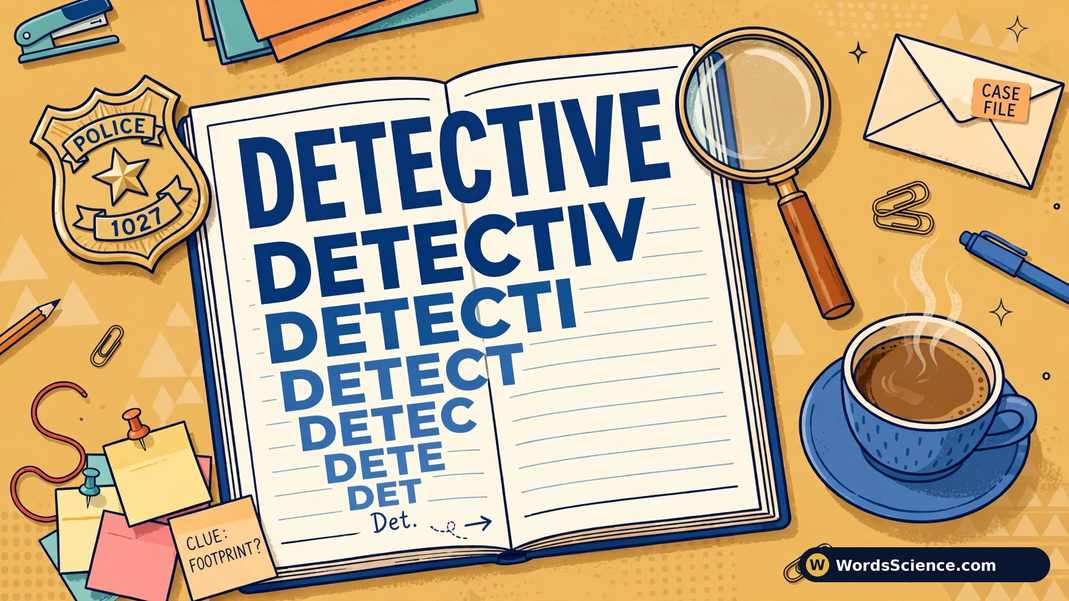
Abbreviation for Detective: Det. and the Police Rank Short Forms
The standard abbreviation for detective is Det. Dictionaries give it in both spellings: American style writes Det. with a full stop; British style usually writes Det with none. You meet it before names in news stories and police reports, as in “Det. Smith” or “Det Jones.”
Detective has one more layer that most words do not. The famous letter codes of crime stories — DC, DS, DI, DCI — do not shorten the word detective by itself. They shorten a whole police rank, such as Detective Sergeant. So the word has one true short form for the job, and a family of short forms for the ranks.
In normal sentences, writers usually spell detective out in full. The short forms live in titles before names, in reports, and in fiction. This guide explains each real form, shows where it is used, and fences the look-alikes — like PI — that mean a different job.
Why the Abbreviation for Detective Matters
Students and teachers meet Det. and the rank codes wherever crime is written about: news reports, novels, and the opening credits of police dramas. When students know DI means Detective Inspector, a British crime show stops being a puzzle of letters.
For writers and ESL learners, the danger is mixing up the job, the rank, and the private worker. Det. names a police detective. PI names a private investigator, who is not in the police at all. Using the wrong short form can quietly change who a sentence is about, so learning the real forms — and the false friends — keeps your English exact.
The Short Form of Detective
Det. – The Standard Short Form
Det. is the standard abbreviation of detective, and dictionaries on both sides of the Atlantic record it. The Oxford Advanced American Dictionary gives the abbreviation as Det. with a full stop, and WordReference lists “Det., Det” as the written abbreviation for the title Detective.
Det. works as a title before a name, in police reports and news writing, and in lists where space is short.
- Det. Ramirez questioned the shop owner about the break-in.
- The report was signed by Det. Okafor of the city police.
Det. is a written form: read it aloud as the full word “detective,” never letter by letter. In a normal sentence with no name after it, writers spell the word out: “The detective questioned the shop owner.”
Det – The British Spelling of the Same Form
Det without a full stop is the same abbreviation in British style. The Oxford Advanced Learner’s Dictionary gives detective with the abbreviation Det, and its own Det entry explains: in writing, Det means detective — as in “Det Insp Cox.”
British police writing often joins Det to a shortened rank: Det Insp for Detective Inspector, Det Sgt for Detective Sergeant, and Det Con for Detective Constable.
- Det Insp Cox is leading the investigation.
- Det Sgt Ahmed spoke to reporters outside the station.
Neither spelling is wrong: Det. is the American habit, Det the British habit — a style difference, not a rule of the language.
Police Rank Abbreviations: Detective Plus a Rank

In Britain, “detective” is not a rank by itself. It is a prefix before the normal police ranks, marking an officer who has passed extra training and exams to work as an investigator, usually in the CID (Criminal Investigation Department). Each rank has a uniformed form and a detective form at the same level: the letter D simply replaces P — PC becomes DC, PS becomes DS.
DC – Detective Constable
DC shortens the rank Detective Constable, the first detective rank. A DC does the daily work of investigations: taking statements, checking cameras, and building case files. Label: a UK police rank.
- DC Patel took a statement from the witness.
DS – Detective Sergeant
DS shortens Detective Sergeant. A DS leads a small team of detective constables and checks their work. (This is why Detective Superintendent is almost never shortened to DS: the letters are already taken.) Label: a UK police rank, one step above DC.
- DS Morgan asked the team to re-check the camera footage.
DI – Detective Inspector
DI shortens Detective Inspector. A DI manages a detective team or a whole investigation and makes the big case decisions. Label: a UK police rank — the first management rank.
- The search was approved by DI Clarke.
DCI – Detective Chief Inspector
DCI shortens Detective Chief Inspector, a senior rank that often leads major investigations. This is the rank learners meet most often in British crime fiction and television. Label: a UK senior police rank.
- DCI Fraser will speak at the evening press conference.
Det Supt and DCS – The Top Detective Ranks
Above DCI come Detective Superintendent, usually written Det Supt (some reference lists show DSU), and Detective Chief Superintendent, shortened to DCS. Both oversee large teams and serious cases as senior managers. Label: UK senior ranks — written with the rank, never for the word detective alone.
- The operation was led by DCS Halloran.
One honest point matters here: a detective is not senior to a uniformed officer of the same rank. A DS and a police sergeant stand at the same level and earn the same pay. The word detective marks special training and the job, not a promotion.
Abbreviation for Detective in Different Settings
- News reports – Det. / Det – Newspapers shorten the title before a name to save space. Example: “Det. Alvarez said the man was arrested at dawn.”
- Police documents and records – Det. and the rank codes – Reports, rosters, and case files use Det. with names and DC, DS, or DI for ranks. Example: “Case notes updated by DC Reid.”
- Fiction and TV credits – Detective in full, or DCI – Novels often spell the title out (“Detective Inspector Morse”), while British screen credits love the rank codes, above all DCI. Example: “Starring Anna Reid as DCI Reid.”
- Everyday and formal writing – Full word – Essays, letters, and reports spell detective out in full. Example: “The detective in the story solves the case in the final chapter.”
Abbreviation for Detective at a Glance
| Form | What It Shortens | Where You See It | Safe to Use? |
|---|---|---|---|
| Det. | Detective (title) | US news, reports, names in records | Yes — American style |
| Det | Detective (title) | British news and police writing | Yes — British style |
| DC | Detective Constable (rank) | UK police, news, crime fiction | Yes — for that rank only |
| DS | Detective Sergeant (rank) | UK police, news, crime fiction | Yes — for that rank only |
| DI | Detective Inspector (rank) | UK police, news, crime fiction | Yes — for that rank only |
| DCI | Detective Chief Inspector (rank) | UK police, TV credits, news | Yes — for that rank only |
| detective (full word) | — | Sentences, essays, formal writing | Always safe, everywhere |
What Is NOT the Abbreviation for Detective
PI means private investigator — a different job. Cambridge Dictionary defines PI as the abbreviation for private investigator: someone who discovers information about people but is not a police officer or a government employee. A PI is hired by clients — a company, a lawyer, or a family — and is also called a private detective. The work looks similar, but PI never shortens the police title detective, and a PI has no police powers.
“D.” alone is not verified. A few low-quality list pages claim detective shortens to D. or even Dt. No dictionary checked records either form. One letter says nothing clear, and readers would not guess it — treat both as list-site inventions.
Lowercase “det” belongs to other subjects. In grammar books, det is the abbreviation for determiner, and in mathematics det is the determinant function. The same letters live in different worlds — they have nothing to do with police work.
How to Choose: Full Stops, Capitals, and When to Spell It Out
Full stops. American style keeps the full stop: Det. British style usually drops it: Det. Both are correct; follow the style of your school, newspaper, or force, and stay consistent.
Capital letters. The short form always starts with a capital D, because it works as a title: Det. Smith, Det Insp Cox. You may also meet all-capital DET in databases, rosters, and form labels — that is a label style, not a different abbreviation.
Plurals. These forms have no common short plural in careful writing. If more than one detective is meant, write the full word: “three detectives worked on the case.”
The simple rule. Match the place. Before a name in a report or a news story: Det. or Det. For a British rank: the rank code, DC to DCI. For a private worker: PI. Everywhere else — sentences, essays, letters — write detective in full. The full word is never wrong.
Short forms are only one part of clear English. Keep building your word power with the guide to the abbreviation for weekend, then see how a school and office word is shortened in the guide to the abbreviation for assessment.
Frequently Asked Questions
What is the abbreviation for detective?
The standard abbreviation is Det. — or Det in British style, without the full stop. Dictionaries record it as the written short form of the title, used before names in reports and news: “Det. Smith.”
What do DC, DS, DI, and DCI mean?
They shorten British police ranks: DC is Detective Constable, DS is Detective Sergeant, DI is Detective Inspector, and DCI is Detective Chief Inspector. They shorten whole rank titles, not the word detective by itself.
Is a detective a higher rank than a uniformed police officer?
No. In Britain, a detective holds exactly the same rank as a uniformed officer at the same level — a DS is a sergeant. The word detective shows that the officer has passed extra exams to work as an investigator.
Does PI mean detective?
No. PI is the abbreviation for private investigator, a person hired by clients to find out information. Cambridge Dictionary stresses that a PI is not a police officer. A police detective is shortened to Det., never to PI.
Can I write “D.” for detective?
No. No dictionary records D. as an abbreviation for detective; it appears only on low-quality list websites. Use Det. before a name, a rank code for a British rank, or the full word.
Conclusion
Remember one true short form and one honest warning. Det. — Det in British writing — is the standard abbreviation for detective, fixed in dictionaries and used before names in news and reports. The warning: the famous codes DC, DS, DI, and DCI shorten whole police ranks, and PI belongs to a different, private job.
Use Det. where titles and tight spaces need it, read the rank codes as full ranks when you meet them in stories and reports, and write detective in full in normal sentences. To explore the world behind the title, read the encyclopedia article on the detective and how this kind of police work began.