Caveat Meaning | What Does Caveat Mean?
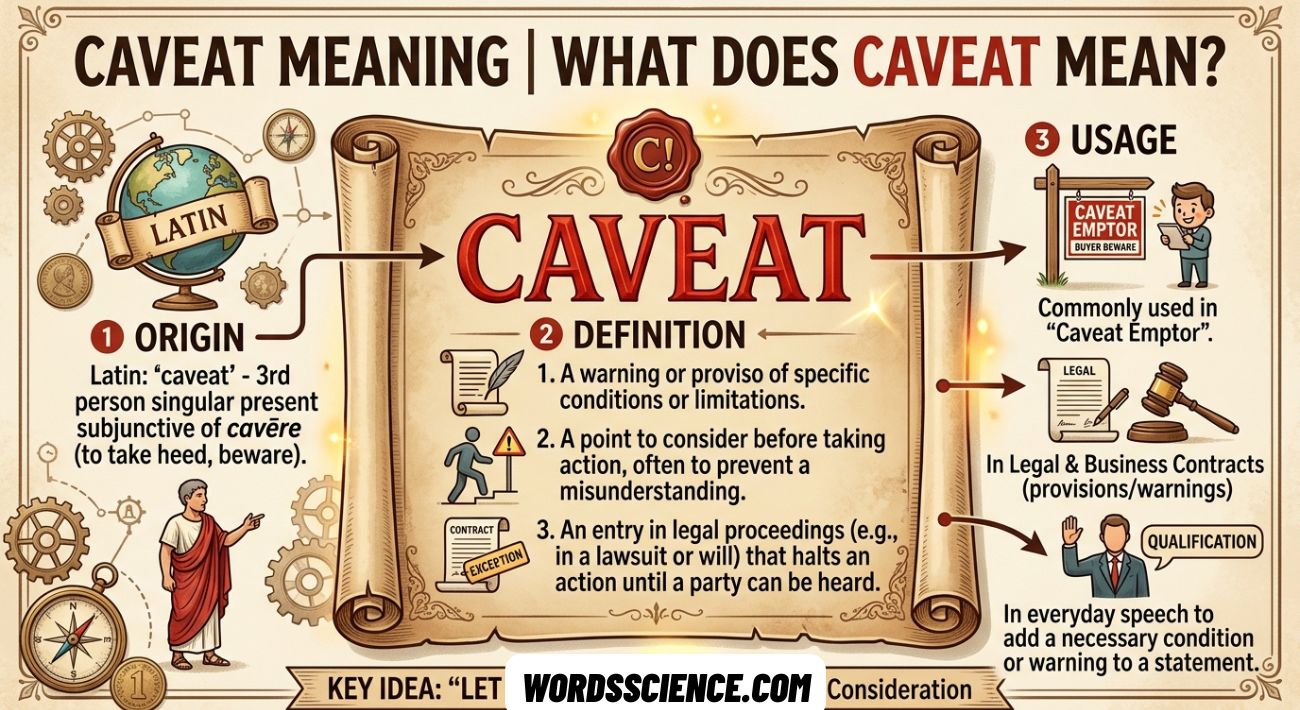
The caveat meaning is a warning, condition, or qualification that you should consider before accepting a statement, agreement, recommendation, or idea. When someone adds a caveat, they are pointing out an important limitation, exception, or possible drawback.
For example, someone might say, “This is a good option, with one caveat: it costs more than the alternatives.” The main idea is positive, but the speaker adds a condition that could affect your decision.
The word is common in standard English, especially in professional language, business communication, research, legal writing, and careful explanations. It can also appear in casual conversation when someone wants to make their meaning more precise.
What Does Caveat Mean?
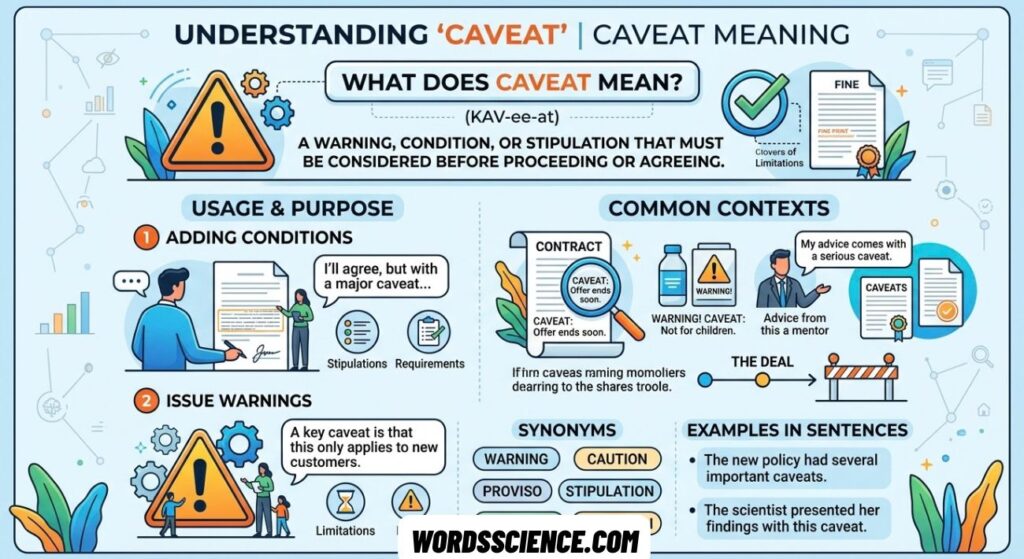
Caveat means a warning, condition, or qualification attached to a statement or situation. It tells you that something should not be understood without considering an additional fact or restriction.
In plain language, a caveat is like saying, “Yes, but there is something you should know first.”
For example:
“The plan should work, but there is one caveat: we need approval first.”
Here, the plan may work, but approval is an important condition. Without that approval, the statement may not apply.
A caveat does not always mean that something is bad. It simply adds information that limits, qualifies, or changes how the main statement should be understood.
The Main Caveat Meaning in Everyday English
In everyday English, a caveat usually refers to an important limitation, exception, or condition that comes with an idea or statement.
Suppose a friend says, “You can borrow my car.” If they add, “There is one caveat—you need to bring it back before 8 p.m.,” the time limit is the caveat.
The word is useful when a simple “yes” or “no” does not tell the whole story. It helps a speaker qualify a statement without completely rejecting it.
You may hear phrases such as main caveat, several caveats, or with one caveat when someone wants to highlight conditions that matter.
What Does “With One Caveat” Mean?
“With one caveat” means “with one important condition, warning, or limitation.”
For example:
“You can use my notes, with one caveat: please do not share them online.”
The person agrees to the request but adds an attached condition.
Another example is:
“The restaurant is excellent, with one caveat: parking can be difficult.”
The restaurant may be good, but the speaker wants you to know about a possible drawback before you decide to visit.
The phrase with one caveat is especially useful when the main statement remains true but has an exception or limitation.
Caveat Meaning in Text and Conversation
The caveat meaning in text is generally the same as in spoken English. If someone writes, “I agree, with one caveat,” they mean that they agree with an important qualification.
For example:
“I think we should accept the offer, with one caveat: the contract needs another review.”
In texting, caveat is not normally slang. It is a regular English word that can sound somewhat formal, depending on the conversation.
A person might use it in a text with a friend, but simpler wording such as “one thing, though” or “the only problem is” may sound more casual.
On social media, including TikTok, caveat meaning on TikTok does not usually represent a separate slang definition. If someone uses the word there, it generally keeps its standard meaning: a warning, qualification, or condition.
How Context Changes the Meaning
The basic meaning of caveat stays the same, but the specific condition changes with the situation. A caveat may involve a requirement, restriction, exception, drawback, or limitation.
1. In recommendations
When giving a recommendation, a caveat points out something the other person should consider before following the advice.
“I recommend this laptop, with one caveat: its battery life is not great.”
The recommendation remains positive, but the battery issue gives the reader useful context.
A review might also say:
“This course is helpful, although there are several caveats about the amount of advanced material.”
Here, the caveats help the reader understand where the recommendation may have limits.
2. In agreements
In agreements, a caveat can describe a condition or restriction that affects what someone has agreed to.
“We can extend the deadline, with the caveat that no further extensions will be available.”
The extension is possible, but it comes with a clear condition.
Legal writing may use more precise terms such as legal qualification, condition, exception, or restriction. The exact wording matters because agreements can create specific obligations.
3. In factual statements
A caveat can make a factual statement more accurate by showing its limits.
For example:
“The treatment was effective in the study, with the caveat that the research involved a small group.”
The caveat does not automatically make the original statement false. It tells the reader how carefully to interpret the evidence.
This is especially useful when discussing research, statistics, evidence, or factual claims where the details behind a statement matter.
4. In casual conversation
In casual conversation, people often use caveat when they want to add a small warning or exception.
“I would go with you, with one caveat: I have to leave early.”
The word is understandable, but it may sound more formal than phrases like “but one thing” or “except that.”
The relationship between the speakers and the overall tone can determine whether caveat sounds natural. In a relaxed conversation, simpler language may be more common.
See Also : 230+ Science Words Start With D: The Complete Glossary for Students and Teachers
Caveat in Different Contexts
The word caveat works across many areas of communication because people often need to explain that a statement has limits.
In business communication, a caveat can identify a condition that affects a proposal, deadline, price, or agreement. For example, a manager might support a plan but mention that it depends on receiving approval from another department.
In research, a caveat can identify a limitation in the evidence. A researcher may explain that a finding applies to a particular group or situation rather than to everyone.
In legal writing, a caveat can relate to a condition, qualification, or restriction. Legal documents often use exact language because a small change in wording can affect how an agreement is understood.
In everyday English, caveat can simply introduce a warning. Someone might recommend a product, restaurant, job opportunity, or travel plan while mentioning one thing that could cause difficulty.
The important idea is that a caveat adds a qualification to the main point. It gives the listener or reader information needed to understand the statement properly.
Real Conversation Examples
These examples show how people can use caveat naturally in different situations.
1: Friends
Person A: “You can stay at my place this weekend.”
Person B: “Really? Thanks!”
Person A: “Sure, with one caveat. I have to work Saturday morning.”
Meaning: The invitation is genuine, but the guest needs to understand that the host will be working Saturday morning.
Another example:
“I can help you move, but there is one caveat. I only have a small car.”
Here, the caveat explains a practical limitation.
2: Workplace
Manager: “I support the new schedule, with one caveat: we need enough staff on Fridays.”
Employee: “That makes sense.”
Meaning: The manager agrees with the schedule but adds a condition that must be satisfied.
Another workplace example is:
“The proposal looks good, with the caveat that the budget needs another review.”
The caveat tells the team what still needs attention before the proposal can move forward.
3: Social Media
A social media post might say:
“This study sounds promising, with one caveat: the results should not be applied to every situation.”
Here, caveat helps prevent readers from taking a claim too broadly.
On platforms such as TikTok, Instagram, or other social networks, the word generally keeps its normal English meaning. Caveat meaning on TikTok does not automatically change just because the word appears in a short video or caption.
Is Caveat Rude or Negative?
Caveat is not inherently rude or negative. It is a neutral word used to identify a condition, qualification, warning, or limitation.
However, the tone can depend on how the speaker uses it. Saying, “I agree, with one caveat,” can sound careful and professional. Saying, “There are too many caveats,” may sound critical because the speaker is emphasizing multiple limitations.
The word itself does not indicate anger, sarcasm, disrespect, or hostility. Context matters.
For casual communication, a person may choose simpler wording such as “one thing, though,” “the only issue is,” or “just keep in mind.” In professional or formal writing, caveat can sound more natural.
How to Use Caveat Correctly
Use caveat when you need to add a meaningful condition, exception, warning, or qualification to a statement.
A common structure is:
“The statement is true, with one caveat: [condition].”
For example:
“The software is easy to use, with one caveat: some advanced features require training.”
You can also use the plural caveats when there is more than one limitation:
“The proposal has several caveats that the team should review.”
Another useful construction is:
“There is one caveat to this approach.”
For example:
“There is one caveat to this approach: it requires more time.”
Avoid using caveat simply because you want a more complicated word. If “problem,” “condition,” “exception,” or “warning” communicates the idea more clearly, one of those words may be better.
When to Use the Word Caveat
Use caveat when a statement needs an important qualification or limitation.
It works well when discussing recommendations, agreements, research, evidence, business plans, rules, or factual statements. It is also useful when you want to acknowledge a possible drawback without rejecting the main idea.
For example:
“I recommend the program, with one caveat: the schedule is demanding.”
The word is especially useful when the added information affects how someone should understand or act on the main statement.
In professional language, caveat can make an explanation more precise because it signals that the speaker is not presenting an idea as completely unrestricted.
When to Avoid Caveat
Avoid caveat when the simpler wording would be clearer for your audience.
For example, in a very casual text, this may sound unnecessarily formal:
“I will meet you there, with one caveat.”
A more natural message could be:
“I can meet you there, but I need to leave early.”
Both sentences communicate a condition, but the second sounds more natural in everyday conversation.
You may also want to avoid caveat when the supposed limitation is actually the main problem. In that case, words such as “problem,” “restriction,” or “drawback” may communicate the situation more directly.
The goal is clear communication, not complicated vocabulary.
Common Mistakes About Caveat
One common mistake is thinking that caveat always means something negative. A caveat can identify a neutral condition or an important exception without suggesting that the main idea is bad.
Another mistake is treating caveat as a synonym for warning in every situation. A warning usually tells someone about a possible danger or problem, while a caveat can be broader and may simply qualify a statement.
Some people also use caveat when they really mean “reason.” A caveat is not just any reason. It is normally an additional condition, qualification, limitation, or exception connected to the main point.
Another common mistake is assuming that caveat is internet slang. It is not. The word belongs to standard English and can appear in formal writing, professional communication, research, and ordinary conversation.
Finally, do not assume that caveat being or subject to the caveat automatically has one fixed meaning outside its sentence. The surrounding context determines exactly what condition is being described.
Similar Words to Caveat
Several words have meanings that overlap with caveat, but they are not always interchangeable.
| Word | General meaning | Main difference |
|---|---|---|
| Warning | Information about possible danger or trouble | Usually focuses on risk or harm |
| Condition | Something that must be true or happen | Often describes a requirement |
| Qualification | A statement that limits or changes another statement | Closely related to caveat |
| Limitation | Something that restricts what is possible | Focuses on boundaries or restrictions |
| Exception | Something that does not follow the usual rule | Focuses on a case outside the general rule |
| Restriction | A rule that limits an action | Usually involves something that is not allowed |
| Drawback | A disadvantage or negative feature | Focuses on a downside |
| Disclaimer | A statement limiting responsibility or clarifying a claim | Often used for legal or informational protection |
So, caveat synonyms include words such as warning, qualification, condition, limitation, and exception, but the best choice depends on context.
For example, “There is one limitation” emphasizes a boundary, while “There is one caveat” emphasizes an important qualification attached to the main point.
Where Does the Word Caveat Come From?
The word caveat comes from Latin. It is related to the Latin verb cavere, meaning “to beware” or “to take care.”
The word entered English with the sense of a warning or caution. Its historical use is closely connected with the idea that someone should pay attention to a condition before proceeding.
Today, caveat has a broader everyday meaning. It can refer to a warning, qualification, condition, limitation, or exception that affects how a statement should be understood.
Its Latin origin also helps explain why the word can sound somewhat formal compared with simpler phrases such as “one thing to remember” or “the only problem is.”
Caveat in Professional Communication
Caveat is useful in professional communication when you need to explain an important limitation without rejecting the main idea. You might use it when discussing a project, business plan, recommendation, report, or agreement.
For example, “The proposal is practical, with one caveat: the deadline may need to be extended.” This wording keeps the message clear and professional while pointing out an important condition.
Caveat vs. Disclaimer
A caveat and a disclaimer can both limit how a statement should be understood, but they are not exactly the same. A caveat usually adds a specific condition, qualification, or limitation to a main point.
A disclaimer often limits responsibility or clarifies what someone does not guarantee. For example, a product recommendation may include a caveat about price, while a website may include a disclaimer about the information it provides.
Caveat in Formal Writing
In formal writing, caveat can help make an argument or explanation more precise. Writers may use it when evidence has limitations, a recommendation has an exception, or a conclusion depends on certain conditions.
For example, a report might say, “The results support the proposed approach, with the caveat that further research is needed.” This clearly shows that the conclusion has a qualification rather than presenting it as absolute.
How to Understand a Caveat Quickly
When you see the word caveat, look for the information that comes immediately after it or nearby. That information usually explains the condition, exception, restriction, or limitation being added to the main statement.
A simple way to understand it is to replace caveat with “one important thing to consider.” If that replacement makes sense in the sentence, the writer is probably using caveat to add an important qualification or warning.
Quick Recap
The caveat meaning is a warning, condition, qualification, limitation, or exception attached to a statement or situation. It tells you that the main idea needs some additional context before you accept or act on it.
“With one caveat” means “with one important condition or limitation.” The word is not automatically rude, negative, or slang. It is standard English and works especially well in professional language, research, agreements, and careful explanations.
In casual conversation, simpler words may sound more natural, but caveat is still correct when the context calls for it. Understanding the context, tone, and attached condition will help you use the word clearly and correctly.
FAQs
What does caveat mean in simple terms?
Caveat means a warning, condition, or limitation added to a statement or agreement.
It tells you about something important you should consider before accepting the main point.
How do I use the word caveat?
Use caveat when you want to mention an important condition, exception, or limitation.
For example, “I agree with the plan, with one caveat: we need more time.”
What is a synonym for caveat?
Common synonyms for caveat include warning, qualification, condition, limitation, exception, and restriction.
The best synonym depends on the context and the exact meaning you want to express.
What is the meaning of “caveat” in Urdu?
In Urdu, caveat can mean تنبیہ، شرط، پابندی، یا احتیاطی وضاحت.
It refers to an important warning or condition that should be considered with the main statement.
Final Thoughts
The caveat meaning is a warning, condition, or limitation added to a statement. It helps readers understand that an idea may have an exception or condition. In text and conversation, caveat usually keeps this same meaning and is not automatically rude or negative. The word works well in everyday English, professional writing, research, agreements, and recommendations when extra context matters.
When using caveat, focus on the condition that follows it. The phrase with one caveat introduces a limitation or exception. Use the word when it makes your meaning clearer, but choose simpler language in casual situations if it sounds natural. Understanding context and tone will help you recognize caveat meaning in text and use the word accurately in clear communication.